Most of us have seen it by now. A call from an unknown number that sounds suspiciously like a relative in trouble. A video of a public figure saying something they never said. A message that looks like it came from your bank but quietly empties your account. Digital life has made things faster and easier, and it has also handed fraudsters a bigger playground than they have ever had.
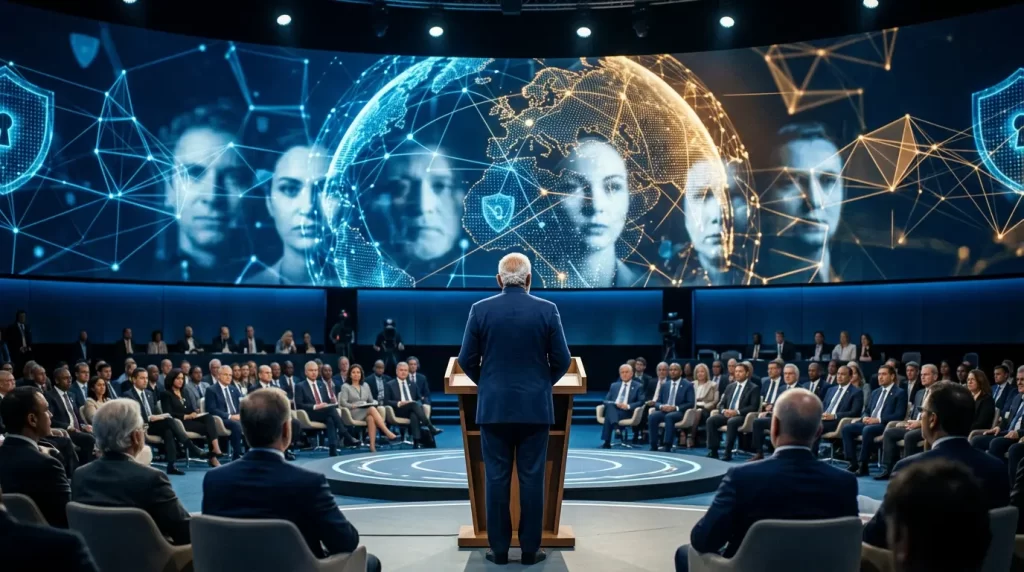
That tension sat at the centre of India Mobile Congress 2026, where Prime Minister Narendra Modi inaugurated the event and made a pointed appeal: the world needs a global framework to tackle cyber fraud and deepfakes.
Why a global framework?
Modi’s argument was simple and hard to dispute. Digital threats do not stop at national borders. A scam run from one country can target victims in another within seconds. A deepfake created in one place can spread across continents before anyone has time to question it.
National laws, however strong, can only do so much when the person behind an attack sits in a different jurisdiction. Investigators often lose precious time chasing data across legal systems that were never designed to move at internet speed. A shared framework, in theory, would let countries cooperate faster, share intelligence and agree on common standards for dealing with online fraud.
The details of what such a framework would look like were not spelled out in the reports reviewed, so it is too early to say how it might work in practice. Still, the call itself signals that India wants a seat at the table where these rules get written.
“Scale Without Boundaries”
This year’s event carries the theme “Scale Without Boundaries,” and the phrase fits the moment well. Technology is expanding rapidly, and the conference has put 6G India, AI, 5G and cybersecurity in focus. India has one of the world’s largest mobile user bases, and the ambition to grow further is clear.
But scale cuts both ways. The more people who are connected, the more people there are who can be targeted. A first-time smartphone user in a small town may be excited by digital payments and online services, yet may have little experience spotting a fake link or a cloned voice. Growth without protection leaves the most vulnerable exposed.
That is the balance the conference keeps returning to: expand quickly, but build trust and safety into the foundation.
Deepfakes and the trust problem
Deepfakes deserve special attention because they attack something more basic than money. They attack trust. When realistic fake audio and video can be made cheaply, people begin to doubt what they see and hear, including things that are real.
For ordinary users, the risks are concrete. Fraudsters can imitate a family member’s voice to demand urgent money. Fake videos can damage reputations or mislead at critical junctures. Public figures, business leaders and everyday citizens can all be targeted.
This is why Modi’s call matters beyond technology circles. Deepfakes are not just a problem for engineers. They touch elections, families, workplaces and public conversation.
AI is speeding up the attackers
Experts at the conference raised a worrying point: AI has shortened the time between an attack and its exploitation. In plain terms, once a weakness is discovered, criminals can now act on it much faster than before.
Tools that once required deep technical skill are becoming easier to use. Automation helps attackers write convincing messages, scan for vulnerable systems and adapt quickly when one approach fails. Defenders, meanwhile, are often working with limited time and staff.
The encouraging side is that AI helps defenders too. It can flag unusual behaviour, spot suspicious transactions and respond to threats in real time. The race is not one-sided, but it is certainly fast.
The smartphone as the new battleground
Another striking observation from the experts was that the smartphone has become a major security battleground in India. That makes sense. For millions of people, the phone is the bank, the wallet, the identity card, the photo album and the office, all in one device.
If someone gains control of a phone, they may gain access to nearly everything. This is why cyber fraud so often arrives through calls, texts, fake apps and messaging platforms. It is not usually about breaking into a big server. It is about tricking one person at the right moment.
Simple habits go a long way here:
Pause before you act. Scammers rely on urgency. Take a minute to verify.
Never share OTPs or PINs. No genuine bank or agency will ask for them.
Check app sources. Install apps only from official stores and review permissions.
Verify unexpected requests. If a relative asks for money in a panic, call them back on a known number.
Keep software updated. Updates often fix the very weaknesses attackers exploit.
Report fraud quickly. Speed improves the chances of limiting the damage.
A wider push for balance
What stands out about this year’s conference is the effort to hold two goals together. India wants to be a leader in 6G, AI and next-generation networks. It also recognises that none of that works if people do not feel safe using it.
This balance is not easy. Strict rules can slow innovation, while loose rules can leave users unprotected. A global framework, if designed well, could help by setting shared expectations without choking progress. Whether countries can agree on one is a different question, since governments often differ on privacy, free speech and data control.
What happens next
A call at a conference is a starting point, not a solution. The real test will be whether governments, tech companies and security experts can turn this conversation into concrete cooperation, through shared standards, faster information exchange and clearer accountability for platforms.
In the meantime, individuals are not powerless. Awareness remains one of the strongest defences, and it costs nothing to talk to parents, grandparents and friends about how these scams work.
The bottom line
Narendra Modi’s appeal at India Mobile Congress 2026 reflects a growing reality: the digital world is borderless, and so are its dangers. As India races ahead with 6G, AI and wider connectivity, protecting users has to move at the same pace. A global framework against cyber fraud and deepfakes will not fix everything, but it points in the right direction, toward a future where growth and safety are built together rather than traded against each other.