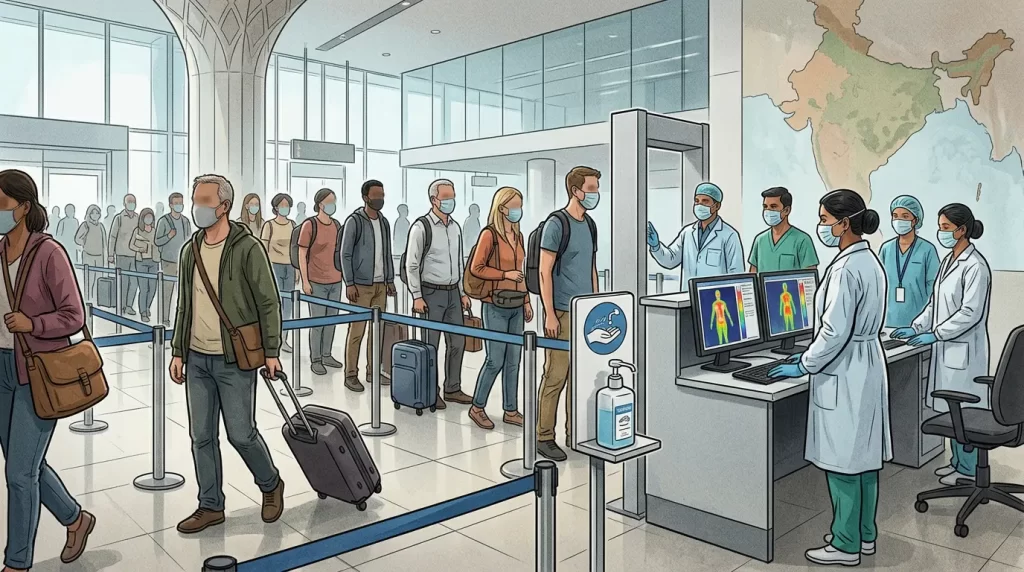
For most people walking through an Indian airport, the signs of a public health emergency are easy to miss. A health desk near arrivals, a thermal scanner, a quick question about where you have been. Yet behind these small checks sits a much larger effort, one that has stayed in place since the World Health Organization declared the Ebola outbreak a public health emergency of international concern in May.
India has now kept its enhanced Ebola surveillance at airports running, and officials are asking travellers from certain regions to play their part.
What the advisory says
The health services directorate has urged travellers arriving from high-risk countries to report any symptoms to airport health officers. The countries named are DR Congo, Uganda and South Sudan. Anyone coming from these places is also asked to self-monitor for 21 days after arrival.
That 21-day window is not arbitrary. It reflects the incubation period of Ebola, the time between exposure to the virus and the appearance of symptoms. Someone infected may feel perfectly well for days, so a single check at the airport cannot catch everything. Self-monitoring fills the gap, and it depends on honesty and awareness from the traveller.
In practical terms, this is the heart of the Ebola India advisory: report symptoms early, do not ignore a fever or unusual illness, and tell health workers about your travel history without hesitation.
No case detected so far
The most reassuring part of the update is also the simplest. Officials said no case has been detected in India. That does not mean the work is finished. Screening is designed to stay ahead of a problem, not respond after it arrives, and keeping measures in place while an international emergency is active is a sensible precaution.
It is worth remembering that the absence of cases is partly the result of vigilance. Airport screening India has put in place is meant to spot a traveller who might be unwell before the virus has any chance to spread locally.
The role of NIV Pune
If a suspected case did appear, samples would need fast, reliable testing. That job falls to the National Institute of Virology in Pune, the designated testing support for Ebola. NIV Pune has long been a key laboratory in the country, known for handling dangerous and emerging pathogens, and its role here matters a great deal.
Having a single, trusted facility for confirmation helps avoid confusion. A suspected case can be isolated and tested quickly, and the result guides what happens next, from treatment to tracing anyone who may have been in contact. For readers in Pune, it is a quiet reminder that the city hosts one of the country’s most important public health assets.
Why the outbreak has global attention
Ebola is a severe and often deadly disease, spread through direct contact with the body fluids of an infected person or animal. It does not spread easily through the air like a cold or flu, which is why outbreaks can usually be contained with good public health practice. But when it takes hold in a region with limited health resources, it can overwhelm hospitals and frighten whole communities.
That is why the WHO designation matters. A public health emergency of international concern signals that the situation could affect more than one country and calls for a coordinated response. Governments, including India’s, respond by tightening surveillance at points of entry.
What about Kenya?
There has been some discussion around a case reported in Kenya. It is important to be accurate here: no new measures tied to Kenya’s case appeared in the reports reviewed. So there is no basis to say India has changed its approach because of it. The existing advisory remains the main guidance, and any changes would need to come from official announcements.
This is a good moment to be careful with information. When a health scare is in the news, rumours travel faster than facts, and travellers sometimes see claims on social media that have no source. Waiting for confirmation from the health ministry Ebola updates is far safer than forwarding a screenshot.
Practical tips for travellers
If you are flying into India from one of the named countries, or know someone who is, a few simple steps can make the process smoother:
Be open at the airport. Tell health officers where you have travelled, even if you feel fine.
Report symptoms immediately. Fever, severe headache, fatigue, muscle pain, vomiting or unexplained bleeding should never be brushed aside.
Monitor yourself for 21 days. Keep a note of your temperature and how you feel.
Seek care the right way. If symptoms appear, contact health authorities first rather than walking into a crowded clinic, so staff can prepare properly.
Rely on official sources. Check government advisories before travelling and before sharing health news.
This kind of Ebola travel advisory is not meant to stigmatise people from affected countries. Most travellers are healthy and simply going about their lives. The point is to catch the rare exception early and to protect everyone, including the travellers themselves.
A calm, steady approach
There is a tendency to swing between panic and indifference when a disease like Ebola makes headlines. Neither helps. The more useful response is steady attention: following the advisory, supporting health workers, and trusting a system that has so far kept India free of cases.
Airport staff, laboratory scientists and public health officers are doing quiet, repetitive work that rarely earns attention. When it succeeds, nothing dramatic happens, and that is exactly the goal.
The bottom line
India’s decision to keep enhanced screening in place reflects a cautious, practical stance while the WHO emergency continues. Travellers from DR Congo, Uganda and South Sudan should report symptoms promptly and self-monitor for 21 days. No case has been detected in the country, and NIV Pune stands ready to support testing if one ever does.
For everyone else, the message is straightforward: there is no need for alarm, but there is every reason to stay informed. Keep an eye on official updates, avoid unverified claims, and remember that early reporting remains the most powerful tool anyone has.