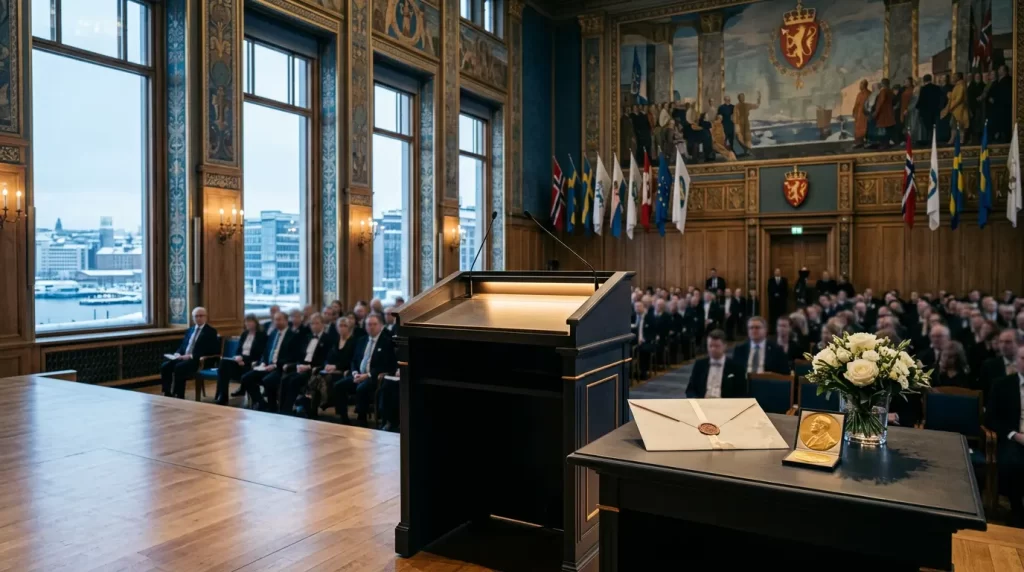
There is a particular kind of quiet that settles over Oslo on Peace Prize morning. Journalists crowd into the Norwegian Nobel Institute, cameras are trained on a closed door, and a room full of people waits for one name. Today, that moment arrives at 11:00 local time, or 14:30 in India, when the Norwegian Nobel Committee announces the Nobel Peace Prize 2026.
At the time of writing, the winner is not known. So instead of guessing, here is what we do know, and why this announcement draws so much attention every year.
Who will read the name
Committee chair Jørgen Watne Frydnes will step up and announce the laureate. He is the face of the process this year, though the decision itself belongs to the whole committee, which deliberates behind closed doors for months. The announcement is brief, often just a few minutes, but the work behind it is anything but.
The Norwegian Nobel Committee has a tough job. It is asked to identify the person or organisation that has done the most for peace, a goal that is hard to define and harder to measure. A physicist can point to a discovery. A peace laureate often works in conflict zones where results are slow, uncertain and sometimes invisible to the outside world.
A crowded field of candidates
This year the committee has 287 candidates to consider: 208 individuals and 79 organisations. That is a large pool, and it reflects how many people around the world are doing difficult, often unrecognised work in the name of peace.
There is one rule, though, that makes the guessing game more chaotic than fun. The committee does not confirm who the nominees are. Nominations stay secret for 50 years. If you read a list of “official” Peace Prize nominees today, it did not come from Oslo.
What does leak out comes from the people who do the nominating. Many people, including members of national parliaments and certain academics, are allowed to put names forward, and some choose to say so publicly. A nomination is not an endorsement from the committee. It is simply a name placed in the pile.
The Trump nomination question
One name has dominated the conversation. Leaders of Cambodia, Israel and Pakistan have said they nominated US President Donald Trump. Because the committee keeps its own records sealed, those claims cannot be checked from the outside, and a public nomination says nothing about how seriously the committee takes it.
It is worth keeping perspective here. Being nominated is not rare, and it is not a signal of being a frontrunner. With hundreds of candidates every year, the real question is who the committee believes best fits the spirit of Alfred Nobel’s will. That is a judgement about the work itself, not about how loudly a nomination is announced.
Last year’s winner sets the tone
Last year’s prize went to Venezuela’s María Corina Machado, honouring her efforts around democratic rights. Her win showed that the committee is willing to recognise people working for peace through political courage and civil society, not only through formal peace deals.
That history matters. The prize has gone to diplomats, activists, scientists, journalists and grassroots organisations over the decades. It has also drawn criticism when the choices felt too political or too early. Every announcement carries that weight.
The prediction-market buzz
If you have looked at online forecasts, you may have noticed some humanitarian groups appearing in the chatter. Sudan’s Emergency Response Rooms, the volunteer networks that have supported communities caught in the country’s conflict, have featured in prediction-market discussion.
A word of caution is needed. Such forecasts are unreliable. Prediction markets reflect what traders think, not what the committee thinks, and the committee’s process is secret. Plenty of past winners were barely mentioned beforehand. Treat these lists as entertainment, not evidence.
Still, the attention given to groups like the Emergency Response Rooms is a reminder of something real. Many of the people doing the most important humanitarian work are volunteers whose names rarely make headlines.
Why this announcement still matters
It is fair to ask why a prize announced from a small room in Norway still captures global attention. Part of the answer is simple: it gives the world a rare moment to pause and ask what peace actually looks like right now.
The prize can shine a light on a crisis that has slipped from the news cycle. It can protect people who face danger because of their work. It can also bring money and influence to causes that badly need both. Whether the honour changes events on the ground is debated, but few doubt that it changes how much attention people pay.
What to watch for today
As the announcement approaches, a few things are worth keeping in mind:
The citation. The committee’s short explanation often reveals as much as the name itself.
Individual or organisation. The balance between the two has shifted over the years, and it says something about the committee’s thinking.
The reaction. Governments, aid groups and activists often respond within minutes.
The ceremony. The formal award is presented later in the year in Oslo.
The takeaway
Today’s Nobel announcement is, at heart, a human moment. A committee that has argued, read and debated for months will finally say a name out loud, and somewhere a person or a team will get a phone call that changes their year.
Until that name is read, predictions are just that. What we can say is that the Nobel Peace Prize 2026 arrives in a world with no shortage of conflict and no shortage of people trying to end it. Whoever Jørgen Watne Frydnes names, the real story begins after the applause, with the work the prize is meant to support.