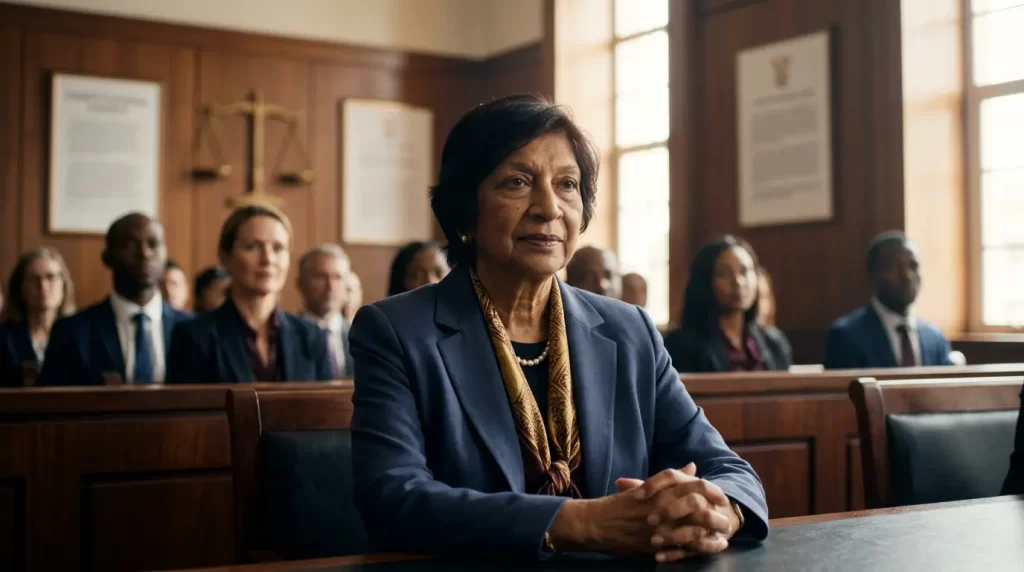
The Nobel Peace Prize 2026 has gone to a woman who spent her career in courtrooms rather than on battlefields or in negotiating rooms. The Norwegian Nobel Committee in Oslo honoured Navi Pillay for her efforts to promote peace and international law. It singled out her role in helping ensure that war crimes, crimes against humanity and genocide are actually prosecuted, not just condemned.
It is a fitting choice for a world where the rules of war are routinely ignored and the idea of accountability often feels fragile.
A Girl from Durban
Pillay’s story begins in Durban, where she was born under apartheid to a family of Indian Tamil origin. Under that system, race decided where you could live, what school you attended and what profession you could realistically enter. For a young woman of her background, becoming a lawyer was an act of defiance in itself.
The committee pointed to this beginning, and for good reason. Pillay did not study injustice from a distance. She grew up inside a legal system designed to deny people their rights, and she chose to devote her life to the opposite idea: that law should protect the vulnerable rather than the powerful.
That conviction runs through everything she later did. A person who has seen the law used as a weapon tends to understand better than most why it must be turned into a shield.
From South Africa to the World Stage
Over the decades, Pillay’s work took her far beyond her home country. She became one of the best-known figures in international justice, serving on international tribunals and later as the United Nations High Commissioner for Human Rights. In that last role she was often the person telling governments uncomfortable truths, which is rarely a popular job.
Her work with tribunals dealing with atrocity crimes mattered especially. The principle that those responsible for mass killings and sexual violence in war can be held individually accountable is relatively young, and it exists because people like Pillay helped build and defend it. Every time a court names a perpetrator and a survivor’s testimony is heard, the idea that impunity is inevitable weakens a little.
The Nobel Committee recognised exactly this. Peace, in its view, is not only the absence of fighting. It is also the presence of justice, because societies that bury their crimes rarely heal.
Still on the Bench
What makes this year’s announcement especially striking is that Pillay’s work continues. She now sits as a judge at the International Court of Justice, including in the case against Myanmar, which concerns allegations of genocide against the Rohingya people.
Few cases carry more weight. The Rohingya have endured violence and displacement on a massive scale, and the world has watched for years to see whether international law can offer them anything concrete. By honouring a sitting judge in the middle of such a case, the Nobel Committee in Oslo seems to be sending a quiet message: the slow, patient machinery of international law deserves support, not cynicism.
It is worth being careful here. A judge in an ongoing case cannot comment on how it should end, and the prize does not predict any outcome. What it does is affirm the importance of the process itself.
The Fifth South African Laureate
Pillay is the fifth South African to win the prize, joining a short and remarkable list that includes Albert Luthuli, Desmond Tutu, Nelson Mandela and F. W. de Klerk. Most of those names are tied to the struggle against apartheid and the negotiated transition that followed.
Pillay’s inclusion extends that legacy in a thoughtful way. Where earlier laureates were honoured for ending an unjust system at home, she is recognised for carrying the lessons of that fight into the wider world. It suggests that South Africa’s moral influence did not end in 1994 but has continued through the people it produced.
President Cyril Ramaphosa was among those who congratulated her, and the mood across the country has been one of pride. For many South Africans, particularly women and members of the Indian community in Durban and beyond, the news carries a personal meaning that no headline can fully capture.
Why This Prize Matters Now
The timing deserves attention. Conflicts are raging in several parts of the world, civilians are paying the price, and trust in international institutions has taken a beating. It is easy to feel that courts and treaties are powerless against armies and ambition.
Pillay’s recognition pushes back on that despair. Her career is evidence that persistence counts. Trials take years. Evidence must be gathered, witnesses protected, arguments made and remade. The work is rarely glamorous, and yet it is how the world slowly moves from “this should never happen” to “those responsible will answer for it.”
The prize also reminds us that peace-building comes in many forms. We tend to celebrate negotiators who shake hands at the end of a war. We should also celebrate the people who spend decades making sure the rules of war mean something.
A Quiet Kind of Courage
Navi Pillay’s Nobel win is not a story of sudden fame. It is the story of a lifetime of steady, unfashionable effort, from a segregated childhood in Durban to the highest courts in the world. The Norwegian Nobel Committee has chosen to honour that persistence, and in doing so has given a boost to everyone who believes that international law, imperfect as it is, remains one of humanity’s best tools for preventing the worst.
For South Africa, it is a moment of pride. For the wider world, it is a reminder that justice, patiently pursued, is a form of peace.
Navi Pillay Wins the 2026 Nobel Peace Prize: A Lifetime Spent Making Justice Real.