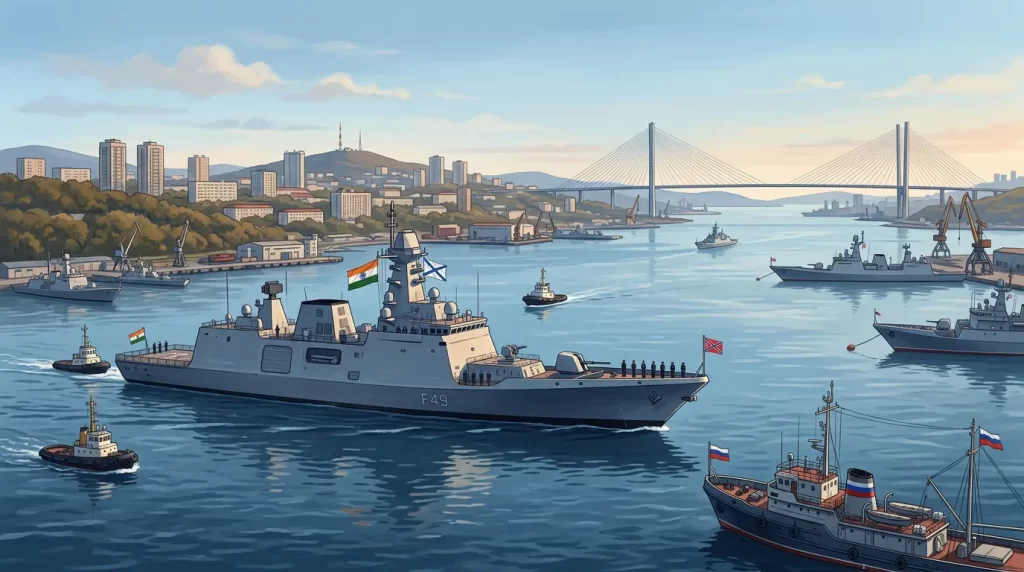
When a warship pulls into a foreign port, the first thing people notice is the grey hull and the flags. What matters more happens afterward, in the shared meals, the bridge-to-bridge radio checks and the conversations between sailors who speak different languages but do the same job. That is the spirit in which the Indian Navy’s stealth frigate INS Sahyadri berthed at Vladivostok on October 10, ahead of the India-Russia exercise INDRA-2026, which was planned to begin on October 13.
A Ship With a Long Way to Travel
Vladivostok sits on Russia’s Pacific coast and is the home port of the country’s Pacific Fleet. For an Indian warship, getting there means a long passage across the Indian Ocean, through the busy waters of Southeast Asia and up into the northwest Pacific. It is no small trip for any crew. Long deployments test machinery, logistics and people alike, so a port call like this is as much a demonstration of endurance as of intent.
INS Sahyadri is one of the Indian Navy’s indigenously built stealth frigates, a class designed to reduce its radar and acoustic signature while carrying a versatile mix of sensors and weapons. Having a ship of this kind take part in INDRA-2026 shows the Indian Navy is comfortable operating far from home waters and keen to work alongside partners across different oceans.
What INDRA Actually Is
INDRA is the long-running bilateral military exercise series between India and Russia, and it has grown over the years to involve different branches of the armed forces. It is one of the more visible pillars of the relationship between the two militaries, which has deep historical roots. Much of India’s military hardware over the decades has had Russian or Soviet origins, so the two forces share a certain technical vocabulary that makes working together easier than it might be with other partners.
For this edition, the reports reviewed did not publish a detailed programme. That is worth saying plainly, because exercises like this are often described with more certainty than the public information supports. What can reasonably be said is what naval exercises of this type typically involve: joint manoeuvres at sea, standard communication procedures and maritime-security drills.
Why the Small Things Matter
It is easy to dismiss routine drills as ceremony, but anyone who has worked in a team knows how much smoother things go when people already know each other. At sea, the stakes of that familiarity are higher. Ships from different navies use different procedures, different signalling habits and sometimes different assumptions about what a given instruction means. A shared exercise lets crews iron out those differences in calm conditions rather than discovering them in a crisis.
Communication drills in particular may sound dull, but they are the backbone of any combined operation. If two ships cannot talk to each other clearly, nothing else works. Exercises like INDRA-2026 give officers and sailors a chance to practise passing information quickly and accurately, building habits that carry over into real-world cooperation, whether that is counter-piracy, search and rescue or protecting shipping lanes.
Then there is the human side. Crews visiting a foreign port get to see how another navy lives and works. They compare routines, swap stories and sometimes discover that the people on the other ship worry about the same things they do. Those relationships are hard to measure, but they are often what makes later cooperation easier.
India-Russia Defence Ties in Context
The India-Russia defence relationship has been a constant in a changing world. Over the years it has weathered shifting global alignments, and both sides continue to describe it as a long-standing partnership. India, for its part, has widened its circle of defence partners considerably, conducting exercises with the United States, France, Japan, Australia and many others. Taking part in INDRA-2026 fits that broader pattern of keeping several relationships active at once rather than relying on any single one.
For Russia, hosting an Indian frigate at Vladivostok is a visible sign that its Pacific Fleet continues to engage with major partners in the Asia-Pacific. For India, the port call extends the reach of its navy into waters where it has growing interests, particularly as the Indo-Pacific continues to draw attention from governments around the world.
It would be a mistake to read too much into any single exercise, though. A bilateral drill is not a declaration of anything beyond cooperation and professional exchange. Its value lies mostly in the steady accumulation of experience.
What to Watch Next
Because a detailed schedule has not been published, the best approach is to wait for official updates from the Indian Navy and Russian defence authorities. Typically, these come in the form of brief statements and photographs once activities are underway or completed. Those will clarify which drills took place, how long the exercise ran and what the participating crews took away from it.
In the meantime, the arrival of INS Sahyadri at Vladivostok is a reminder of how naval diplomacy works: quietly, patiently and often far from the headlines. A ship arrives, flags are exchanged, crews meet, and over several days a bit more trust is built.
Final Thoughts
INDRA-2026 may not be the largest exercise on the calendar, and the public details remain limited. Still, the presence of INS Sahyadri in Vladivostok says something worthwhile about the state of India-Russia defence ties and the Indian Navy’s expanding footprint. For the sailors on board, it is a long deployment and a chance to learn. For observers, it is another data point in a relationship that has lasted for decades and continues to adapt.
As more information emerges from official sources, we will understand better what this edition of INDRA covered. Until then, the story is simple and human: a ship from India has crossed an ocean to train with its Russian counterparts, and both navies are better for the effort.
INS Sahyadri Arrives in Vladivostok for INDRA-2026, Adding a New Chapter to India-Russia Naval Cooperation.