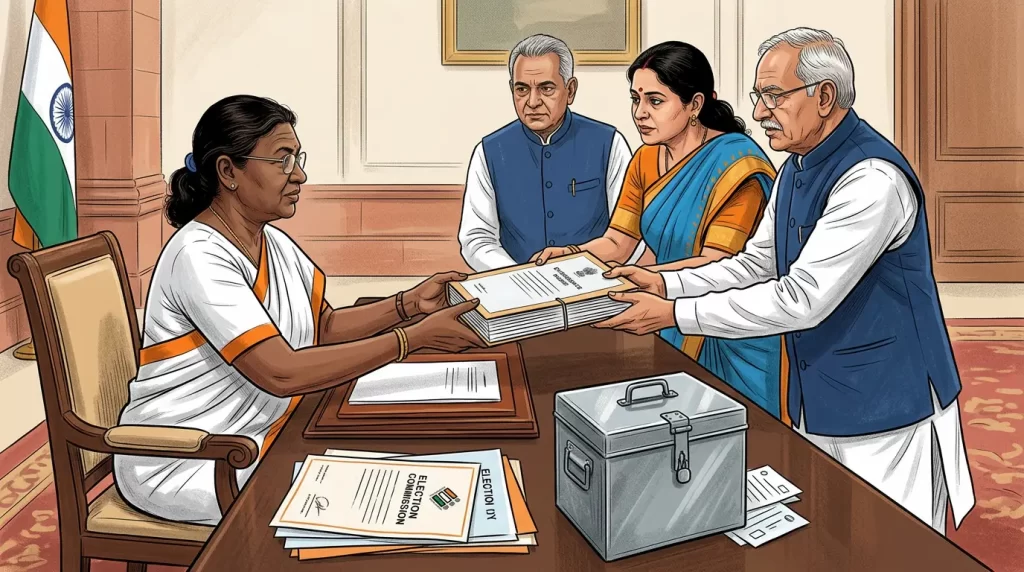
Politics in India often moves between two arenas: the noisy one of rallies and television studios and the quieter one of memoranda, meetings, and courtrooms. On October 9, the opposition’s dispute with the Election Commission stepped into the second arena. A delegation of INDIA bloc MPs, led by Rahul Gandhi and Congress president Mallikarjun Kharge, met President Droupadi Murmu in New Delhi and handed her a memorandum outlining their demands.
What the Opposition Is Asking For
The memorandum makes three main demands. The delegation wants Chief Election Commissioner Gyanesh Kumar to resign. It wants the Special Intensive Revision (SIR) of the electoral rolls suspended. And it wants voters whose names were deleted during the exercise to be restored to the lists.
These are significant asks. Seeking the removal of a constitutional functionary, halting a nationwide administrative process and reversing deletions all go well beyond routine criticism. They show how seriously the bloc wants this matter treated and how far apart the two sides currently stand.
The President’s Reported Response
The most talked-about detail from the meeting is what the president reportedly said. According to Rahul Gandhi, President Murmu asked the delegation for evidence. The opposition says it will provide that material, and Gandhi added that the bloc will also approach the Supreme Court.
One point deserves care here. This account of the meeting comes from Gandhi himself. No independent or official readout of the conversation has been cited, so the President’s exact words and tone remain, for now, as relayed by one participant. That does not make the account untrue, but readers should treat it as one side’s description of a private meeting.
It is also worth noting that a request for evidence is not unusual. The President’s office is not an investigative body, and any serious allegation against a constitutional authority would normally need to be backed with specifics before anything can move forward. Whether the request signals sympathy, caution, or simple procedure is something only the President’s office could clarify, and it has not been quoted here.
The “Vote Chori” Allegation
At the heart of the dispute is the phrase “vote chori,” which translates roughly as “vote theft.” Opposition leaders have used it to describe their claim that the electoral process is being manipulated, with names removed from voter lists in ways that they say disadvantage certain groups. It is a blunt phrase, and it has become a rallying cry because it speaks to something voters understand instantly: the worry that their say in choosing a government could be quietly taken away.
The Election Commission sees things very differently. It has earlier dismissed similar allegations as baseless. In its view, the revision of the rolls is a routine and lawful exercise meant to keep the voter list accurate, with names of deceased, duplicate or shifted voters removed. Both sides, in other words, are describing the same exercise in nearly opposite terms.
Why the SIR Matters to Ordinary Voters
For most people, the electoral rolls are not an abstract subject. A name on the list is what allows a citizen to walk into a polling booth and vote. A Special Intensive Revision, by its nature, involves checking entries, asking for documents and sometimes deleting names. Done well, it cleans up bloated and outdated lists. Done poorly, it can leave genuine voters stranded, often those with the least time or paperwork to fix an error.
That tension is why the SIR has become so contentious. Supporters of the exercise stress accuracy and integrity. Critics stress the risk of wrongful exclusion. Both concerns are legitimate in principle, and the argument is really about whether the process, as carried out, strikes the right balance. Neither the opposition’s claims nor the Commission’s rebuttals can be settled by slogans; they depend on data, case-by-case verification, and, possibly, judicial scrutiny.
The Supreme Court Route
Gandhi’s statement that the bloc will approach the Supreme Court is the next development to watch. Courts have a record of examining questions about voter rolls and electoral procedure, and a petition would put the opposition’s claims before a forum that can demand records and responses from the Commission. That would shift the debate from accusation to evidence, which is roughly what the President reportedly asked for as well.
If the opposition does file, much will depend on what it presents. Specific examples of wrongly deleted voters, clear numbers and verifiable documents tend to carry far more weight than broad allegations. The Commission, for its part, would likely be asked to explain its methods and defend its figures.
A Debate About Trust
Stepping back, this episode is about more than one official or one exercise. Elections work only when the people taking part, winners and losers alike, believe the machinery is fair. When a large section of the political spectrum says it has lost confidence in the referee, and the referee says the complaints have no basis, the gap is hard to bridge with statements alone.
For ordinary citizens, the most practical advice is also the simplest. Check your name on the electoral roll, keep your documents in order and use the official channels to correct any mistakes. Whatever the outcome of the political fight, that step protects your own vote.
Final Thoughts
The meeting at Rashtrapati Bhavan did not resolve anything, and it was never likely to. What it did was formalise the opposition’s grievances and set a path forward: submit evidence, go to court and keep the pressure on. The Election Commission’s earlier stance of dismissing such claims suggests it will resist, so the contest is likely to continue.
Until concrete evidence is placed before the President or the Supreme Court, the questions around the “vote chori” allegation, Gyanesh Kumar’s position as CEC and the future of the SIR will remain open. The facts, when they emerge, will matter more than the rhetoric on either side.