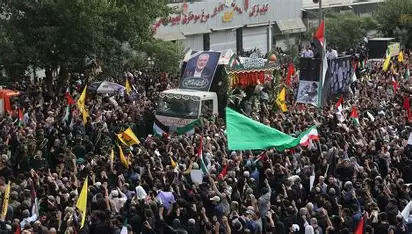
In a powerful display of national grief and unity, Iran held a grand state funeral for several senior military commanders killed during recent clashes with Israel. The funeral, described by local media as “historic,” drew tens of thousands of mourners to the streets of Tehran on Thursday, marking a significant moment in the intensifying conflict between the two nations.
The fallen commanders, whose names have not been officially disclosed by Iran’s Islamic Revolutionary Guard Corps (IRGC), were among the top brass involved in regional military operations, particularly in Syria and Lebanon. Iranian authorities confirmed that the commanders were killed in an Israeli airstrike targeting a military facility in Syria earlier this week.
Mourners, many dressed in black and waving national flags, chanted anti-Israel and anti-U.S. slogans during the emotionally charged procession. Senior Iranian leaders, including President Ebrahim Raisi and Supreme Leader Ayatollah Ali Khamenei’s representatives, were present, underscoring the political and symbolic weight of the ceremony.
Iranian state media broadcast the funeral live, calling it “a turning point in Iran’s resistance axis,” while promising retaliation for what officials labeled as a “cowardly act of aggression.” The IRGC also issued a stern warning, vowing to strike Israeli military and strategic positions “at a time and place of our choosing.”
This development is expected to escalate the already tense Middle East geopolitical landscape, with concerns rising over a broader regional war. The Israel-Iran conflict has spilled into neighboring countries over recent months, with Syria, Lebanon, and Iraq becoming battlegrounds for proxy warfare.
Western analysts have noted that the commanders’ deaths could lead to a recalibration of Iran’s military strategy, particularly regarding its regional allies like Hezbollah in Lebanon and Shiite militias in Iraq. “Iran’s response will be strategic, not just symbolic,” said Dr. Farhad Alavi, a Tehran-based geopolitical analyst. “They’ve lost irreplaceable assets, and the nation’s military doctrine will be forced to evolve.”
The United Nations has called for restraint on both sides, urging de-escalation and dialogue to prevent a full-scale war. Meanwhile, Israel has not officially commented on the strike but has repeatedly stated that it will not allow Iranian military entrenchment near its borders.