
7 July, 2025-In a recent statement celebrating the eight-year milestone of the Goods and Services Tax (GST) implementation, Prime Minister Narendra Modi emphasized the significant role GST has played in enhancing the ease of doing business in India. However, the remark has sparked controversy after a prominent U.S.-based CEO publicly disagreed, calling the tax regime “complicated and restrictive” for foreign investors.
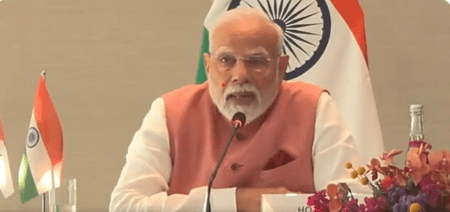
Launched on 1 July 2017, GST was touted as a landmark reform aimed at simplifying India’s complex indirect tax system. Prime Minister Modi hailed the tax structure as a transformative step that unified the country into a single market, reduced logistical inefficiencies, and increased tax compliance. “GST has streamlined business operations across states, eliminated cascading taxes, and brought transparency to the system,” he said during a virtual address to industry leaders on Saturday.
The Prime Minister also highlighted data from various international agencies, suggesting that India’s ranking in terms of ease of doing business has improved significantly over the years. “We are witnessing a rise in investments and registrations under GST, which demonstrates trust in our economic reforms,” Modi stated.
However, not everyone shared the same optimism. John H. Meyers, CEO of Pacific Tech Global—a U.S.-based multinational with operations in Asia—raised concerns over the operational challenges faced by companies under the GST regime. In an exclusive interview with a global business daily, Meyers said, “India has tremendous potential, but the GST framework in its current form is burdensome for international businesses. Frequent rule changes, delayed refunds, and state-level compliance variations defeat the purpose of a unified tax structure.”
Meyers’s remarks have resonated with other members of the international business community, many of whom have voiced similar frustrations, particularly regarding tax credit mismatches and technological glitches in the GSTN portal. Critics argue that while the intention behind GST is commendable, its execution continues to pose significant hurdles, especially for exporters and SMEs.
Experts in India are divided on the issue. Some economists agree with the government’s view that GST has streamlined taxation and improved formalization of the economy. However, others admit that structural inefficiencies remain. “There’s no doubt that GST has reduced tax evasion and increased compliance, but from a foreign investor’s perspective, there is still a learning curve. Greater simplification and stability in the tax system are essential,” said Professor Anjali Rao, a tax policy analyst.
Meanwhile, the Ministry of Finance responded to the criticism by reiterating the government’s commitment to further refining the GST system. “We have taken multiple steps over the years to simplify return filing and expedite refunds. Constructive feedback is welcome, and we are working towards a more business-friendly tax environment,” said an official statement.
As India aims to attract more foreign direct investment and position itself as a global manufacturing hub under the “Make in India” initiative, the debate over the efficacy of GST is likely to continue. While the government maintains that GST is a game-changer, the concerns raised by international stakeholders highlight the need for continuous reform and engagement.

