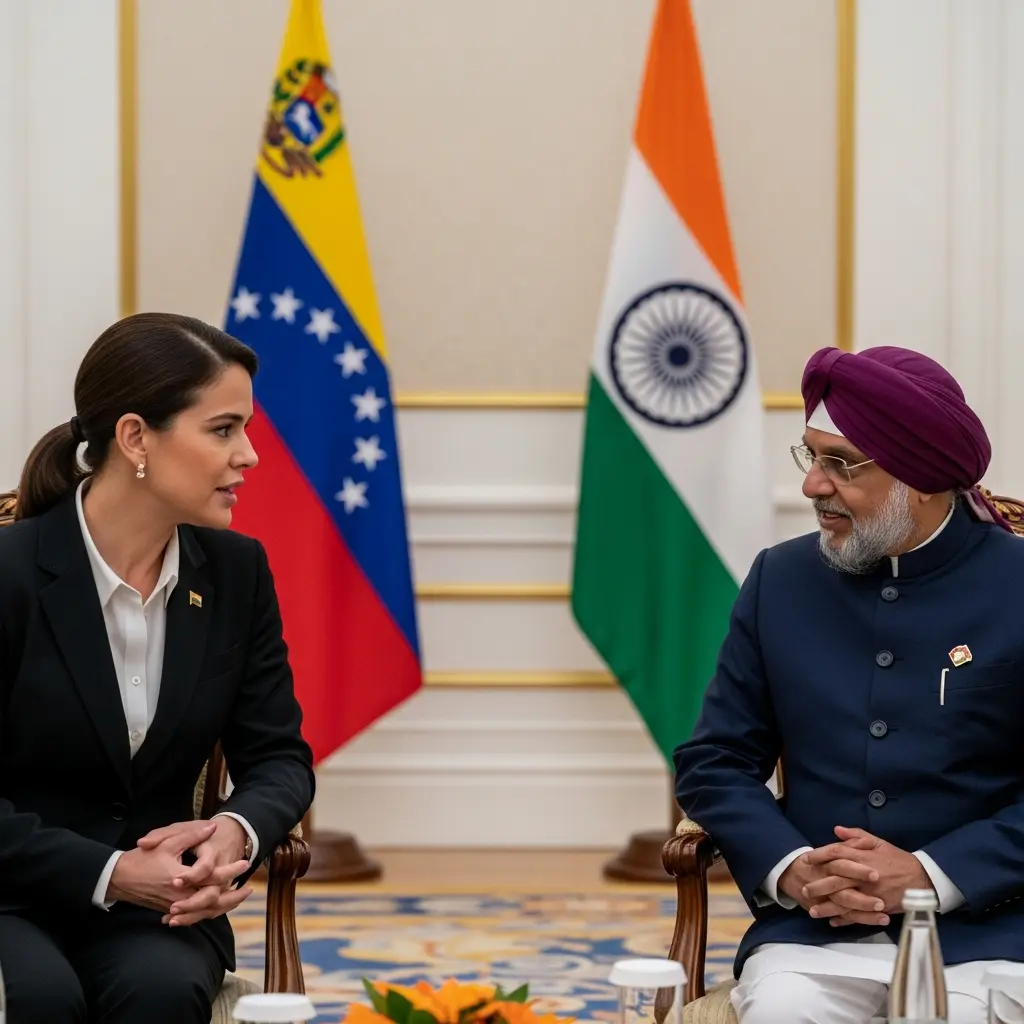
As global energy markets grow more volatile and old alliances get tested, Venezuela’s Acting President has arrived in New Delhi for a five-day visit — and both sides are arriving with something they rarely find easily: a willing partner.
There is a particular kind of diplomatic visit that goes beyond the choreography of handshakes and joint statements. It carries a sense of genuine urgency — of two nations looking at a complicated world and deciding, quietly but deliberately, that they are better off working together than apart. The Venezuela India visit that began this week, with Acting President Delcy Rodriguez touching down in New Delhi for a five-day engagement, feels like exactly that kind of trip. It is purposeful, pragmatic, and arriving at precisely the right moment.
Rodriguez, who heads Venezuela’s government in an acting capacity and is one of the most experienced diplomatic hands in Caracas, did not travel this distance for ceremony alone. The agenda being drawn up between Venezuelan and Indian officials is focused and substantive: energy cooperation, technology exchange, and the expansion of bilateral trade ties that have remained underexplored despite the very real complementarities between the two economies. Venezuela sits atop some of the world’s largest proven oil reserves. India is one of the world’s fastest-growing energy consumers. On paper, the partnership almost writes itself.
“Two economies that need what the other has — one sitting on oil, the other running on growth. The logic of this partnership is almost too obvious to ignore.”
The timing of these diplomatic talks is not incidental. For months, global energy markets have been under sustained pressure, driven by geopolitical disruptions, shifting supply chains and an ongoing recalibration of how countries source and secure their fuel. With a high import dependence on crude oil and extreme sensitivity to oil price fluctuations, India’s diversification of energy partnerships is not a luxury — it is a strategic necessity. Venezuela, which has long sought to expand its export relationships beyond a narrow set of buyers, sees in India an enormous and growing market. The convergence of these interests is what gives this visit its momentum.
5 Days of talks
3 Key sectors discussed
#1 Venezuela proven oil reserves globally
But energy cooperation, while central, is not the whole story of this visit. Indian and Venezuelan officials are expected to discuss investment opportunities in infrastructure, agriculture, and technology — sectors where India’s expertise and capital could find meaningful application in Venezuela’s economy, which has spent years navigating sanctions and external pressure. Venezuela is an unexplored frontier with significant long-term potential for India, which has been proactively building up its profile as a development and investment partner across Latin America and the Caribbean.
What’s on offer
Energy: Long-term crude oil supply arrangements and possible joint ventures in Venezuela’s oilfields, along with discussions on refining technology.
Technology: Indian expertise in digital infrastructure, fintech and pharmaceutical manufacturing – sectors in which Venezuela has shown a strong interest in partnership. Trade: Both sides are expected to discuss scaling up bilateral trade volumes and cutting reliance on third country intermediaries in settlement mechanisms. Investment: Venezuelan officials are eager to draw Indian investment into infrastructure and agricultural development projects. Analysts tracking the visit have noted that it fits into a larger pattern in international relations, with countries of the Global South increasingly defining their own terms of engagement, beyond the parameters usually set by Western powers. India has been especially adept at this sort of multi-directional diplomacy, maintaining strong ties with the United States and Europe, while also deepening relations with Russia, Iran and now Venezuela. It is a foreign policy built on strategic autonomy, and the Caracas-New Delhi engagement fits squarely within it.
For Rodriguez personally, this visit is a significant platform. She arrives in India not just as an acting head of state but as a seasoned negotiator who has navigated some of the most difficult moments in Venezuela’s recent diplomatic history. The reception she receives in New Delhi — and the substance of what gets agreed upon — will say something important about where Venezuela stands in the eyes of one of the world’s most consequential rising powers.
“India’s foreign policy has always preferred options over allegiances. In Venezuela, it may have found exactly the kind of partner that suits that philosophy.”
On the Indian side, the visit lands at a moment of active foreign policy engagement. New Delhi has been expanding its diplomatic footprint across Latin America, recognizing the region as an increasingly important theatre for trade, energy security, and strategic relationships. A successful Venezuela India engagement could serve as a template — demonstrating that India’s South-South partnerships can deliver real economic outcomes, not just communiqués and photo opportunities.
Five days is a short window to transform a relationship. But diplomatic visits of this kind are rarely about what happens in the room alone — they are about what they set in motion. The frameworks agreed upon, the working groups established, the personal relationships built across negotiating tables: these are the building blocks of the long-term international relations that both countries appear to be reaching for. If the conversations over these five days are as substantive as both sides have signaled, the visit could mark the beginning of a genuinely consequential bilateral partnership — one built not on sentiment, but on shared interest, mutual need, and the clear-eyed recognition that the world is changing, and that navigating it well requires friends in unlikely places.
Venezuela and India may be separated by an ocean and a world of different histories, but in the language of energy, trade, and economic ambition, they are speaking with increasing clarity to each other. This week’s visit is proof that they are finally choosing to listen.
A Bridge Across Oceans: Venezuela’s Delcy Rodriguez Lands in India with Big Ambitions.