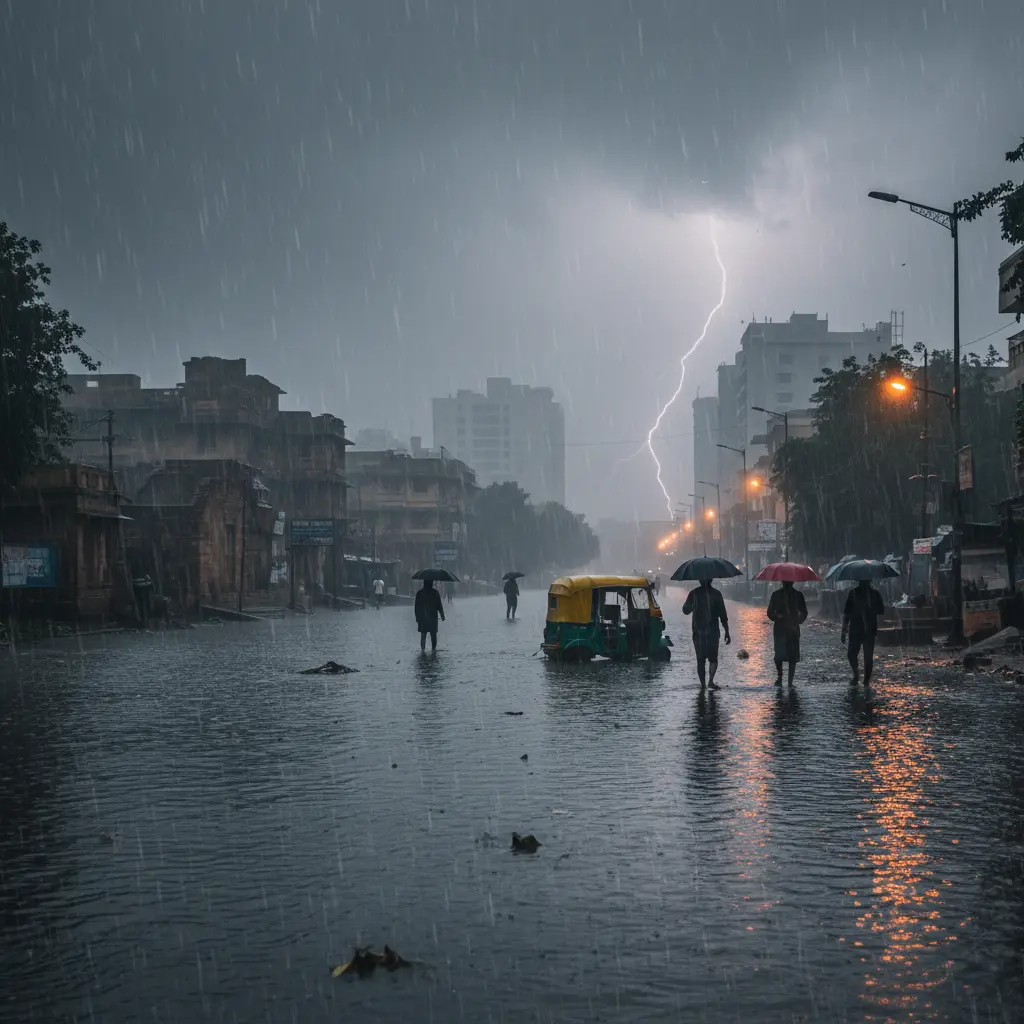
Gujarat is going through one of its wettest stretches of the season, and Friday, July 31, is shaping up to be the toughest day yet. The India Meteorological Department (IMD) has sounded a red alert for extremely heavy rainfall across Ahmedabad, Vadodara, Surat and several other districts, and the state machinery has shifted into full preparedness mode.
What the IMD Red Alert Actually Covers
According to the latest IMD bulletin, Ahmedabad, Vadodara, Anand, Bharuch, Narmada, Chhota Udepur, Surat, Navsari, Valsad, Tapi, Dang, Bhavnagar and Botad are all under a red alert for July 31, with the weather office warning of extremely heavy rainfall in these districts. That’s a wide stretch of central, south and coastal Gujarat, meaning the rain isn’t just a city problem — it’s a statewide event.
An orange alert has been issued for Gandhinagar, Kheda, Surendranagar, Rajkot, Amreli, Dahod, Panchmahal and Mahisagar, while the remaining districts of north Gujarat and Kutch are on yellow alert. In plain terms, almost no part of the state is being asked to let its guard down this week.
The IMD has also flagged a broader four-day spell of heavy to extremely heavy rain, with some reports suggesting Ahmedabad could see rainfall totals nearing eight inches on Friday alone, while Narmada district could be looking at closer to twelve inches. That kind of volume, dropped over a short window, is exactly what triggers urban flooding, not just puddles on the road.
Ahmedabad Flooding Risk and the School Holiday Call
With the red alert in place, the Ahmedabad district administration wasted no time. A holiday has been declared for July 31 across all government, grant-in-aid and private schools and colleges in the city, covering everything from primary schools to higher secondary institutions. The decision was taken by the District Education Officer on instructions from local authorities, purely as a precaution to keep students and staff off the roads during the worst of the downpour.
Authorities have also urged residents to step out only if absolutely necessary, avoid low-lying areas, and stay in touch with local emergency contacts if things get difficult. It’s the kind of advisory that sounds routine until you remember how quickly Ahmedabad’s roads can go from wet to waterlogged once the drains can’t keep up.
City data backs up how active this monsoon has already been. As of the afternoon of July 30, Ahmedabad had received an average of over 512 mm of rainfall this season — already past half of the city’s typical seasonal total. So Friday’s red alert isn’t arriving out of nowhere; it’s landing on ground that’s already saturated, which raises the odds of standing water, slow-draining roads and traffic snarls in the city’s usual trouble spots.
Not Just Ahmedabad — A Statewide Weather System
What’s driving all this isn’t a single storm cell. Multiple weather systems have become active over Gujarat at the same time, and the state has been told to expect heavy rain for close to a week, not just one bad day. Vadodara’s district administration has echoed the same warning, with officials there saying the rain threat was expected to intensify through the night as the system strengthened.
To coordinate the response, Gujarat’s State Emergency Operation Centre in Gandhinagar convened a meeting of the Weather Watch Group under Relief Commissioner Gaurang Makwana. The focus was straightforward: map out available manpower, equipment and rescue teams across departments so nothing is scrambling at the last minute if flooding turns serious in any district.
The Bigger Monsoon 2026 Picture
Gujarat isn’t experiencing this alone. Monsoon 2026 has turned genuinely active across a big chunk of the country right now, with the IMD also pointing to heavy to very heavy rainfall over Maharashtra, Madhya Pradesh, Telangana, and parts of north and east India. Mumbai, Thane, Nagpur, Nashik and several other Maharashtra cities have their own heavy rain warnings running in parallel, which suggests this isn’t a localized weather blip but a broader monsoon surge moving across central and western India together.
For anyone in the affected districts, the message from officials is fairly consistent: don’t take unnecessary risks, keep an eye on local alerts rather than assuming yesterday’s forecast still holds, and expect commutes to be messier than usual over the next few days. The IMD’s own outlook suggests conditions may ease slightly heading into early August, with rain activity expected to taper to light-to-moderate showers in several districts by August 4 and 5 — but until then, Gujarat is very much in the thick of it.
For now, red means red. Schools are shut, emergency teams are on standby, and much of Gujarat is simply waiting out the rain.
Ahmedabad and Gujarat Brace for Red-Alert Rainfall.