
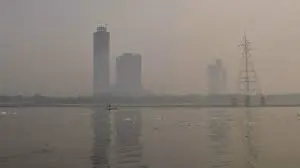
Air pollution across India deteriorated sharply in October 2025, with the Indo-Gangetic Plain emerging as the country’s most polluted zone. According to a monthly snapshot released by the Centre for Research on Energy and Clean Air (CREA), the region — particularly the National Capital Region (NCR) and adjoining cities — recorded some of the highest concentrations of fine particulate matter (PM₂.₅) in recent months. Meteorological conditions typical of late autumn, such as cooler surface temperatures and slower winds, helped trap pollutants near the ground, worsening air quality across much of northern India.
The CREA report revealed that in October 2025, over 240 Indian cities exceeded the World Health Organization’s daily guideline for PM₂.₅ concentration of 15 µg/m³, compared to around 200 cities in September. Dharuhera in Haryana emerged as India’s most polluted city, recording a monthly average PM₂.₅ level of 123 µg/m³ — more than double the National Ambient Air Quality Standard (NAAQS) limit of 60 µg/m³. The city breached this limit on most days of the month, experiencing several ‘Very Poor’ and ‘Severe’ air quality days.
Delhi’s pollution levels also rose sharply, averaging 107 µg/m³ in October, nearly three times higher than its September average of 36 µg/m³. The national capital ranked sixth among India’s most polluted cities, reflecting how meteorological stagnation combined with high emissions led to sustained pollution peaks.
While stubble burning in neighbouring states remains a contributing factor, CREA’s analysis found that in October 2025, crop residue fires accounted for less than six per cent of Delhi’s PM₂.₅ levels. Instead, emissions from vehicles, industries, construction dust, and re-suspended road particles played a larger role. Experts noted that seasonal weather patterns do not create India’s air-pollution crisis but merely amplify it, revealing the high baseline pollution already present in the atmosphere.
The report also highlighted a drastic drop in the number of Indian cities with “Good” air quality (PM₂.₅ between 0–30 µg/m³), which fell from 179 in September to just 68 in October. Cities with “Satisfactory” or “Moderate” air quality rose sharply, while nine cities entered the “Poor” category and one fell into the “Very Poor” range. The Indo-Gangetic Plain accounted for most of these shifts, showing that the pollution surge was not an isolated incident but part of a larger, recurring regional pattern.
The scale of this deterioration has reignited calls for stronger and more consistent air-quality management in India. Experts argue that the current National Ambient Air Quality Standards lag behind global health recommendations, and that short-term measures like the Graded Response Action Plan (GRAP) are insufficient. To bring about lasting change, authorities must enforce year-round controls on key pollution sources, strengthen monitoring systems, and update emission norms for vehicles and industries.
Meteorological forecasts indicate that late-autumn and winter conditions — marked by lower boundary-layer heights and calmer winds — will continue to favour pollutant accumulation. This makes it imperative for governments at all levels to move from reactive emergency measures toward proactive and sustained pollution-control strategies.
The October 2025 data serves as a stark reminder that India’s air-pollution crisis is a persistent, structural issue rather than a seasonal anomaly. With millions exposed to unsafe air across the Indo-Gangetic Plain, comprehensive and long-term interventions are urgently needed. Reducing emissions, modernizing air-quality standards, and implementing continuous monitoring will be essential steps toward ensuring cleaner air and healthier lives for India’s citizens.

