
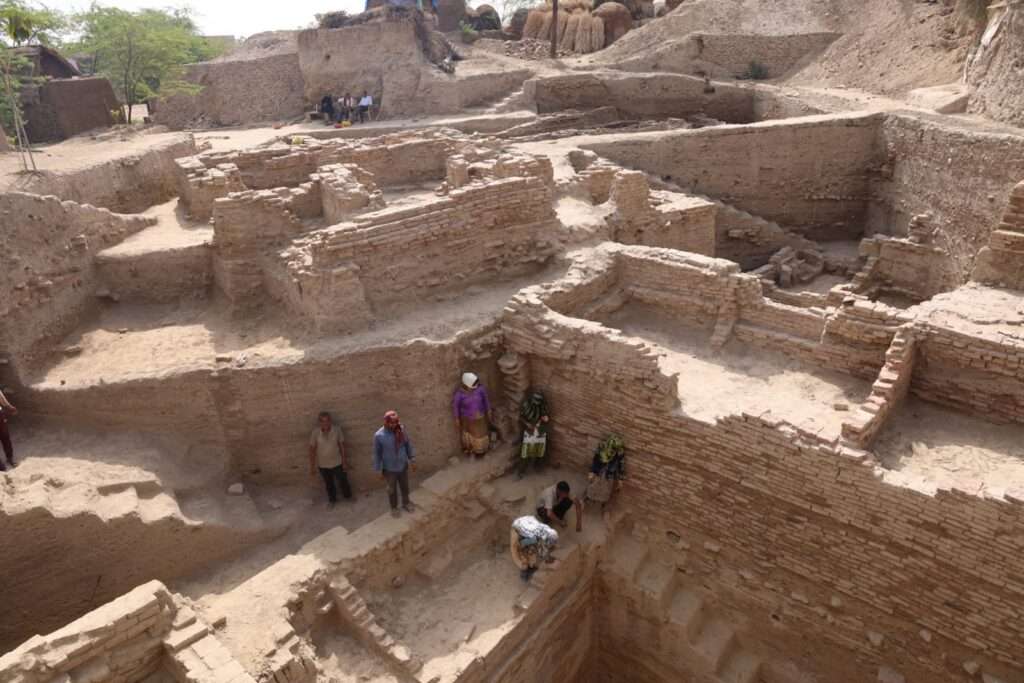
1 July, 2025-A groundbreaking geological discovery in Rajasthan has brought new insights into the long-debated existence of the mythical Saraswati River, often mentioned in ancient Indian scriptures. Scientists have identified a 3,500-year-old buried river channel beneath the desert terrain, which could potentially mark the path of the long-lost river believed to have supported early Indian civilizations.
The research, conducted by experts from the Indian Institute of Technology (IIT) Kanpur and the Archaeological Survey of India (ASI), involved the use of advanced satellite imagery, ground-penetrating radar, and sediment analysis. The ancient riverbed, found in the arid zones of western Rajasthan, stretches several kilometers in width and exhibits geological features characteristic of a once-perennial river system.
According to the study, the flow patterns and sediment composition indicate a freshwater river that once coursed through this region between 2000 BCE and 1500 BCE. This timeline overlaps with the Late Harappan period, suggesting the river may have played a critical role in the settlement and sustenance of ancient communities. Researchers believe the drying of this river could be linked to the gradual eastward migration of the Harappan civilization.
Historical references in the Rigveda, one of the oldest known texts in the world, describe a powerful river named Saraswati that flowed from the Himalayas to the sea. For years, historians and scientists have debated whether these descriptions were symbolic or based on real geography. The newly discovered paleo-channel now provides scientific evidence that may align with these ancient accounts.
Experts involved in the study believe that the river likely originated from the Himalayan glaciers and flowed southwest through present-day Haryana, Punjab, and Rajasthan before reaching the Arabian Sea. The presence of fluvial deposits and fossilized soil layers supports the theory of a substantial watercourse that once ran through the region.
The research team used optically stimulated luminescence (OSL) dating to determine the age of the sediment layers, confirming the channel’s antiquity. The findings have generated significant interest among archaeologists, geologists, and cultural historians, as well as renewed public fascination with India’s ancient river systems.
While the discovery is being hailed as a major step toward validating historical and cultural narratives, scientists have emphasized the need for further research. Additional excavations, hydrological modeling, and cross-disciplinary collaboration will be necessary to trace the full course of the river and understand its ecological and civilizational impact.
This remarkable finding offers a compelling example of how scientific advancements can bring new clarity to ancient mysteries—reshaping our understanding of history, geography, and culture. If confirmed, the lost river’s rediscovery could become one of the most significant archaeological breakthroughs in the study of early Indian civilization.

