
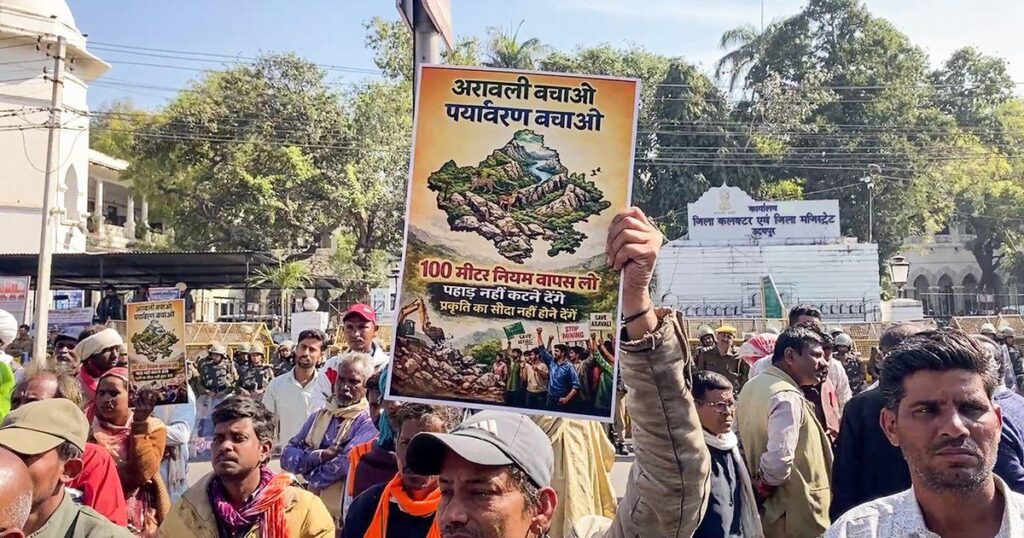
A fresh controversy has erupted in December 2025 over the Indian government’s newly notified uniform definition of the Aravalli range, reigniting long-standing tensions between development priorities and environmental protection. While the Union Ministry of Environment, Forest and Climate Change has asserted that the revised technical criteria restrict mining activities to a minuscule portion of the region, environmental activists and conservation experts have raised alarm over what they describe as an impending ecological crisis in one of India’s oldest mountain ranges.
The Aravalli range, spanning approximately 1.44 lakh square kilometres across Rajasthan, Haryana, Delhi, and Gujarat, plays a critical role in maintaining ecological balance, groundwater recharge, and climate regulation in northern and western India. The latest dispute centres on a uniform definition introduced by the government to classify what constitutes “Aravalli hills” for regulatory and legal purposes.
Union Environment Minister Bhupender Yadav clarified that under the new definition, only around 0.19% of the total Aravalli landscape—equivalent to 277.89 square kilometres—has been identified as eligible for mining activities. According to the ministry, this move aims to remove ambiguity arising from inconsistent interpretations by different states and courts, while continuing to safeguard the vast majority of the fragile ecosystem.
Government officials argue that the revised definition is rooted in scientific and geological parameters rather than revenue records alone. They maintain that the policy ensures clarity for environmental clearances, infrastructure planning, and enforcement, without opening the floodgates for indiscriminate mining in the Aravalli range.
However, environmental activists and civil society groups strongly contest this claim. They warn that redefining the Aravallis based on technical criteria could effectively exclude large forested and hilly tracts from protection, leaving them vulnerable to mining, real estate expansion, and industrial projects. Critics fear that the move may legitimise past violations and accelerate environmental degradation in ecologically sensitive zones.
Key Concerns Raised by Environmentalists Include:
- Increased mining activity leading to loss of forest cover
- Depletion of groundwater in an already water-stressed region
- Higher air pollution levels affecting Delhi-NCR and adjoining areas
- Long-term impact on biodiversity and wildlife corridors
At a Glance: Government vs Activist Claims
| Aspect | Government Position | Activist Concerns |
|---|---|---|
| Mining eligibility | Only 0.19% of Aravalli area open | Definition may exclude large protected zones |
| Basis of definition | Scientific and technical criteria | Ignores ecological and historical realities |
| Environmental impact | Minimal and regulated | Risk of widespread ecological collapse |
The Aravalli mining controversy has also gained political traction, with opposition leaders demanding greater transparency and parliamentary scrutiny. Legal experts note that the issue could trigger fresh litigation, given the Supreme Court’s past interventions to curb mining in the region.

