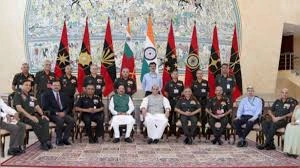
India’s military future has come under scrutiny following the recent Army Commanders’ Conference in New Delhi. Lessons from recent conflicts, self-reliance and the like are at the heart of the push by senior brass to rebuild the force for tomorrow’s battles.
Why This Conference Is Relevant Now
The state of security in India seems more unsettled than ever. Border tensions simmer in geopolitical stress, cyber dangers loom large and global supply systems falter.To address these difficulties, the bi-annual Army Commanders’ Conference was organized from 13 to 16 April 2026 with Chief of Army Staff, Chief of Defence Staff, Defence Secretary and Cabinet Secretary.This was not just discussion, but led by senior leadership. Decisions made here affect how 1.4 million soldiers prepare for real world upheaval.
Atmanirbharta or self-reliance became the rallying cry. Speakers pointed to the need to reduce external dependency, particularly in light of recent disruptions which had revealed weaknesses in defense imports. Think about it: Can India wait on foreign parts when a catastrophe hits? The response was a definite no. Modernisation was also a strong theme, with a clear blueprint for a “future-ready force” that integrates tech improvements and flexible tactics.
The timing of this gathering is crucial. While the US under President Donald Trump is trying to build stronger ties in the Indo-Pacific, India knows that strategic autonomy requires strength at home. It is a boost to Make in India by linking military needs with domestic economic growth.
Self-Reliance: From Slogan to Strategy
Atmanirbharta is not new, but the meeting gave it teeth. Leaders emphasized domestic manufacturing of essential tech such as AI, drones, and electronic warfare systems. Sovereign AI, said Defence Secretary Somanathan, is a “strategic necessity” and warned against over-reliance on foreign technology in decision-making cycles. Resilient supply chains gained equal billing – crucial for keeping things running in wartime.
The push builds on the gains. Defence exports have seen a big rise and it is an indication that India is making its mark on the world stage. But obstacles remain. Glocal interruptions from Red Sea snarls to chip shortages underline the importance of local production. The Army wants increased private sector involvement, creating an ecosystem that churns out next-gen weaponry from companies.
It’s mainly about AI powered analytics, drone swarms and cyber defences. The goal is to reduce import reliance from 70% to below 50% in five years. Real world tie-in: border ops need gear that gets here swiftly, not months out at sea.
Cabinet Secretary Raju called for a “whole-of-nation” approach that integrated civil-military activities. It’s not just guns it’s jobs, innovation and security all rolled into one. A move like this may trigger a manufacturing boom in a country like India with its huge industrial base.
Lessons from Modern Warfare: More than Bullets and Bombs
Modern fights are nothing like the textbooks teach. The conference examined steps to multi-domain operations (MDO), linking land, air, sea, cyber, space and info warfare. India’s MDO Doctrine, declared in August 2025, aligns with the subject of 2026: “Year of Networking and Data-Centricity.”
Forget platform battles – individual tanks or aircraft. It’s getting data-driven, network-centric now. Drones locate targets, AI processes info, cyber ops destroy enemies before boots contact dirt. The recent fights, like Ukraine’s grind, provide obvious lessons: non-contact warfare rules, with inexpensive drones killing expensive ships.
India adapts. The Bhairav Force is an infantry reform with advanced technology, equipping battalions with Ashni drones and Javelin missiles for precise strikes. These are not elite commandos, these are bridge units, a combination of regulars and special forces, ready for counter-terror or border clashes.
Training the “hybrid warrior” is essential. Soldiers require expertise with AI tools, electronic warfare, and joint ops across services. Theatre commands were long overdue, imperative even, promising tri-service synergy over compartmentalized armies.
What does it signify for India? Hybrid threats along LAC with China or LoC with Pakistan intermix regulars, militants and cyber attacks. A data-centric Army finds patterns earlier and responds faster.
Theatre Reforms: Technology at its Core: AI, Drones
Technology dominated the conversation. Multi-domain ops require data to flow seamlessly from sensors to shooters in seconds. India is placing significant bets on local AI to prevent imported black boxes that could glitch in battle.
The main attraction was drones. They are force multipliers, from surveillance to kamikaze attacks. Bhairav units combine them per soldier, turning old infantry scripts on their heads. Space assets protect sats from anti-satellite attacks, cyber teams strengthen networks.
Theatre commands are designed to settle territorial wars. Integrated commands encompass areas like China’s Western Theatre instead of Army-centric viewpoints. Conference consensus: accelerate Progress sluggish yet steady Old methods were platform based, like tanks, now it’s data centered networks. Operations become multi-domain integration instead of single-domain, AI accelerates decision cycles and Atmanirbhar tech replaces import-heavy gear.
Context global? US & China dominate MDO, India closing in on the back of collaborations like QUAD, but self-reliance means no strings attached
Operational Readiness & Human Edge
Tech doesn’t win without humans. Conference discussed LAC readiness: enhanced LAC patrol, strict LoC vigil. Drills with integrated combat groups (artillery, infantry, air support) are based on lessons from Galwan 2020 on high-altitude warfareLeaders emphasized civil-military coordination is vital to protect interests, with “hard power” playing a role. Operation Sindoor, a hint from previous conversations, had indigenous systems and troop grit on display.
Training is constantly evolving. Hybrid soldiers learn drones, cyber fundamentals, even bio dangers. Women officers breaking barriers bring variety, fresh ideas. But there are still gaps: officer shortages, tech know-how for jawans.
India’s context is shining here. Neighbors are arming rapidly – China’s hypersonics, Pakistan’s drones – so readiness is not optional. The Army wants an agile army, forces that can go from peacetime to war footing overnight.
The Way Forward
Self-reliance sounds nice, but there are obstacles. Budgets are tight – billions needed for upgrading, calls for welfare Indigenisation slowed by Bureaucracy; No long term orders from private enterprises.
The speed of modern warfare is intimidating. As the Russia-Ukraine case revealed, cyber strikes can paralyze before a shot is fired. India needs to establish resilience: AI for offense, firewalls for defence.
Resistance to theatre reforms, Services protect fiefdoms. The key to success is leadership buy-in. Allies like US provide tech but Atmanirbharta needs intelligent pickings worldwide.
How can India balance speed with sustainability? That is the question being asked in Delhi’s war rooms.
Strategic Autonomy and Global Ties
India is not isolating itself. Conference credits to collaborations US for tech, Israel for drones, France for aircraft But self-reliance breeds independence. Exports to friendly nations develop influence, money for R&D.
China’s shadow hangs over the Indo-Pacific. MDO preps counter with QUAD drills emphasizing jointness The echoes of former remarks of Raksha Mantri Rajnath Singh, foundations of power, strategy, and self-reliance.
It is economic also for India. UP, Tamil Nadu buzz defence corridors, creating jobs, skills. A self-reliant Army is a growing Army.
Army Commanders’ Conference of India: Forging the Path of Self-Reliance in Evolving Warfare Scenarios