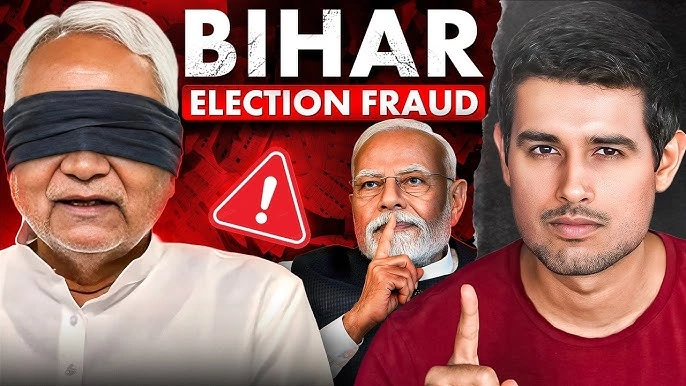
On November 27, 2025, prominent social-media influencer and political commentator Dhruv Rathee released a highly-anticipated video titled “Bihar Elections were a SCAM! Here’s the Proof”, alleging widespread manipulation in the recently concluded 2025 Bihar Assembly elections. The video, which claims to present concrete evidence of vote-rigging and procedural irregularities, has ignited intense debate across India’s political and public spheres.
Allegations at the Core of the Video
In the video, Rathee presents six major claims challenging the legitimacy of the election outcome:
- Paid vote inducements: Tens of thousands of women — reportedly 1.25 lakh members of state-run self-help groups — allegedly received ₹10,000 each just days before the election, with promises of a larger payout later. Rathee describes this as an attempt to influence votes.
- Fake voters and multiple voting: The video alleges around 14.35 lakh fake voter entries in Bihar. Some names reportedly belonged to individuals who had already voted in other states but allegedly returned to vote in Bihar using duplicated identities.
- Special trains for transporting voters: Rathee claims that people from outside Bihar were transported on special trains financed by party functionaries to cast ballots.
- Suppressed CCTV evidence: He points out that changes in polling rules allowing deletion of CCTV footage after 45 days and restrictions under the Right-to-Information Act have limited public access to critical audit trails.
- Mass deletion of legitimate voters: The electoral roll revision prior to the election reportedly saw deletion of approximately 47 lakh voters, disproportionately affecting Muslim and Dalit communities.
- Alleged bias of the poll body: Rathee accuses the Election Commission of India (ECI) of systematic bias toward the ruling coalition, citing inaction in Bihar despite evidence of financial inducements.
Political Fallout
The video has intensified scrutiny from opposition parties. The Rashtriya Janata Dal (RJD) publicly stated that the “people’s mandate was stolen” and demanded that the Election Commission provide explanations for alleged financial irregularities, CCTV lapses, and unaccounted transport movements.
Prashant Kishor, a prominent poll strategist, also noted that certain election outcomes did not align with his team’s ground-level feedback, hinting at potential external influence on results.
Meanwhile, media analysts and critics have raised concerns about the reliability of some allegations. They highlight that the 2025 Bihar polls occurred amid widespread misinformation, including synthetic and manipulated content, which the Election Commission has cautioned against.
The ECI has historically dismissed similar “vote theft” allegations in other states as unsubstantiated, urging officials to focus on verified complaints and warning against irresponsible statements that could undermine trust in the electoral process.
Implications for Democracy
The debate surrounding Rathee’s video touches the core of electoral integrity in India. Allegations of fake votes, vote-buying, and voter roll manipulation — if verified — could seriously erode public confidence in the democratic process.
- Trust in elections: Transparency, fair roll revisions, and unfettered access to audit trails like CCTV footage remain essential to maintaining voter confidence.
- Political polarization: The video has already intensified debates across party lines and may increase social and political tensions ahead of future elections.
- Need for accountability: Both the Election Commission and political parties may face growing pressure to ensure strict enforcement of electoral laws and independent investigations into alleged irregularities.
Dhruv Rathee’s latest video underscores a growing demand for transparency and accountability in Indian elections, sparking conversations that could influence how voters, parties, and institutions approach democratic processes in the future.