
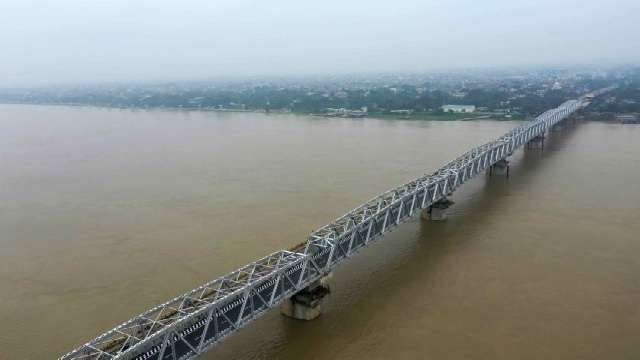
August 7,2025 – The Bihar government has introduced the Bihar State Bridge Management and Maintenance Policy, 2025, which incorporates artificial intelligence (AI) and machine learning (ML) technologies to strengthen the maintenance and monitoring of bridges across the state. This marks a major step towards digitising infrastructure oversight and improving public safety.
Under this newly formulated policy, AI and ML tools will be deployed to undertake regular inspections, assess structural health, predict deterioration, and detect potential faults in real time. The initiative is part of the state’s broader digital audit framework and is expected to enhance the efficiency and accuracy of bridge maintenance, thereby reducing the risk of structural failures.
According to officials from the Road Construction Department, the policy will apply to approximately 5,500 bridges, including both major and minor structures. These technologies will be used to collect and analyze data through sensors, drones, and other digital tools, enabling predictive maintenance rather than reactive repair. The department also plans to create a centralized digital platform to store and analyze the bridge data.
“We are moving towards a preventive maintenance model powered by AI and machine learning. This will allow us to identify risks before they escalate into safety hazards,” said a senior government official involved in the policy implementation.
The AI-enabled digital audits will also support the classification of bridges based on their structural health, assigning priority to those requiring immediate attention. The initiative is particularly timely, as incidents involving collapsed or damaged bridges have raised public concern over infrastructure safety in recent years.
The policy outlines a comprehensive system for bridge lifecycle management, covering construction quality audits, periodic inspections, load testing, rehabilitation planning, and automated alerts. Government officials noted that the system would ensure transparency, accountability, and timely action by integrating AI insights with engineering expertise.
The Bihar government has also indicated plans to train engineers and technical staff in AI and ML applications to ensure effective implementation. Additionally, collaboration with academic institutions and private tech firms is being explored to bring in domain expertise and advanced analytics capabilities.
Infrastructure experts have lauded the initiative as a progressive move, stating that Bihar could become a model for other states looking to modernize their infrastructure maintenance systems. “Using AI for predictive infrastructure management is a global best practice. Bihar’s decision reflects a forward-looking governance model focused on sustainable development and safety,” said Dr. R.K. Mishra, an urban infrastructure specialist.
Conclusion:
With the launch of the Bihar State Bridge Management and Maintenance Policy, 2025, the state government aims to lead the way in leveraging digital technologies for infrastructure resilience. By integrating AI and ML into its maintenance protocols, Bihar is not only improving the safety of its bridge network but also embracing data-driven governance as a cornerstone of future development.

