For three decades, Bankipur belonged to the BJP. It was a seat so safely saffron that the party’s own national president once represented it. So when the results came in on the night of August 4, in a counting hall roughly 1,000 kilometers from New Delhi, few in Patna expected what happened next: the ruling party lost it. And the loss wasn’t just embarrassing — it landed at the center of a growing conversation about whether Prime Minister Narendra Modi’s party is losing its grip on India’s youngest voters.
What Actually Happened at the Ballot Box
Three by-elections were held in the first week of August, and the results split two ways. The BJP lost two of the three contests — Bankipur in Bihar and Datia in Madhya Pradesh — both in states it currently governs, while comfortably holding onto Manjalpur in Gujarat, Modi’s home state.
The Bankipur result stung the most. Prashant Kishor’s fledgling Jan Suraaj Party pulled off the win in the Patna parliamentary constituency, in a seat that had been held for three decades by the very man who now serves as the BJP’s national president, Nitin Nabin. According to the Election Commission of India, Kishor’s margin over BJP candidate Neeraj Kumar topped 19,000 votes — a striking number for a party contesting its very first election.
Datia told a similar story. The Congress held onto the Madhya Pradesh seat, a result complicated by internal BJP friction — the party had passed over former state Home Minister Narottam Mishra’s preferred candidate in favor of another nominee, a decision that reportedly clouded the campaign even after Mishra eventually campaigned for the party’s pick.
Only in Gujarat did the BJP’s dominance hold firm, with its candidate winning Manjalpur by more than 30,000 votes over the nearest Congress rival — a reminder that the party’s core strongholds remain largely intact, even as cracks appear elsewhere.
The “Cockroach” Movement Behind the Headlines
The by-poll losses didn’t happen in a political vacuum. They landed just weeks after a wave of youth-led protests forced the resignation of India’s education minister, Dharmendra Pradhan — a rare retreat for a government that has generally prided itself on not bending to public pressure.
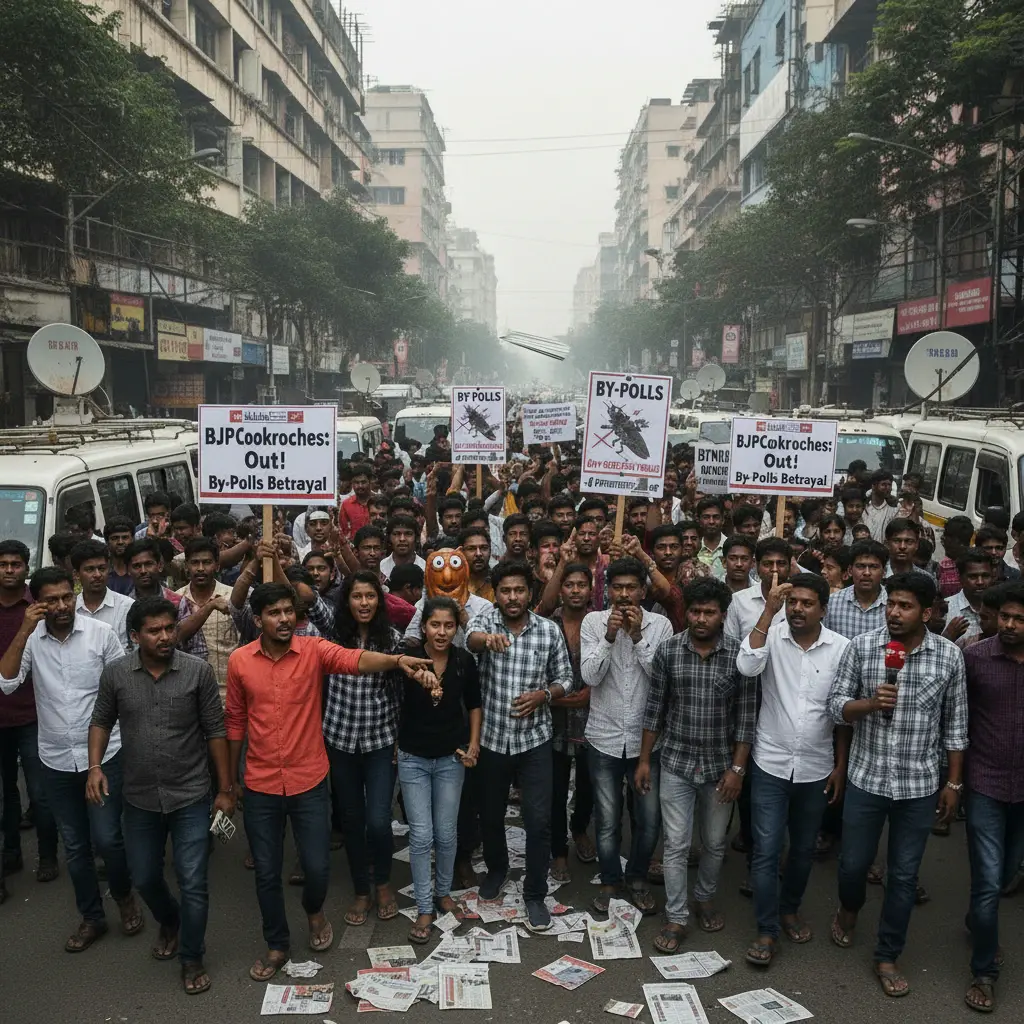
At the core of those protests is a movement with an unusual name: the Cockroach Janta Party. Former Aam Aadmi Party staffer and political communications strategist Abhijeet Dipke launched a satirical movement on May 16, 2026, after comments by India’s Chief Justice Surya Kant, who compared unemployed young Indians to “cockroaches” and “parasites of society”. <cite index=”49-1″ Within days it had attracted more than 350,000 sign-ups and more than 20 million followers on Instagram, with volunteers later taking the protest off-line — some turning up to demonstrations in cockroach costumes.
What began as internet satire evolved into sustained street pressure. Pradhan’s resignation comes after seven weeks of student protests that erupted in New Delhi and spread to cities across the country over leaked exam papers and other grievances. Interestingly, Bankipur was no passive spectator to this turbulence. The Bihar constituency had already witnessed its own agitation over controversial UGC equity guidelines that students said were unfair to general-category applicants.
The language used to describe the movement became personal during the Bankipur campaign. Nitin Nabin, the outgoing BJP MP whose seat was up for grabs, described the largely Gen Z protesters as “a virus and a cockroach gang devoted to breaking the country”. It was a line that may have backfired: after losing the seat, Nabin said the party would “undertake a thorough introspection,” and senior BJP sources acknowledged the defeat had shown that even core supporters could change their minds.
Turnout data adds another layer to the story. Bankipur, which is home to a significant urban and youth population, saw turnout slump to just over 34% — a notable drop from the previous cycle, with roughly a third of the electorate under 25. Party insiders quoted in Indian media suggested core BJP voters simply stayed home rather than turning out to vote against Kishor.
The BJP’s Recalibration
The party isn’t standing still. In Uttar Pradesh, India’s most populous state and a key battleground ahead of the 2027 assembly election, the BJP has initiated a new outreach drive aimed at the Gen Z. The initiative directs civil administrative officers into schools for career counselling sessions, and the party has also released promotional content featuring young people trading internet slang with an older trainer who steers conversations toward the government’s development record. The reception online was mixed at best — the slang was laid on so thick that many Instagram users mocked the effort, joking the party had seemingly paid young people to write propaganda aimed at their own generation.
Party leadership has also convened strategy meetings across the Delhi-NCR region, bringing together MPs and organizational leaders from Uttar Pradesh, Haryana, and Rajasthan to design outreach targeted at students, competitive-exam candidates, and their families — betting that many protest sympathizers simply lack full information about the government’s policy record.
Reading the Political Tea Leaves
Not everyone is convinced this signals a lasting shift. Analysts caution against reading too much into a handful of by-election results. By-elections typically attract the participation of only a small slice of the electorate – less than a third of the population votes – and the BJP’s political machinery has traditionally been good at absorbing setbacks,” One instructive parallel: Haryana, where the BJP went on to win a majority a few years after farmers waged a yearlong protest campaign against controversial agricultural laws — a subsequent election fought less on farmer grievances and more on caste politics.
Still, the symbolism is hard to ignore. The BJP had, only months earlier, been riding high after breaching its long-elusive West Bengal barrier and sweeping Assam and Puducherry. That momentum has since given way to a string of political headaches — from the Cockroach-driven protests to the Bankipur and Datia defeats — leaving the party’s famed electoral machine facing its most serious test yet from a generation it has struggled to fully understand, let alone win over.