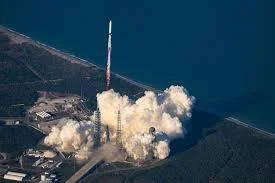
On Thursday, November 13 2025, the rocket company Blue Origin achieved a significant breakthrough as its heavy‑lift launcher, the New Glenn, successfully launched two NASA spacecraft under the ESCAPADE (Escape and Plasma Acceleration and Dynamics Explorers) mission to Mars. The launch not only advances Mars exploration but also represents a key step in reusable‑rocket technology and commercial deep‑space capacity.
The ESCAPADE mission comprises two identical satellites—nicknamed “Blue” and “Gold”—designed to probe how the solar wind interacts with the Martian atmosphere and magnetosphere, shedding light on the planet’s atmospheric loss and climate evolution. Launched from Launch Complex 36 at the Cape Canaveral Space Force Station in Florida at 3:55 p.m. EST, the mission marks NASA’s next‑generation heliophysics contribution to Mars science.
In parallel, New Glenn achieved a key technical milestone: its first‑ever successful landing of the first stage on the sea‑based platform named “Jacklyn.” The booster, powered by seven BE‑4 engines, lifted off with about 3.8 million pounds of thrust and returned to region‑accurate touchdown—an accomplishment previously dominated by rival SpaceX.
Key mission and technology highlights include:
- Twin‑satellite deployment: ESCAPADE launches two probes rather than the more customary single spacecraft—enabling stereo measurements of Mars’ space‑weather environment.
- Extended loiter trajectory: Because the next ideal Earth‑to‑Mars transfer window opens only in 2026, mission planners opted for a “loiter” orbit near Earth prior to the Mars leg—allowing broader mission flexibility.
- Affordable deep‑space science: With an approximate cost of $107 million, ESCAPADE provides planetary‑science returns at a fraction of the cost of traditional Mars missions.
- Reusable heavy‑lift validation: New Glenn’s successful booster recovery underscores Blue Origin’s move into the high‑stakes orbital launch market and sets up future missions—including lunar‑ and Mars‑bound logistics.
The scientific payoff of ESCAPADE is substantial: the ability to monitor how the solar wind strips charged particles from Mars’ upper atmosphere will deepen understanding of why the planet lost much of its early air and water. This data is critical for future human exploration of Mars, as space‑weather hazards and atmospheric conditions must be well characterised.
Beyond Mars science, the launch holds strategic implications for commercial spaceflight and NASA’s broader roadmap. With Blue Origin proving its large‑rocket infrastructure and reusable booster technology, competition in the launch market intensifies. Mission success could accelerate private‑sector participation in deep‑space missions, while also reinforcing NASA’s reliance on commercial partners for cost‑efficient exploration.
The November 13 launch of the New Glenn rocket carrying NASA’s ESCAPADE twin probes marks a convergence of commercial space innovation and cutting‑edge planetary science. With the first‑stage booster recovered and the Mars‑bound spacecraft deployed, both technological and exploratory frontiers have advanced. As the spacecraft coast toward Mars—arriving around 2027—these efforts promise new insights into the Red Planet’s atmospheric fate and prepare the groundwork for human missions beyond Earth. In an era where reusable heavy‑lift rockets and interplanetary science co‑exist, this mission sets a high bar for what comes next in space exploration.