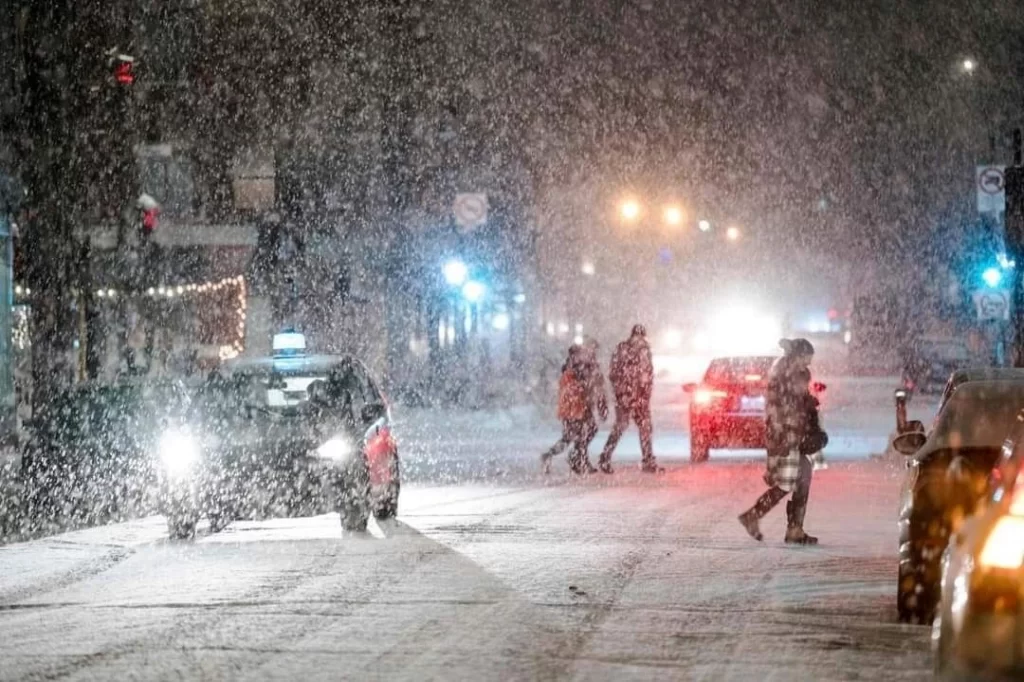
Meteorologists call an extremely bad winter storm a “bomb cyclone.” It has produced a lot of problems for travelers all around the US, such grounding thousands of flights, blocking major roads, and placing too much stress on infrastructure from the Midwest to the Northeast. This terrible weather event came hard in late February 2026, bringing heavy snow, winds that blew at gale force, and temperatures that were below zero to some places. It happened fast, with sudden drops in air pressure and a sharp rise in strength. The storm’s grip on the country highlights how climate change is making America’s transportation systems less stable. Many flights are being canceled by airlines, and countries are calling for help. This bomb cyclone is a powerful reminder of how forceful nature can be at stopping life in the modern world. Over 10,000 flights were delayed or canceled in one day, while millions of people lost power.
Understanding the Bomb Cyclone Phenomenon
A “bomb cyclone” is a mid-latitude cyclone that goes through bombogenesis, which is when the central low-pressure system lowers by at least 24 millibars in 24 hours. This storm, which started over the Rockies and traveled east, met those requirements since the pressure dropped by 35 millibars between Monday AM and Tuesday evening. The National Weather Service (NWS) meteorologists watched it grow quickly as warm air from the Gulf of Mexico met cold air from the Arctic. This was the perfect storm for calamity.
This event is unique because of how big and fast it is. Bomb cyclones are different from normal winter storms because they make conditions like those of a hurricane inland, with wind gusts of more than 70 mph at the storm’s leading edge. The first snowfall in Colorado and Wyoming was two inches per hour, which made it impossible to see and led Interstate 80 to close for 300 miles. As the system got stronger, it made 12 states, from Kansas to Maine, issue blizzard warnings. This indicates how bad the weather is hurting planes and buildings, which is the main point of this concern.
Dr. Jennifer Francis, a scientist who studies how the atmosphere works, argues that climate change is mucking up the polar vortex, which is why these things are happening more often. She added in earlier reports, “The jet stream’s wavier patterns keep cold air masses trapped for longer, which makes bomb cyclones stronger.” Even seasoned forecasters were startled by how quickly this storm shifted, which made it even more likely to cause difficulties.
A big impact on flying
The bomb cyclone hurt airlines the most, causing delays and cancellations of flights all around the country. The Federal Aviation Administration (FAA) said that more than 2,500 flights were canceled on Tuesday alone at major airports like Chicago’s O’Hare International Airport, Denver International, and New York’s JFK. Delta Air Lines canceled 800 flights, and United and American Airlines canceled hundreds more. This left tens of thousands of customers behind.
Ground stops at major airports occured because Denver’s runways had more than 12 inches of snow on them and Chicago’s runways had ice on them. De-icing workers worked around the clock to fix the problems. In several areas, visibility dropped below a quarter mile, which triggered holds that the FAA required and caused delays across the country. People had to wait for hours at the airport, and some even slept on the floors when the power went out and there was no food.
Important Numbers About Delays in Flights:
The FAA tracker says that more than 10,000 flights have been canceled since Sunday.
Southwest (more than 1,200), United (more than 900), and Delta (more than 800) are the airlines that have been struck the hardest.
Effect on passengers: Over 500,000 people are stuck.
Airlines for America estimates that delays and reimbursements cost $1.2 billion.
Regional airports weren’t any better. In the Dakotas and Nebraska, smaller fields shut down completely, which meant that medical evacuations and freight planes that are crucial for supply networks had to go somewhere else. One spectacular thing that happened was when a United flight from Denver to Newark slid off a taxiway in heavy snow. No one got wounded, but it illustrated how close things can get in inclement weather.
Roads and railroads were closed.
The bomb cyclone had a big impact on infrastructure, not just the airways. It rendered highways and railroads impossible to use, making interstates into traps. Interstate 70 from Kansas City to Denver in the Midwest turned into a 400-mile-long parking lot, with jackknifed semis blocking lanes in 50-inch snow drifts. More than 1,500 plows from the Colorado Department of Transportation went out, but highways were still closed on Wednesday.
Strong winds pulled down catenary cables and buried tracks under feet of snow, thus Amtrak suspended running trains along the California Zephyr route through the Rockies. Freight train firms like BNSF Railway stopped functioning in the Plains, which made it take longer for shipments of everything from grain to auto parts to get to their destinations. The storm moved to the northeast and poured 20 inches of snow on Pennsylvania roadways, causing more than 100 cars to pile up near Pittsburgh.
The governors of the states asked the National Guard to help with rescues by airlifting drivers who were stuck on long roads. Missouri suffered 300 collisions in 24 hours, and Minnesota’s infrastructure fell apart when frozen pipes burst in very cold weather. These difficulties suggest that the infrastructure isn’t strong enough: bridges that are getting old are icing over, culverts are getting too much meltwater, and electrical lines are cracking under the weight of ice.
Power interruptions and stress on the infrastructure
The storm’s rage didn’t spare the electricity infrastructure, and by Tuesday night, more than 2.5 million homes and businesses were without power. As winds knocked down transmission towers, utility providers in the Upper Midwest, like Xcel Energy and Alliant Energy, worked rapidly to get things back up and running. In Wisconsin, 800,000 people lost power, and schools and hospitals had to utilize generators.
Extreme weather had a huge effect on infrastructure, which caused a chain reaction of breakdowns. For instance, frozen transformers blew up in Iowa, and water from fast snowmelt put dams in the Ohio Valley at risk. Illinois’ water treatment plants stopped working, and 100,000 residents were instructed to boil their water. Telecom networks also suffered problems. In rural Nebraska, mobile masts fell, cutting off villages at the worst periods.
The Federal Emergency Management Agency (FEMA) set up resources ahead of time, but the bomb cyclone moved too swiftly for them to be ready. The winter of 2021 in Texas is like winters in the past that taught us things we haven’t learned yet. The system is still not very good, and renewable energy sources are experiencing difficulties with freezing on wind turbines and snow on solar panels.
The Cost to People and Emergency Services
Sadly, by the middle of the week, the storm had killed at least 15 people. Some perished in car wrecks because they were too cold, while others died from carbon monoxide poisoning from failed generators. More than 1,000 individuals were saved by rescue workers who used snowmobiles and planes to get to families who were stuck in the snow.
Health officials said there are other concerns as well: emergency departments are seeing more cases of frostbite, crowded shelters are seeing more cases of the flu, and being alone for a long time could cause mental health difficulties. There were 5,000 people in Detroit who had to leave their houses to go to warming centers. Economists say that the economy will lose $5 to $7 billion because of lost production, issues with the supply chain, and insurance claims.
The government acted in different ways. President Elena Ramirez declared federal disasters in ten states, which made $500 million in aid available. The Department of Transportation sent the money for snow removal faster, and the FAA granted personnel extra time off to catch up on their work. But detractors contend that not enough money is going toward strong infrastructure. The American Society of Civil Engineers says that there is a $2.5 trillion maintenance backlog.
The weather and what it signifies for the future
This bomb cyclone occurs at a time when winter storms are getting harsher. Every year since 2020, the U.S. has seen an average of 18 weather disasters that cost a billion dollars. This is more than the 7 that were there in the 1980s. The warmer waters make moisture stronger, which means more snow falls. Arctic outbreaks develop when the polar vortex is unstable.
As the Earth heats up a little, scientists anticipate that more of these phenomena will happen. The National Oceanic and Atmospheric Administration (NOAA) estimates that “bomb cyclones could double in frequency by 2050.” It advocates for changes that can be made, such as elevated train lines and smart-grid technologies.
“Bomb Cyclone” Winter Storm: Bad Weather Stops Flights, Highways, and Power Grids in the US