Campaigning for the first phase of the 2025 Bihar Assembly Elections has officially come to a close, as political parties in the state make a final push ahead of polling scheduled for November 6. Across 121 assembly constituencies in 18 districts of Bihar, electioneering halted at 5 p.m. today, paving the way for voters to exercise their franchise without further campaign interference.
The two-phase electoral battle in Bihar will see the first phase polling on November 6 and the second phase on November 11, for a total of 243 seats. The first phase covers crucial districts including Saharsa, Darbhanga, Muzaffarpur, Gopalganj, Siwan, Vaishali, Samastipur, Begusarai, Munger, Patna, Ara, and Buxar.
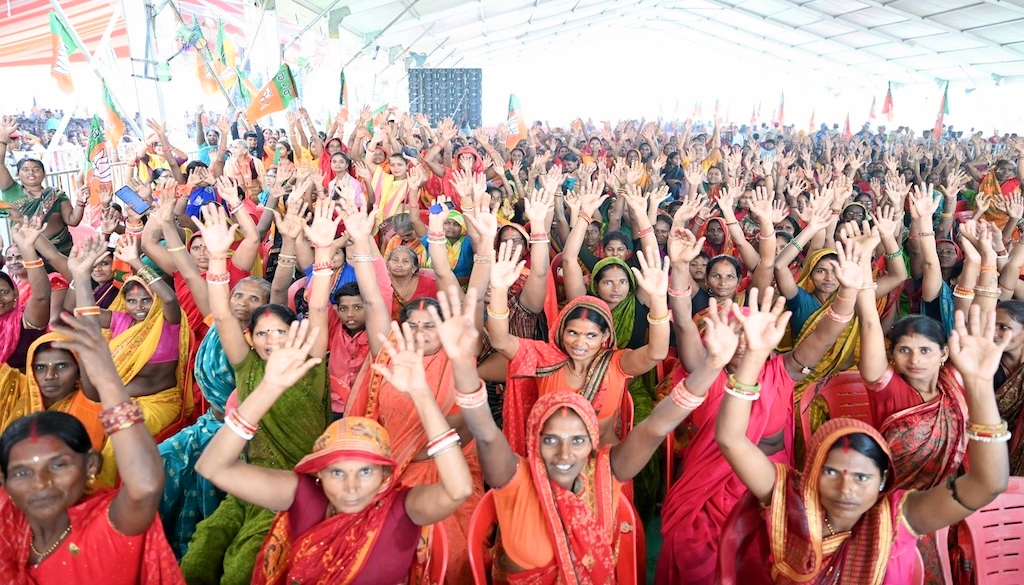
With campaigning ending today, senior leaders from both the ruling Bharatiya Janata Party (BJP)-led National Democratic Alliance (NDA) and the opposition Rashtriya Janata Dal (RJD)-headed Mahagathbandhan made last-minute appeals to voters. Prime Minister Narendra Modi interacted with women workers under the BJP’s “Mera Booth Sabse Majboot” drive, while Union Home Minister Amit Shah led multiple mass rallies in the Darbhanga and Champaran regions.
A key dynamic in this election is the contest between development and change. The NDA has pitched its governance record in Bihar under Chief Minister Nitish Kumar and the BJP-led Central government, while the Mahagathbandhan has advanced a narrative of anti-incumbency and job creation. Prime Minister Modi has emphasised “vikas” (development) for Bihar, contrasting it with “vinash” (destruction), which he attributes to opposition parties.
The election will also be shaped by first-time voters, women electorates, and the logistics of conducting polling at over 90,000 polling stations across the state. Around 74.35 million voters are registered for the election, making it one of the largest state polls in India this year. The Election Commission has increased security arrangements in sensitive constituencies to ensure peaceful voting.
The Mahagathbandhan, led by RJD’s Tejashwi Yadav, has centred its campaign around youth employment, education, and healthcare reforms, while also criticising the NDA for alleged governance lapses. Meanwhile, the BJP and Janata Dal (United) are seeking to consolidate their core voter base through promises of infrastructure development, women empowerment, and welfare schemes.
As the campaign ends, the political temperature in Bihar remains high, with both alliances expressing confidence in their prospects. Analysts believe voter turnout will play a decisive role in determining the outcome, especially in semi-urban and rural areas where local issues often outweigh national narratives.
With the campaign phase over, all eyes will now turn to the polling booths. The first phase on November 6 will set the tone for the subsequent rounds, and possibly indicate whether Bihar’s electorate favours continuity under Nitish Kumar’s alliance or a shift towards the opposition’s call for change. The results of these elections are expected to reshape Bihar’s political direction and governance for the next five years.