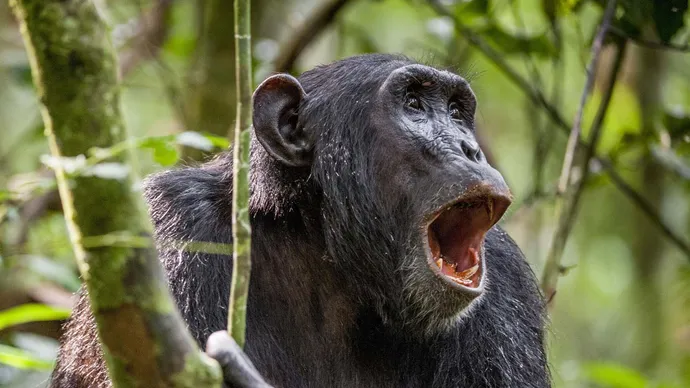
In a development of considerable scientific interest, a team of international primatologists has uncovered compelling evidence that chimpanzees residing in the dense rainforests of West Africa employ rhythmic drumming upon tree trunks as a method of long-range communication.
The observations, published this week in Nature Communications, reveal that the great apes produce distinctive, patterned beats upon the buttress roots of large trees—natural resonators capable of carrying sound over distances as great as one kilometre. The drumming, previously thought to be mere play or random noise, has now been identified as a purposeful and structured form of non-vocal communication.
According to Dr. Catherine Hobaiter of the University of St Andrews, who led the study, each chimpanzee exhibits a unique “drumming signature,” enabling others to identify the individual from afar. “We have determined that these drumming patterns are not arbitrary,” stated Dr. Hobaiter. “They convey specific messages concerning identity, movement, and intent.”
The findings stand to challenge long-held assumptions in the field of primatology, particularly the notion that vocalisation alone serves as the principal means of communication among non-human primates. Instead, this drumming appears to complement existing vocal signals, forming a multi-modal communication system that is both complex and socially significant.
The mechanism of sound transmission, researchers noted, is made possible by the acoustics of the forest itself. The tall buttresses of kapok and fig trees serve to amplify the percussive beats, which resonate through the undergrowth and canopy with remarkable clarity.
Field observations conducted over a period of three years indicate that such drumming is often associated with group coordination, such as preparing for travel or regrouping after separation. In some instances, drumming preceded movements by large family groups, suggesting a potential role in spatial organisation and leadership.
Scholars in the field have remarked upon the implications of this behaviour for our understanding of early human evolution. Some have drawn parallels between these rhythmic displays and the rudimentary origins of music and language in prehistoric hominins.
“This is no mere curiosity,” commented Professor Emmanuel Babo of the Côte d’Ivoire Institute of Natural Sciences. “It affords a rare glimpse into the ancient roots of symbolic behaviour. The line between human and animal communication continues to blur.”
Concerns have also been raised regarding the preservation of such behaviour, as habitat destruction and deforestation may sever these acoustic networks, thereby impairing the chimps’ ability to interact across distances. Conservationists stress the urgency of protecting the remaining forest habitats in order to safeguard not only the species but their sophisticated cultural practices.
In sum, the discovery casts the humble tree drum in a new and reverent light—not as a toy, but as an instrument of intelligence and social cohesion.