
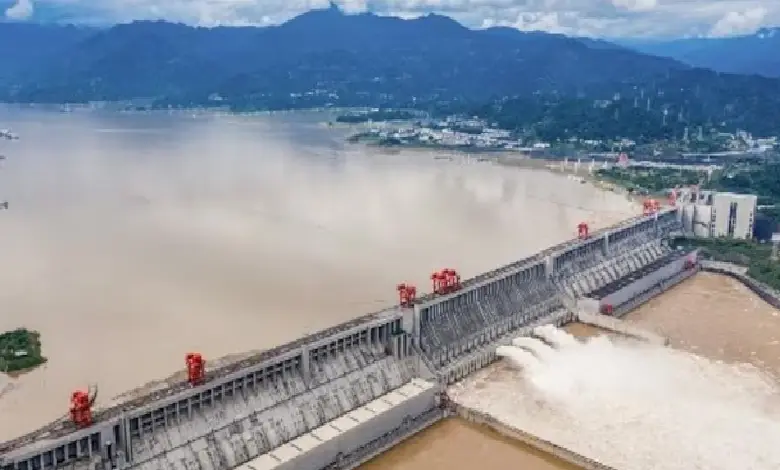
July 21,2025 — China has officially approved a massive $167 billion hydroelectric dam project on the Yarlung Tsangpo River in Tibet’s Nyingchi prefecture, close to the Indian border. The project, which will reportedly become the world’s largest dam by power generation capacity, has triggered significant concern in India over its potential impact on water flow, ecological balance, and national security.
The Yarlung Tsangpo becomes the Brahmaputra River after entering India through Arunachal Pradesh and flowing into Assam. The Chinese project site is located just a few kilometers north of the Line of Actual Control (LAC), a region that has witnessed heightened military tensions between India and China in recent years.
According to Chinese state media, the dam—part of Beijing’s 14th Five-Year Plan—aims to generate over 70 gigawatts of electricity, nearly double that of the existing Three Gorges Dam. The ambitious project is being led by PowerChina and China Three Gorges Corporation as part of the country’s push toward renewable energy and energy security.
India has raised objections over the lack of transparency and consultation on the project, especially given its transboundary nature. Experts warn that the dam could significantly alter the natural flow of the Brahmaputra, posing a risk to water availability in India’s northeastern states, particularly Assam and Arunachal Pradesh.
“There is deep concern that China could use the dam as a strategic asset, especially during border tensions. It not only threatens water security but also gives China leverage in any future conflicts,” said a senior Indian government official who spoke on condition of anonymity.
India is reportedly expediting its own hydropower projects on the Brahmaputra, including the proposed 10 GW Upper Siang project in Arunachal Pradesh, to counterbalance China’s move and assert its own hydrological rights over the river.
Environmentalists have also raised alarms about the potential ecological consequences of constructing such a massive structure in the seismically active Himalayan region. The river basin supports rich biodiversity and is a lifeline for millions of people in India and Bangladesh.
“There is a real risk of disrupting fragile ecosystems, increasing sedimentation, and triggering landslides or even earthquakes,” warned Dr. Arvind Kumar, an environmental policy expert.
Bangladesh, a downstream country, may also face long-term challenges related to water availability and agricultural productivity if the natural flow of the Brahmaputra is affected.
Currently, India and China share limited hydrological data under a bilateral agreement, but no formal water-sharing treaty exists between the two nations. Analysts have called for a comprehensive regional framework involving China, India, and Bangladesh to ensure sustainable management of shared river systems.
As China moves forward with its record-breaking dam, the project is set to become a new flashpoint in the already strained ties between New Delhi and Beijing, underscoring the critical need for dialogue, transparency, and cooperation on transboundary water governance.

