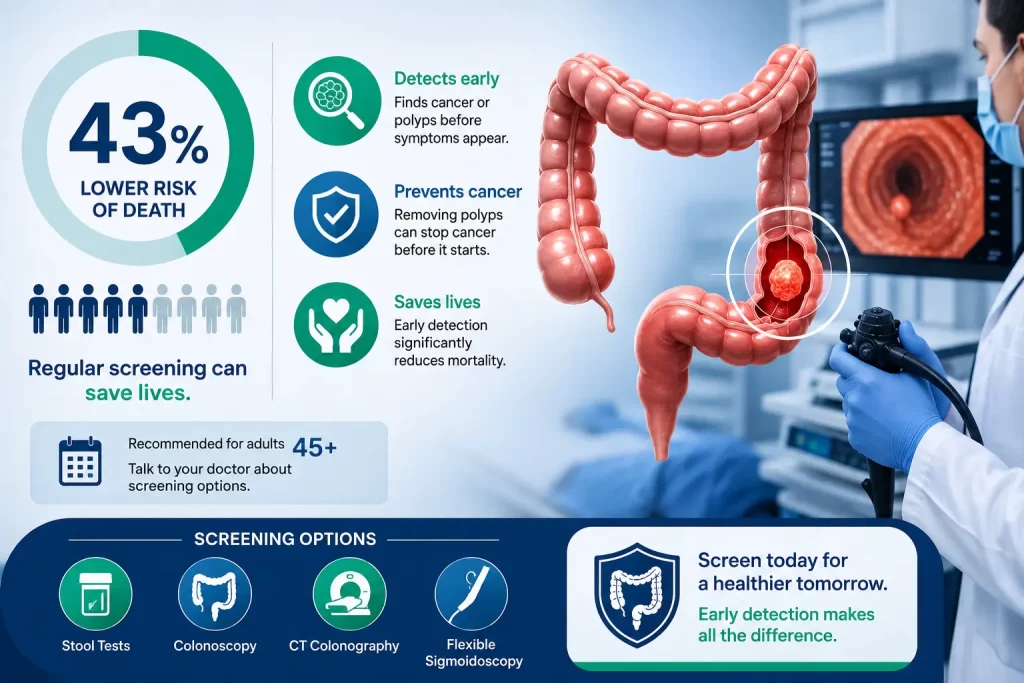
A new Swedish study is giving public health researchers one of the clearest signals yet that a simple, at-home test really can save lives. Researchers at Karolinska Institutet and Umeå University followed more than 376,000 people for up to 14 years and found that those who actively participated in colorectal cancer screening had a 43% lower risk of dying from the disease compared to those who didn’t. The findings, published in JAMA Network Open, add significant weight to ongoing calls for wider adoption of routine screening programs.
What the Study Actually Found
The research drew on data from Sweden’s Stockholm–Gotland screening program, one of the country’s earliest regional efforts, which launched in 2008. Researchers compared people who were invited to screening between 2008 and 2012 against a control group made up of individuals who either received their invitation later or hadn’t been invited at all. By following both groups through Swedish national health registers, the team was able to track the diagnoses and deaths from cancer for a long period of time, in some cases up to 14 years.
In total, the study included 376,511 individuals, and 1,668 deaths from colorectal cancer were recorded during the follow-up window. After adjusting for statistical factors like people in the control group eventually being invited later, or invited individuals never actually participating, the researchers arrived at two separate figures. Simply receiving an invitation to screening was linked to a 26% lower risk of dying from colorectal cancer. But for people who actually completed the screening, that risk reduction jumped to 43%.
Why Participation Made Such a Difference
According to Johannes Blom, one of the study’s authors and a senior consultant involved in the research, earlier evaluations of the program had estimated a more modest 14% reduction in mortality tied to receiving a screening invitation. With longer follow-up data and more refined statistical methods, the benefit tied to actual participation turned out to be considerably larger. It’s a distinction that matters: an invitation alone doesn’t protect anyone. It’s the act of completing the test that appears to drive the bulk of the benefit.
The mechanics of the test itself are fairly straightforward. Eligible residents, generally those between ages 60 and 74, are mailed a screening kit and asked to provide a small stool sample, which is then analyzed for traces of blood not visible to the naked eye. If blood is detected, the person is typically referred for a colonoscopy to investigate further. Colorectal cancer tends to have a much better prognosis when caught early, particularly before it has had a chance to invade deeper into the bowel wall or spread elsewhere, which is exactly the kind of early detection this at-home test is designed to catch.
The Participation Gap Researchers Are Worried About
Despite the test being free and relatively simple to complete, the researchers note that roughly a third of people who are invited never actually submit a sample. That gap is part of what makes this study so relevant beyond Sweden’s borders. If a screening program with strong infrastructure and universal access still sees a third of eligible participants opting out, it raises real questions about how to close that gap, whether through better public messaging, reminders, or simply making the process even easier.
Blom pointed to this participation shortfall directly, noting that the findings highlight the importance of actually completing colorectal cancer screening rather than just being offered the opportunity to do so. The data suggest that there can be a large difference in survival outcomes between an invitation sitting unopened on a kitchen counter and a completed test mailed back.
Strengths and Limitations of the Study
One of the main strengths of the study is its scale. With over 376,000 people followed for over a decade and the extensive national health registers in Sweden, researchers have a level of statistical power that smaller or shorter studies simply can’t match. However, the researchers caution that their results are based on statistical adjustments for various sources of bias rather than on a real-time randomized trial. People who elect to be screened may not be the same as those who do not in ways that cannot be fully controlled for, such as in their overall health habits or contact with the health care system. That means some uncertainty remains, even with the size and rigor of this analysis.
What This Means Going Forward
Colorectal cancer remains one of the most commonly diagnosed cancers worldwide, and this kind of large-scale cancer prevention study offers real-world evidence that population-based screening programs can meaningfully reduce deaths. For health systems weighing whether to expand or improve their own colorectal cancer screening infrastructure, the Swedish results offer a compelling data point: a low-cost, at-home test, when actually completed, appears to be strongly associated with a lower risk of dying from the disease.
The bigger challenge now may not be building the infrastructure but boosting participation. As this research shows, the benefit of screening isn’t just about offering the test. It’s about the roughly two-thirds of people who send their sample back, and finding ways to bring more of the remaining third along with them.
This article discusses cancer screening and mortality research. If you are experiencing anxiety around a personal health situation, it’s worth speaking with a doctor or another healthcare professional who can advise on your individual circumstances.