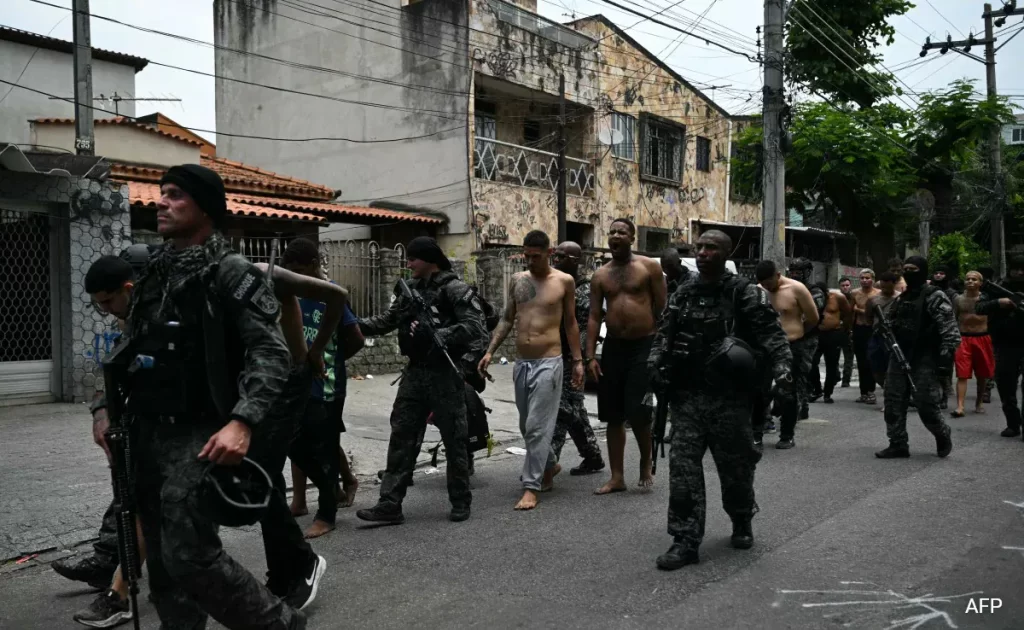
In a dramatic escalation of Brazil’s war on organised crime, state authorities in Rio de Janeiro launched their most lethal operation to date on October 28, 2025, deploying approximately 2,500 security personnel to target the Comando Vermelho (Red Command) network in the favela complexes of Complexo do Alemão and Complexo da Penha. The operation, labelled “Operation Containment”, resulted in at least 64 deaths, 81 arrests and the seizure of dozens of firearms, in what has been described as the most violent police action in Rio’s history.
Authorities indicated that the operation was executed following a year-long investigation aimed at dismantling the Red Command’s expanding territory and trafficking infrastructure. The governor of Rio de Janeiro state, Cláudio Castro, declared that what the state faces is no longer mere “common crime” but “narcoterrorism,” underscoring the gravity of the challenge.
The favelas of Complexo do Alemão and Complexo da Penha have long been strongholds of the Red Command. In this latest offensive, the police deployed helicopters, armoured vehicles and executed around 250 arrest and search warrants. Gang members mounted fierce resistance—blocks of the city were disrupted by barricades, burned vehicles and reports of drones being used to drop explosives on police forces.
From a security policy perspective, the operation reveals both the scale of Brazil’s organised-crime problem and the lengths to which authorities are now going. Analysts point out that while large-scale raids have been common in Rio, the death toll makes this uniquely deadly and raises questions about collateral damage, oversight and long-term efficacy.
The timing is also significant: the operation took place just ahead of major international events in Rio and Brazil, including the C40 World Mayors Summit and the forthcoming COP30 climate summit, leading to speculation that heightened security mandates influenced both the scope and urgency of the action.
The consequences of the raid are manifold. For one, the high death toll, including among police officers, will put renewed attention on human-rights concerns and oversight of police tactics in Brazil’s favelas. The operation may also reshape public perception of crime and security in Rio and could influence the 2026 presidential race, where public safety is already emerging as a key issue.
On the other hand, the scale of the operation and its immediate impact may send a strong deterrent message to gangs, potentially slowing the Red Command’s territorial expansion—at least in the near term. Critical, however, will be what comes next: follow-through arrests, sustainable community engagement and structural reforms in policing. Without these, past raids have shown only repeated cycles of violence.
The October 28, 2025 raid marks a watershed moment in Brazil’s battle with organised crime, representing both a bold escalation in law-enforcement tactics and a flashpoint for debate over strategy, rights and the future of public security. While the immediate results are striking, the longer-term question remains whether such operations will translate into sustained reductions in gang control of urban territories—or simply deeper cycles of violence in the favelas of Rio de Janeiro.