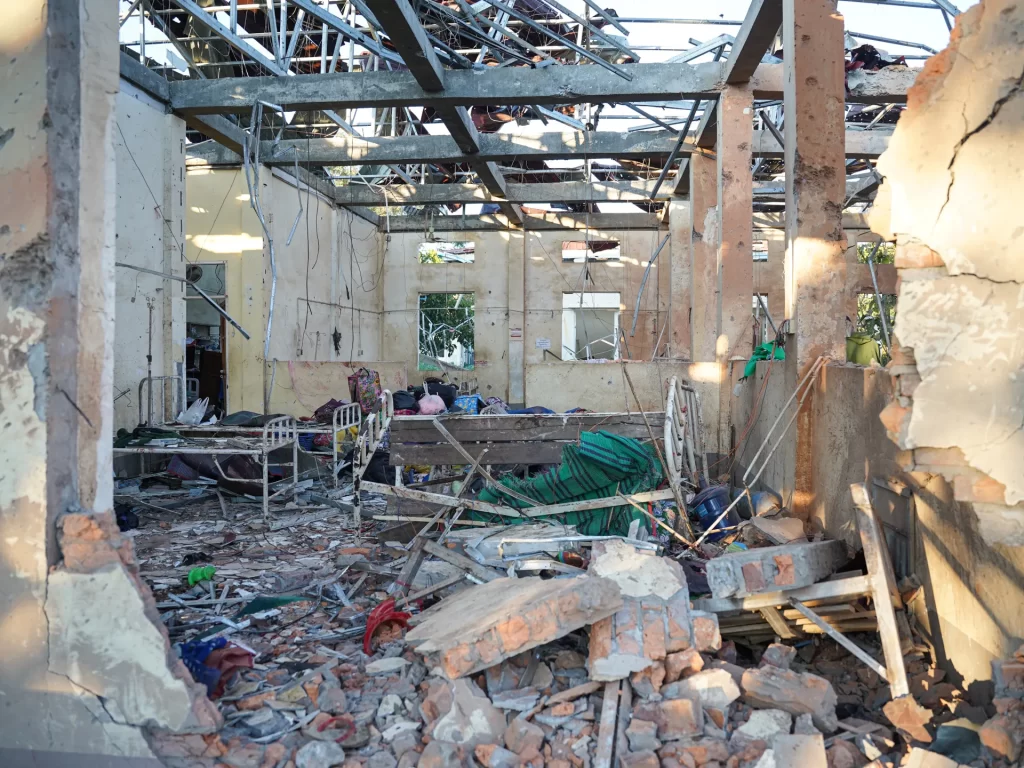
A devastating air strike by Myanmar’s military junta on the Mrauk‑U General Hospital in western Rakhine State on the evening of December 10, 2025, has killed at least 31 people and wounded dozens more, according to aid workers, local sources, and the ethnic Arakan Army (AA) rebel group. The attack—one of the deadliest against a civilian medical facility in the country’s protracted conflict—has intensified international concerns about civilian safety amid escalating hostilities ahead of controversial elections later this month.
Eyewitnesses described scenes of utter devastation as a military jet reportedly dropped bombs directly on the hospital, which was filled with patients at the time of the strike. Local aid worker Wai Hun Aung characterized the aftermath as “very terrible,” with bodies laid out outside the shattered facility and dozens of wounded still being treated under dire conditions. At least 68 people were injured in the explosion, though the toll could rise as rescue operations continue.
Impact on Civilians and Healthcare Infrastructure
The attack on Mrauk‑U’s principal healthcare institution—vital for tens of thousands in a region heavily affected by conflict—has further eroded an already fragile medical system. Rakhine State has witnessed repeated clashes between the Myanmar armed forces and the Arakan Army, an ethnic Rakhine armed group that controls much of the territory. Hospitals and clinics have frequently struggled to remain operational amid ongoing bombardments and shortages of medical supplies.
Key Human Impact Figures:
- Deaths: At least 31 people confirmed, including patients and caregivers.
- Injuries: Dozens wounded, with many in serious condition.
- Critical Facility Damage: Hospital wards, recovery rooms, and support structures destroyed.
In similar incidents over recent months, civilian sites such as markets, tea shops, and villages have suffered from aerial bombardment, underscoring a stark pattern of civilian harm. In one reported episode earlier this December, an air strike on a Sagaing tea shop killed at least 18 civilians, including children.
Conflict Context and Political Calculus
The attack takes place against the backdrop of Myanmar’s deepening civil war, which erupted after the military’s 2021 coup that deposed the democratically elected government. Since then, conflict has spread across multiple states and regions, with ethnic armed organizations like the Arakan Army resisting junta control. The junta has scheduled nationwide elections for December 28, a move it casts as a return to democratic processes; however, opposition fighters have pledged to disrupt voting in areas under their influence.
Analysts note that air strikes by the junta have increased year‑on‑year since the coup, with civilian infrastructure often caught in the crossfire. Despite global condemnation, the regime has not issued any official explanation or apology for the Mrauk‑U hospital bombing.
Humanitarian and Geopolitical Implications
The attack has drawn sharp criticism from international humanitarian organizations and rights advocates who argue that deliberate or reckless targeting of medical facilities violates international humanitarian law. With the Rakhine region already facing severe shortages of food, medicine, and shelter, the destruction of a primary hospital further imperils vulnerable populations.
Community leaders in Mrauk‑U denounced the strike as an “inhuman act,” sorrowfully observing mass funerals and family members mourning their loved ones. As the conflict extends into its fifth year, analysts warn that such episodes could fuel broader displacement and exacerbate regional instability.
Outlook
Beyond immediate rescue and relief efforts, the bombing at Mrauk‑U highlights the urgent need for renewed diplomatic engagement aimed at de‑escalation. Observers emphasize that without meaningful steps toward ceasefire agreements and civilian protection measures, Myanmar’s cycle of violence and suffering—embodied by incidents like the Mrauk‑U hospital strike—may deepen further, with long‑term repercussions for peace prospects and regional security.