
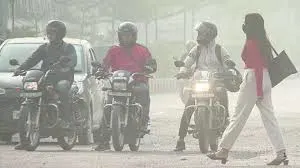
The national capital, New Delhi, has been engulfed in toxic smog for the third consecutive day, with air-quality readings remaining in the “severe” category and prompting warnings from medical professionals. Authorities have launched an investigation into the root causes, while schools and vulnerable populations are being advised to stay indoors as the region battles extremely hazardous conditions.
According to the Central Pollution Control Board (CPCB), many of the city’s monitoring stations recorded Air Quality Index (AQI) levels above 400, placing the region firmly in the “severe” category, which can adversely affect even healthy individuals. The worsening pollution has prompted the Commission for Air Quality Management (CAQM) to impose Stage 3 of the Graded Response Action Plan (GRAP) across the region — including a blanket ban on non-essential construction, curbs on high-emission vehicles and industrial activity. Analysts attribute the spike in pollution to multiple factors: stubble burning in neighbouring states, vehicle emissions, road construction dust, industrial output and adverse meteorological conditions such as temperature inversion that trap pollutants near ground level.
Medical specialists have sounded the alarm, warning of a surge in respiratory and cardiovascular issues as a direct result of the deteriorating air quality. In many hospitals across Delhi-NCR, patients — including children and the elderly — are presenting symptoms such as coughing, wheezing, rapid breathing and aggravated asthma. Health professionals emphasise that prolonged exposure to high concentrations of fine particulate matter (PM2.5 and PM10) can lead not only to lung disease, but also a weakened immune system and increased risk of heart attack or stroke. Meanwhile, residents have been seen wearing masks, limiting outdoor activity and sharing images of clogged air-purifier filters to illustrate the seriousness of the air pollution crisis.
The authorities are investigating the principal sources of this spell of extreme pollution. Forecasting models from the Decision Support System suggest that on one of the critical days, crop-residue burning contributed about 22.5% of PM2.5 levels in Delhi — surpassing vehicle emissions at roughly 15.5%. The Supreme Court has intervened, asking the governments of Punjab and Haryana to submit detailed reports on actions to curb stubble-burning ahead of a hearing scheduled for November 17. Meanwhile, the imposition of GRAP Stage 3 has led to immediate operational restrictions: schools up to class 5 have been directed to switch to hybrid or online mode, and office timings and vehicular traffic patterns are under review. Experts argue that while reactive measures are in place, tackling Delhi’s endemic air-pollution problem will require sustained, long-term policy enforcement and inter-state coordination.

