
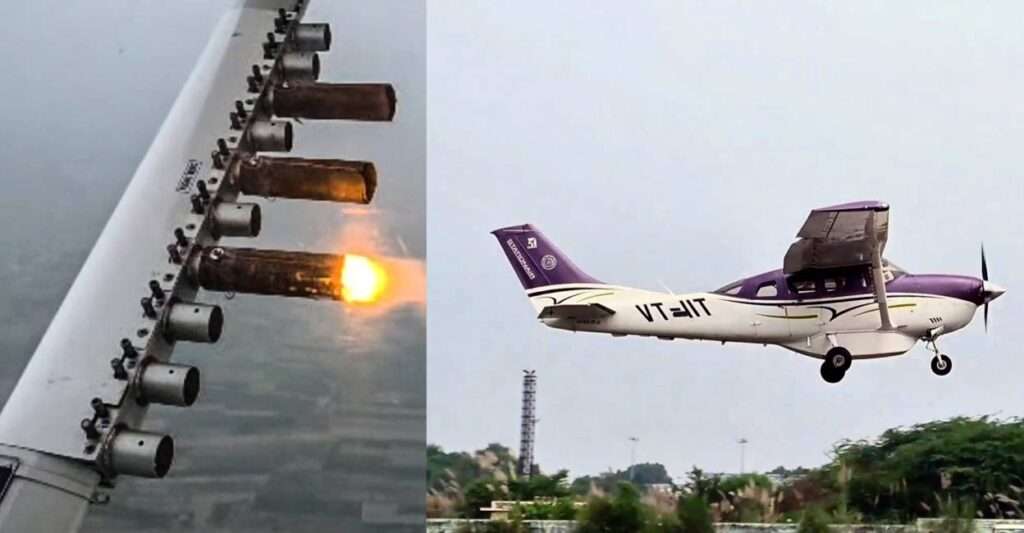
In a bold bid to combat the persistent air-quality crisis in the national capital, the New Delhi government, in collaboration with IIT Kanpur, carried out multiple cloud-seeding operations aimed at triggering artificial rain and reducing smog. Despite the significant investment and high hopes, the experiment failed to produce meaningful rainfall, leaving the city’s air quality largely unchanged. The initiative, marked by an estimated cost of over ₹3 crore, now faces scrutiny from experts questioning its scientific basis and long-term value.
The Delhi cabinet approved the pilot for cloud seeding earlier this year, allocating roughly ₹3.2 crore for five trial flights, each estimated at around ₹60–70 lakh. On 28 October 2025, a small aircraft dispatched from IIT Kanpur fired silver-iodide and sodium-chloride flares over parts of Delhi and its adjoining areas—Burari, Karol Bagh, Mayur Vihar, and the Delhi-Noida border. The stated aim was to trigger rainfall to wash down suspended particulate matter (PM₂.₅ and PM₁₀) and improve the city’s “very poor” Air Quality Index (AQI).
However, the experiment failed to match expectations. No significant rainfall was recorded within Delhi, though negligible precipitation of 0.1 mm and 0.2 mm respectively were noted in parts of Noida and Greater Noida. The key reason cited by meteorologists was the extremely low moisture content in the targeted clouds, reported at just 10–20 percent humidity, far below the ideal threshold for effective cloud seeding.
Officials nonetheless maintained that the trials constitute a “science-first step” in tackling air pollution. The environment minister stated that if favourable results were achieved, the programme would be extended through February.
Meanwhile, atmospheric scientists and pollution experts cautioned against viewing artificial rain as a long-term solution. They argued that such interventions are heavily dependent on specific meteorological conditions, which do not reliably occur in Delhi’s winter climate. Moreover, they emphasized that the root causes of Delhi’s high pollution—crop-residue burning in neighbouring states, vehicular emissions, industrial output, and stagnant winter winds—remain unaddressed.
The recent cloud-seeding trials in Delhi underscore both the ingenuity and the limitations of weather-modification techniques as tools for air-pollution mitigation. While the initiative signalled a proactive stance by the Delhi government and IIT Kanpur, the lack of rainfall despite significant expenditure serves as a pointed reminder: without conducive meteorological conditions and parallel emissions-control measures, technological fixes alone are unlikely to deliver sustained relief. As Delhi continues to confront hazardous air quality each winter, the imperative remains to address systemic pollution sources alongside any emergent interventions. The cloud-seeding effort may thus be viewed not as a definitive answer, but as a provisional experiment—one whose true value will depend on future results and the broader policy response.

