
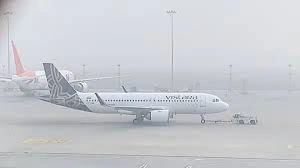
Dense fog continues to pose a serious operational challenge for the aviation sector, significantly disrupting flight schedules and airport efficiency. As winter conditions intensify, reduced visibility caused by persistent fog has led to widespread delays, diversions, and cancellations at several airports. To ensure passenger safety, aviation authorities enforce strict Low Visibility Procedures (LVPs), which, while essential, substantially reduce airport capacity and slow down air traffic movement.
How Dense Fog Impacts Aviation
Fog reduces Runway Visual Range (RVR), a critical parameter for safe aircraft landing and take-off. When visibility drops below prescribed thresholds, airports are compelled to activate LVPs. Under these conditions, aircraft operations rely heavily on advanced navigation systems and precise coordination between pilots and air traffic control.
Only aircraft equipped with Category III Instrument Landing System (CAT III ILS) and operated by specially trained pilots are permitted to land during severe fog. This selective operational capability immediately limits the number of flights that can operate, creating bottlenecks in already congested airspace.
Key Effects of Dense Fog on Airport Operations
- Reduced runway and taxiway visibility
- Activation of Low Visibility Procedures (LVPs)
- Decreased landing and departure frequency
- Increased flight delays and cancellations
- Higher likelihood of diversions to alternate airports
Low Visibility Procedures Explained
Low Visibility Procedures are standardized safety protocols implemented when visibility falls below safe operating limits. These procedures prioritize safety over volume, leading to fewer aircraft movements per hour.
| Aspect | Normal Conditions | Fog Conditions (LVPs Active) |
|---|---|---|
| Runway Operations | High frequency | Significantly reduced |
| Aircraft Eligibility | All certified aircraft | Only CAT III-equipped aircraft |
| Pilot Requirement | Standard certification | Special low-visibility training |
| Airport Capacity | Optimal | Reduced by up to 40–50% |
Operational and Economic Consequences
The cascading impact of fog-related disruptions extends beyond airports. Airlines face increased operational costs due to fuel burn during holding patterns, crew duty-time extensions, and passenger compensation. For travelers, dense fog often results in long waiting hours, missed connections, and uncertainty.
Cargo operations are also affected, particularly time-sensitive shipments such as pharmaceuticals and perishable goods. Repeated fog episodes can disrupt supply chains and impact overall economic activity, especially at major aviation hubs.
Technological and Human Preparedness
Airports have increasingly invested in advanced landing systems, upgraded runway lighting, and improved weather monitoring tools to mitigate fog-related disruptions. However, technology alone is not sufficient. Pilot training, air traffic controller coordination, and ground staff readiness play an equally vital role in maintaining safe operations during low visibility.
Despite these measures, aviation experts emphasize that zero-risk operations are impossible under extreme weather conditions, making temporary capacity reduction unavoidable.

