
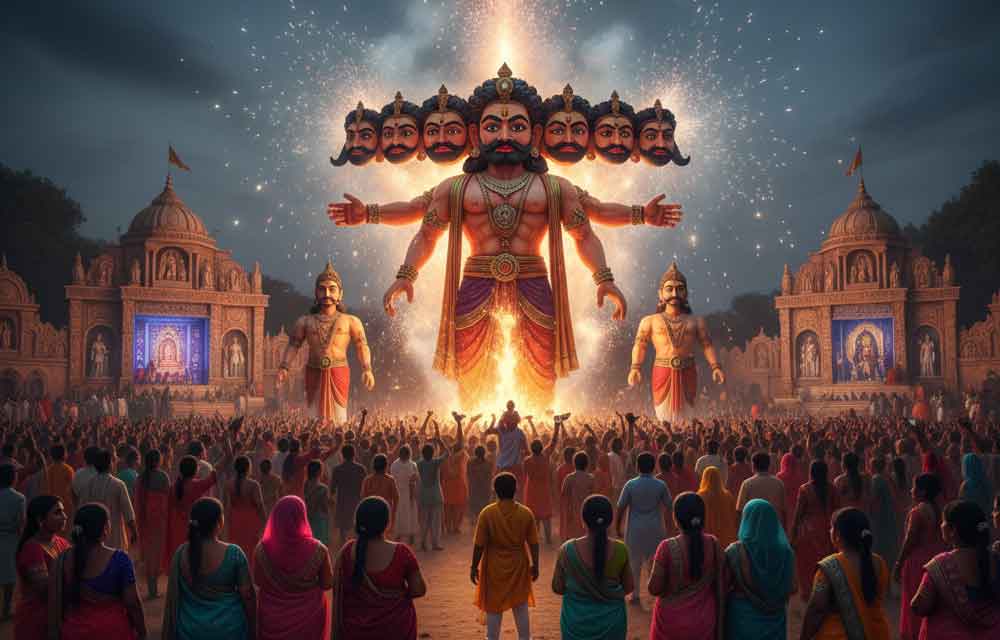
Dussehra, also known as Vijayadashami, is a pan-Indian festival that signifies the triumph of good over evil. In 2025, this auspicious occasion falls on Thursday, October 2, marking the culmination of the nine-day Navratri festival. While the core theme remains consistent, the manner of celebration varies, reflecting India’s rich cultural diversity.
Ramlila: The Northern Spectacle
In northern India, particularly in cities like Delhi, Varanasi, and Ayodhya, Ramlila performances take center stage. These dramatic enactments of the Ramayana depict Lord Rama’s battle against the demon king Ravana. The performances culminate in the symbolic burning of effigies of Ravana, Kumbhakarna, and Meghnath, accompanied by fireworks, signifying the destruction of evil. UNESCO recognized Ramlila as an Intangible Cultural Heritage of Humanity in 2008, underscoring its cultural significance.
Kullu Dussehra: A Himalayan Tradition
In Himachal Pradesh, the Kullu Dussehra stands out for its unique blend of spirituality and community participation. Unlike other regions, the festivities in Kullu commence after Vijayadashami and last for a week. The festival’s origins trace back to the 17th century when the Raja of Kullu invited the deity of Raghunath Temple to participate in a local fair. Today, the event features a grand procession of deities from various temples, traditional folk dances, and a vibrant mela, attracting thousands of devotees and tourists.
Mysuru Dasara: Royal Grandeur
Mysuru, Karnataka, is renowned for its royal Dasara celebrations, which are among the state’s most significant cultural events. The 416th edition in 2025 spans 11 days, deviating from the traditional 10-day duration. The festivities commence with the Nandi Dwaja pooja at Mysuru Palace’s north gate, followed by a floral tribute to Goddess Chamundeshwari. The highlight is the grand procession featuring elephants, including the iconic Abhimanyu, adorned in traditional attire and carrying the deity’s idol in a golden howdah. The city is aglow with decorations, and cultural performances enrich the atmosphere, making it a major tourist attraction during the festival.
Durga Puja: The Eastern Extravaganza
In West Bengal and parts of Eastern India, Dussehra coincides with Durga Puja, a festival dedicated to Goddess Durga’s victory over the buffalo demon Mahishasura. The celebrations are marked by elaborate pandals, artistic idol displays, cultural performances, and community feasts. In Kolkata, the grandeur of the pandals and the immersion processions are major attractions. In Hyderabad, neighborhoods host beautifully decorated pandals featuring intricate idols of Goddess Durga, folk performances, and artistic installations. The celebrations go beyond religious devotion, embracing heritage, art, and eco-conscious themes, drawing diverse crowds of all ages.
Regional Variations: Diverse Celebrations
Beyond these major celebrations, several regions in India have their own unique Dussehra traditions. In Goa, the village of Poriem celebrates with rituals involving Goddess Mahalsa’s symbolic visit to the Valvonti river, a tradition significant for the local community. In Mangaluru, Karnataka, the Kudla Pili Parba showcases the traditional Huli Vesha (Tiger Dance) of Tulunadu, emphasizing the importance of festivals like Dasara in uniting communities and preserving local cultural traditions.
Conclusion
Dussehra 2025 offers a vivid tapestry of traditions, each reflecting the cultural ethos of its region. From the dramatic Ramlila performances in the north to the spiritual processions in Kullu, the royal grandeur in Mysuru, and the artistic expressions in Durga Puja celebrations, the festival underscores India’s rich cultural diversity. As communities come together to celebrate, Dussehra continues to be a testament to the enduring spirit of unity and the triumph of good over evil.

