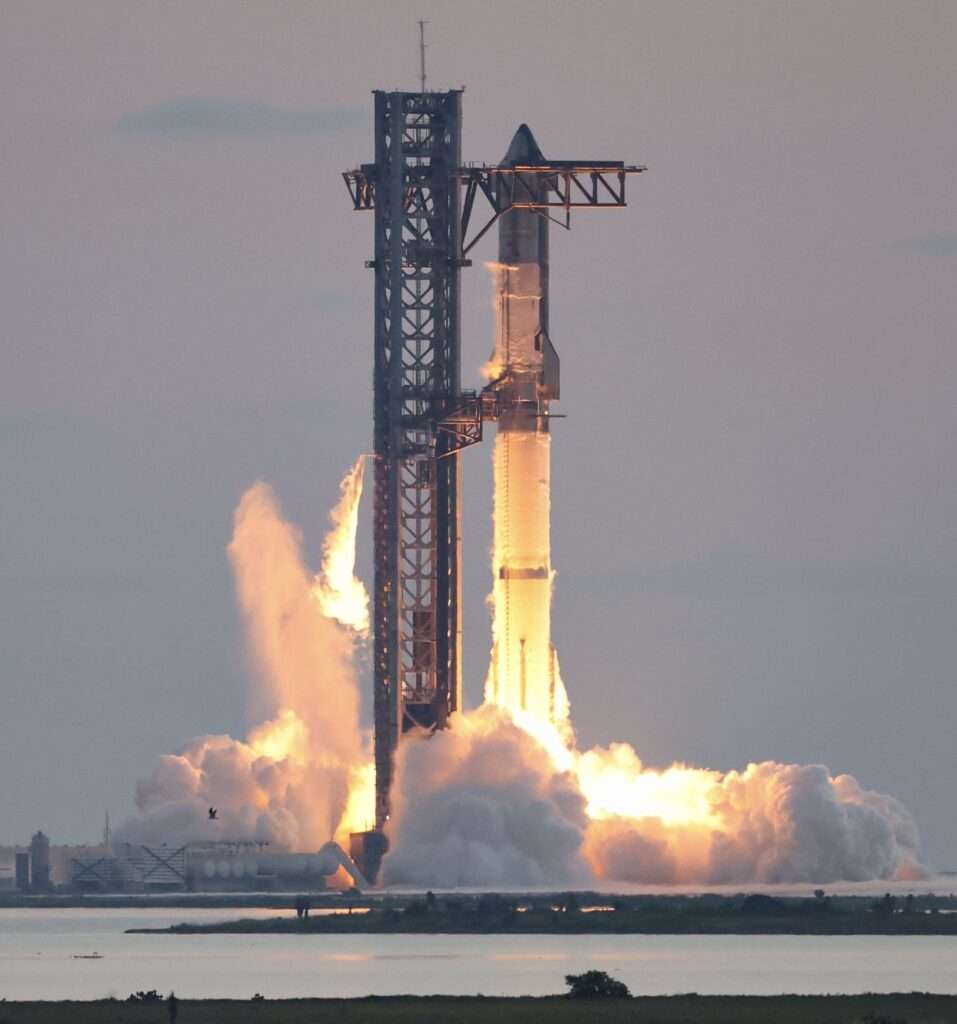
On May 27, 2025, SpaceX’s Starship prototype suffered a catastrophic failure during its ninth test flight, leading to the spacecraft breaking apart over the Indian Ocean shortly after launching from SpaceX’s Starbase facility in Texas. This incident represents a significant hurdle in the company’s pursuit of developing a fully reusable launch system for future deep space missions.
Flight Progress and Malfunctions
The unmanned Starship successfully completed its main engine shutdown as planned, marking progress compared to previous attempts. However, problems arose when the payload bay doors did not open, which prevented the release of test payloads. More critically, a leak in the fuel system caused a drop in pressure inside the main tank during the flight’s coast and atmospheric re-entry stages. This pressure loss resulted in the spacecraft losing stability, spinning uncontrollably until it disintegrated upon re-entry.
The Super Heavy booster, reused from an earlier mission, also failed to land as intended, exploding during its descent into the Gulf of Mexico. Despite these setbacks, engineers reported improved performance of the heat shield, which sustained only minor damage during the mission.
Musk’s Remarks and Future Plans
Elon Musk addressed the failure, highlighting the fuel leak as the key issue behind the loss of control. He expressed confidence in the data collected during the flight, which will be essential for refining Starship’s design. Musk also announced plans to increase the frequency of Starship launches to roughly once every three to four weeks, demonstrating SpaceX’s commitment to rapid development through iterative testing.
Implications for Space Exploration
Starship is central to SpaceX’s goal of lowering launch costs and enabling missions beyond Earth orbit, including crewed flights to the Moon and Mars. Each test flight, even those ending in failure, provides critical information that helps engineers improve the spacecraft’s capabilities.
NASA’s Artemis III mission, which aims to return astronauts to the lunar surface, depends on the successful development of Starship technology. Thus, resolving current technical challenges remains a top priority for SpaceX and its partners.
In conclusion, while the recent test flight did not meet its objectives, the knowledge gained moves SpaceX closer to creating a reliable, reusable spacecraft designed for interplanetary travel. The company’s emphasis on frequent launches and continuous learning underlines its dedication to achieving these ambitious goals.