
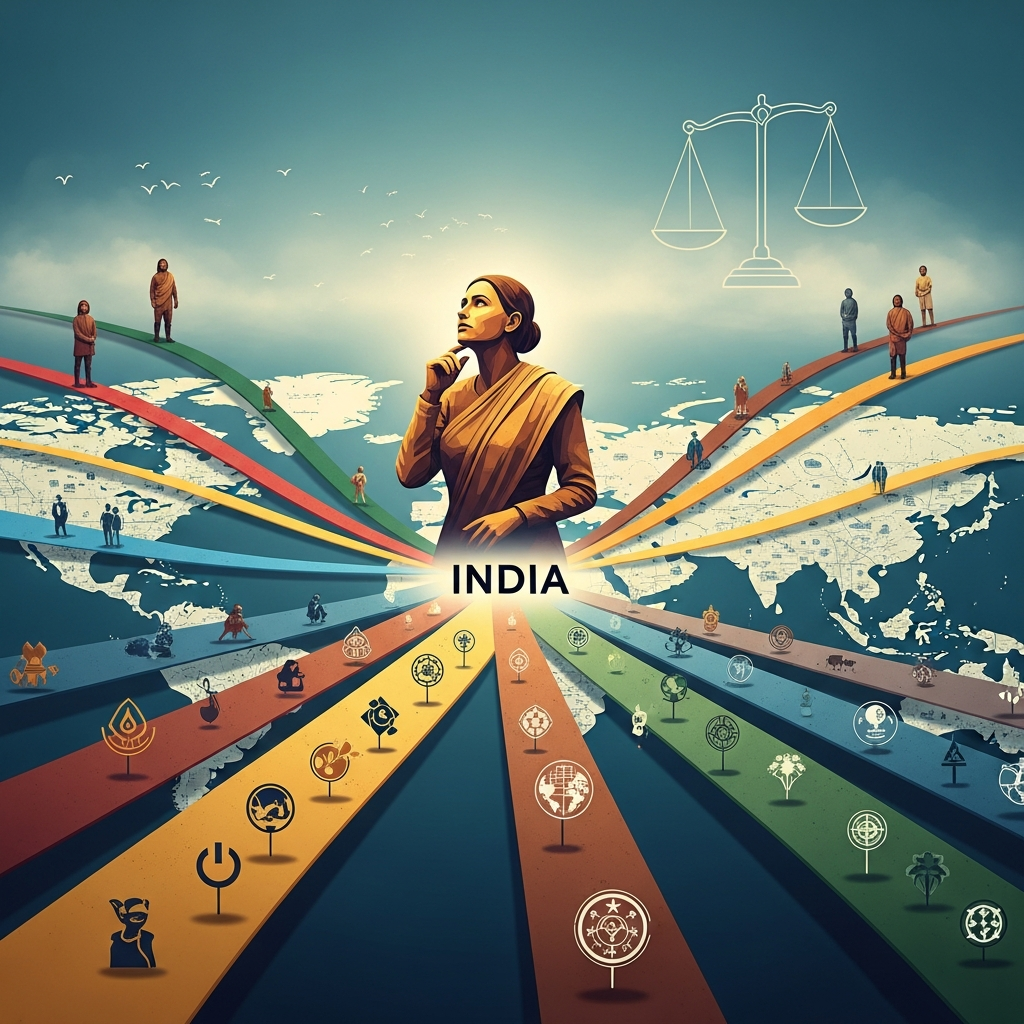
India’s foreign policy, a carefully constructed edifice of friendship without the weight of formal obligations, is now under unprecedented strain. As global tensions rise and powerful nations demand explicit allegiances, the very strategy that has defined India’s diplomatic approach is being examined in ways its architects probably never anticipated.
There is an old diplomatic principle that India has quietly made its own over the past seven decades: never let anyone else write your foreign policy for you. Since the days of Jawaharlal Nehru and the Non-Aligned Movement, India has operated with an instinctive resistance to being told which side of a global argument it must stand on. This posture — what diplomats call strategic autonomy — has served the country remarkably well through Cold War stand-offs, regional conflicts, and the shifting tectonic plates of great-power competition.
But the world of 2026 is testing that posture in ways that are harder to navigate than anything that came before. Conflicts in the Middle East and Europe have deepened. Climate negotiations, technology standards, and global trade frameworks are all becoming arenas of geopolitical competition. And the space in between — the comfortable, productive middle ground that India has always preferred to occupy — is shrinking with each passing year. India’s foreign policy is not broken. But it is under review, and the conversation happening inside diplomatic and policy circles right now is both urgent and genuinely consequential.
The Art of Balancing — and Its Rising Cost
India’s global strategy has always rested on a deceptively simple foundation: cultivate strong relationships with as many major powers as possible, avoid formal military alliances that constrain your options, and use your size, market, and strategic geography as leverage to extract the best possible terms from everyone. In practice, this has meant buying Russian defence equipment while deepening security ties with the United States. It has meant being a founding member of the Quad while maintaining dialogue with China despite border tensions. It has meant trading with Iran while partnering with Gulf Arab states that view Tehran with deep suspicion.
For a long time, this approach worked because the major powers were willing to tolerate India’s studied neutrality in exchange for access to its massive and growing market, its geopolitical weight in the Indo-Pacific, and its democratic credentials in a region increasingly contested by authoritarian influence. The implicit bargain was: India doesn’t have to choose, as long as India remains valuable to everyone.
What analysts are observing now is that this bargain is becoming harder to maintain. The US and its allies have grown more explicit about their expectations of partners in a world defined by great-power competition. Russia’s deepening isolation has complicated India’s long-standing defence ties with Moscow. China’s assertiveness on the border — the Galwan clash of 2020 left scars that have not fully healed — has made it difficult to treat Beijing simply as an important economic partner. Every major development in international relations is quietly forcing a recalibration of choices that India once had the luxury of deferring.
Where the Pressure Is Coming From
Three broad pressure points are currently driving the review of India’s diplomatic positioning. The first is energy and sanctions. India’s decision to continue purchasing discounted Russian oil after the Ukraine invasion drew significant criticism from Western capitals, even as New Delhi argued — not unreasonably — that it was acting in the economic interest of its 1.4 billion citizens and that it was not bound by sanctions it had not voted to impose. That argument bought India time, but it has not made the underlying tension disappear.
The second pressure point is technology and supply chains. As the United States and its partners move to restrict China’s access to advanced semiconductors and build alternative technology supply chains, India is being actively courted as a manufacturing and investment destination. This is, on the surface, an opportunity. But it comes with expectations — about regulatory alignment, about data governance, about the degree to which India’s technology ecosystem moves into the Western orbit rather than maintaining its current studied openness to multiple systems.
The third is security architecture. India’s international relations in the Indo-Pacific are evolving rapidly. The Quad — the grouping of India, the US, Australia, and Japan — has grown significantly in ambition and visibility since its revival in 2017. India has been careful to frame Quad as a platform for positive cooperation on issues like vaccines, infrastructure, and maritime security rather than as a military alliance. But the line between the two is blurring as security concerns in the region intensify, and India will eventually have to decide how far it is willing to go.
What India Is Quietly Getting Right
It would be a mistake, however, to read the current moment purely as a story of India being squeezed. Beneath the pressure lies a significant and underappreciated truth: India’s geopolitical value has never been higher, and New Delhi is well aware of that fact. The country’s G20 presidency in 2023 was executed with considerable diplomatic skill, positioning India as a bridge between the Global South and the developed world at a moment when that bridge is urgently needed. Its voice on issues from climate finance to digital public infrastructure carries genuine weight.
India’s diplomacy has also been quietly effective at using the competition between major powers to its own advantage. When the US court India more energetically, India secures better technology transfer deals. When Russia needs India to maintain some semblance of normalcy in its international relationships, Moscow becomes more flexible on defence pricing and supply terms. When China seeks to keep India from fully aligning with Washington, Beijing shows greater willingness to engage on border management. Strategic autonomy, in this reading, is not weakness or indecision — it is leverage, carefully maintained.
The Road Ahead: Clarity Without Capture
The review of India foreign policy that analysts are observing is not a crisis of direction. It is, more accurately, an upgrading of complexity — a recognition that the strategies that served India well in a more forgiving international environment now need to be sharper, more proactive, and better resourced. The country’s foreign service, stretched thin relative to the demands placed on it, needs investment. Its economic diplomacy, still far less sophisticated than its political diplomacy, needs deepening. Its messaging to the world about what India stands for — beyond the compelling but abstract language of multipolarity and strategic autonomy — needs articulating with greater clarity.
The fundamental instinct, though — to remain sovereign in its choices, to avoid being captured by any single power’s agenda, to balance security and economic interests across multiple partnerships — is unlikely to change. Nor should it. In a world where the major powers are asking everyone to pick a side, India’s refusal to be anyone’s satellite is not just a diplomatic tradition. It is, for a country of its size and diversity and democratic complexity, a necessity.

