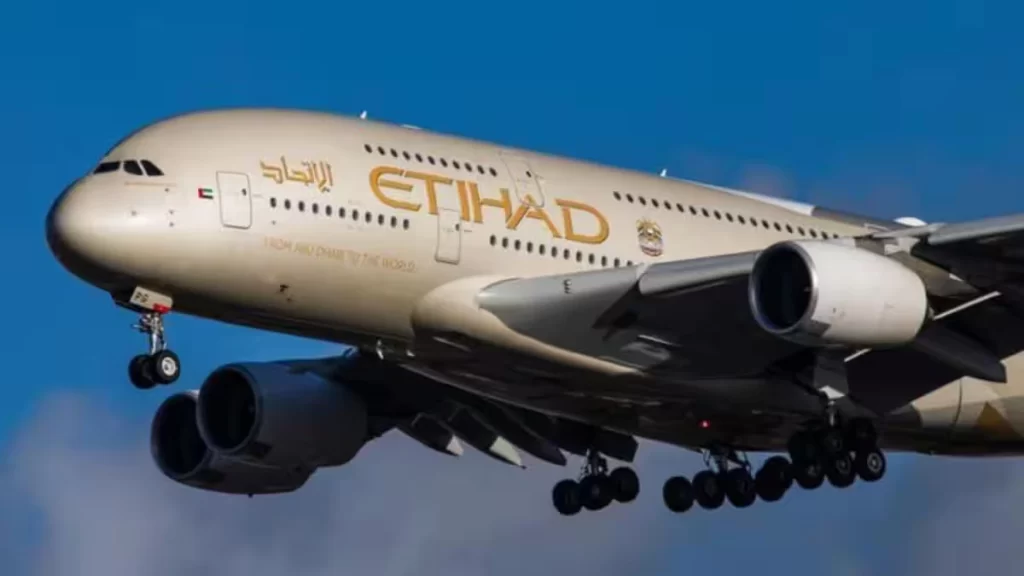
An Etihad Airways flight headed for Abu Dhabi was dramatically halted at Chennai International Airport on Monday when pilots saw fire in the left wing of the aircraft as it was prepared to take off. All 280 passengers were safely evacuated and airport fire officials quickly extinguished the inferno — but the event has once again brought aviation safety regulations in South India under the spotlight.
— ### A Near Miss on the Runway
By any measure, it was a terribly disturbing moment. Bags were stowed, seatbelts buckled, some 280 people sat on the Etihad Airways plane, probably thinking about arrivals and subsequent journeys – and then everything stopped. The aircraft was in the pre-departure phase on the tarmac at Chennai International Airport when the flight crew spotted something alarming – fire on the left wing.
The pilots acted without delay. The take-off was interrupted before the aircraft had any speed and the plane was stopped. Airport fire department personnel were called and arrived at the aircraft within a short time and extinguished the fire before it could spread. All passengers were safely removed and airport officials confirmed the incident had caused no injuries.
Then the flight to Abu Dhabi was called off. Etihad Airways has not yet issued an official statement and airport authorities have not officially released the precise cause of the wing fire.
— ## The state of the art
The event took place on Monday, May 12, 2026, at Chennai International Airport – one of India’s busiest airports and a major entry point for visitors to the Gulf region. The Etihad Airways flight, operated by the United Arab Emirates national carrier based in Abu Dhabi, had about 280 passengers on board when the emergency was announced on the ground.
Here’s a basic rundown of what airport officials confirmed:
Left wing fire discovered by pilots as aircraft was ready for take-off
Immediately the take-off was aborted as a precautionary measure
Airport fire services acted quickly and put out the fire
– All passengers safely evacuated and no injuries reported
– Scheduled flight Abu Dhabi was officially cancelled.
The cause of the fire has yet to be determined by aviation authorities
The crew’s quick and immediate response probably averted what could have been a disastrous disaster. Even minor fires on the wings of an airplane are extremely dangerous, especially in the high-pressure, fuel-heavy phase of take-off preparation.
— ## The Importance of Wing Fires in Aviation Emergencies
To comprehend the seriousness of what happened in Chennai, it helps to have some idea of the design of airplane wings and what they carry. On a commercial plane, the wings are not just structural members, but also store the fuel tanks. A large percentage of an aircraft’s onboard fuel is held within the wing structure, making any fire in or around that location a very high-priority emergency.
A tiny spark kept burning too long, even a few seconds, can multiply exponentially. That is why aviation safety regulations require pilots to abort take-off promptly if any such indication is seen below a certain speed, and why airport fire services are on standby during all departure and landing operations at large airports.
That it was the pilots themselves who spotted the fire and not some ground crew member or an alert system is a testament to the vigilance that aviation experts operate under. Whatever the cause of the fire – whether it was a mechanical failure, a gasoline leak, an overheating component or some other technical cause – investigators will now have to track it back to its source.
Could the incident have ended substantially differently if the fire had been noticed even a minute later, or if the crew had stopped before aborting the take-off? It’s a question that makes us conscious of how much depends on those split-second judgment calls.
— ## Chennai Airport Emergency Response: Successful Protocols
Chennai International Airport (IATA: MAA, ICAO: VOMM), often known as Chennai Airport, is an international airport serving the city of Chennai, Tamil Nadu, India. It is a major hub in India’s aviation network, especially for international routes to the Middle East, Southeast Asia and beyond.”
The airport has 24 hours fire and emergency services as per the requirements of Directorate General of Civil Aviation (DGCA) and the safety standards laid forth by International Civil Aviation Organisation (ICAO). Monday’s occurrence seems to be a case of those protocols functioning just as they were planned.
Fire tenders were mobilised swiftly, the fire was contained, passengers were evacuated in an orderly manner and the airport’s other flight operations were not reported to have been seriously disrupted. It’s this kind of response — rapid, organized and calm — that comes from considerable training and regular emergency simulations airport authorities do year round.
It is also worth mentioning that aircraft on the ground fires are, in an existential sense, the easier case than mid-air emergencies. The crew was fortunate to be on the ground, with emergency services physically near and passengers able to get out using normal exits, not emergency slides.
— #Etihad Airways India Operations
Etihad Airways is the national airline of the United Arab Emirates, headquartered in Abu Dhabi, and is one of the most significant airlines flying international flights to and from India. The airline offers a number of daily services from Indian cities like as Chennai, Mumbai, Delhi, Hyderabad, Bengaluru, Kochi and others to Abu Dhabi and beyond to Europe, North America and Australia.
The Chennai-Abu Dhabi route is particularly important given the number of Indian workers, professionals and families travelling between Tamil Nadu and the UAE. The corridor is a busy one all year round and an occurrence such as Monday’s will certainly raise concerns for those who traverse the route regularly.
Etihad has had a solid safety record overall and events of this sort, while troubling, do not instantly indicate systematic safety failures. Every aircraft incident is initially considered as an individual event until investigations show wider patterns. Any formal probe would examine the airline’s maintenance practices, the service history of the particular aircraft, and the technical circumstances of the incident on Monday.
— ## Aviation Safety in India: The Bigger Picture
India’s aviation industry has had remarkable expansion over the past decade and continues to be one of the fastest growing commercial aviation industries globally. That development is coming with more and more questions about safety standards, maintenance procedures and emergency readiness – not just for Indian carriers but for all international airlines operating in Indian airspace and utilizing Indian airports.
India’s civil aviation authority, DGCA, has increased its scrutiny on domestic and international airline operations in recent years. It can investigate any incident that occurs on Indian soil, no matter whether airline is involved, and issue directives based on the results.
Incidents such as Monday’s Etihad incident at Chennai tend to trigger a review process at multiple levels: the airline’s own internal safety review, any investigation initiated by the Indian aviation regulator, and potentially a report submitted to ICAO’s global safety database, which helps aviation bodies around the world track and learn from incidents.
The Indian aviation industry is extremely challenging in terms of size and diversity. There are scores of airlines, domestic and foreign, operating hundreds of routes and thousands of flights a day. Maintaining safety standards across that ecosystem requires not only robust regulation, but real cooperation between airlines, airports and government organizations.
— ## What Passengers Ought to Know
That Etihad aircraft Monday morning was certainly a terrifying experience for the 280 passengers on board. Being asked to get off an airplane is unpleasant under any circumstances – frequently without a clear explanation in those first hectic minutes – and knowing that a fire was seen on the wing adds a specific kind of shock.
Passengers whose flights are cancelled as a result of safety incidents are provided with some rights under airline policy, and sometimes applicable regulations. In most situations this means putting you on the next available flight, assisting with finding lodging if the delay is considerable and sometimes offering compensation. Etihad Airways said travelers affected should contact the airline directly for clarification on their options.
And it is also worth noting – and it does matter – that the crew’s quick decision to abort the take-off, and the airport’s emergency response, almost probably meant that what could have been a disaster was a close call with a safe conclusion. In aviation terminology, that’s the system doing its job.
— ## What is Next
As the dust settles over Chennai airport and investigators get down to work to ascertain exactly what led to the fire breaking out on the left wing of the Etihad aircraft, several questions remain outstanding. What was the technical cause? Were there any prior maintenance flags on that aircraft? Had they missed any pre-flight checks? And what will the airline and the airport do to prevent a similar scenario from happening again?
These are questions that will take time to address well. What is certain is that a potential aviation calamity was averted on Monday morning, owing to the sharp-eyed pilots, trained fire services and processes created for occasions like these.
Incidents like this remind the travelling public that although air travel continues to be statistically the safest of all long-distance transportation, the safety record it enjoys is no accident – but a product of constant vigilance, rigorous training and a culture of preparedness that aviation demands at every level.
The aviation authorities are anticipated to complete the probe into the Chennai wing fire in the next several days and weeks. Until then the attention is squarely on the result that really matters: all 280 people went away safe.
—
*This material has been prepared from information available from airport officials and press reports as of May 12, 2026. Etihad Airways has not yet responded at the time of publication. The incident is currently being investigated.*
Fire On Wing Causes Etihad Airways Flight To Abort Take-Off At Chennai Airport; 280 Passengers Safely Evacuated