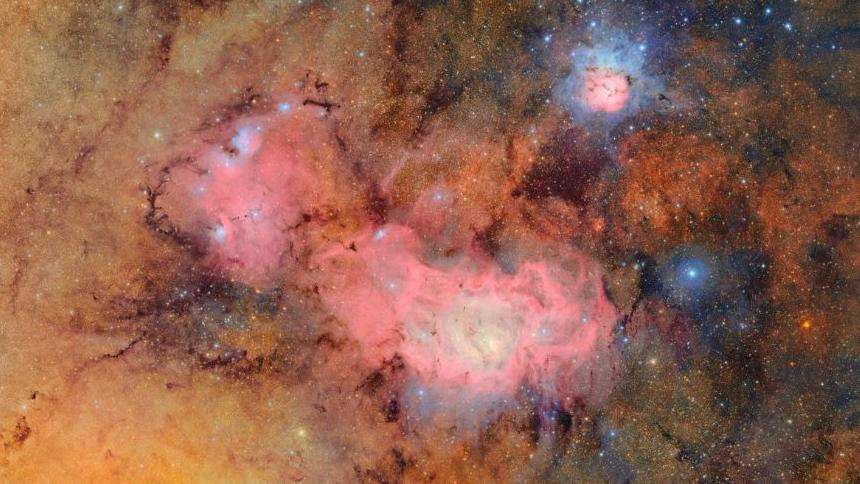
June 2025 — The Vera C. Rubin Observatory has unveiled the first images captured by the world’s most powerful digital camera, the LSST (Legacy Survey of Space and Time) camera. Installed atop Cerro Pachón in Chile, the LSST camera marks a significant advancement in astronomical observation and data collection.
With a massive 3.2-gigapixel sensor, the LSST camera is the largest ever built for ground-based astronomy. It can capture high-resolution images with an ultra-wide field of view — capable of photographing an area seven times larger than the full Moon in a single shot. The camera, roughly the size of a small car and weighing over three tonnes, is now entering its final testing phase before full-scale operations begin in 2025.
The initial images demonstrate the camera’s extraordinary capability to detect faint and distant celestial objects. Scientists and engineers describe the images as “breathtaking” and “historically significant,” as the camera is expected to generate approximately 20 terabytes of data each night during its 10-year sky survey.
The Legacy Survey of Space and Time will repeatedly scan the southern sky, allowing astronomers to observe and analyze billions of galaxies, track near-Earth asteroids, and investigate transient events such as supernovae. The project also aims to address fundamental questions in cosmology, particularly the mysteries of dark matter and dark energy.
Named in honor of pioneering astronomer Vera C. Rubin, the observatory is jointly funded by the U.S. National Science Foundation and the Department of Energy. Rubin’s work played a pivotal role in proving the existence of dark matter, making the LSST’s mission a fitting tribute to her legacy.
“The clarity, depth, and scale of these first images are unmatched,” said Dr. Aaron Roodman, Deputy Director of the Rubin Observatory. “This camera will transform how we explore the universe — not just deeper and further, but faster and with more detail than ever before.”
The LSST camera is equipped with a sophisticated cryogenic cooling system that minimizes sensor noise, further enhancing image quality. Its ability to capture the dynamic sky — spotting changes and movement in space — represents a major leap for time-domain astronomy.
The observatory’s full-scale operations are set to commence in early 2025, promising a decade of groundbreaking data that will be accessible to researchers and the public alike. With the LSST camera now fully operational, astronomers around the world are preparing for an unprecedented journey into the cosmos.