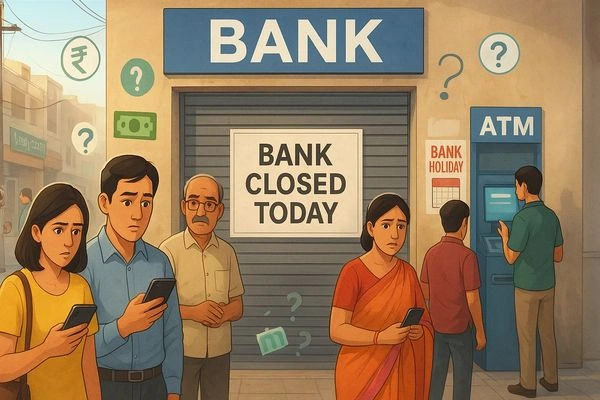
New Delhi, February 28, 2026—As India enters the last weekend of February, millions of Indians with bank accounts are dealing with a problem they know all too well: all banks in the country are closed today for the fourth Saturday bank holiday. Today is a normal bank holiday in India, which surprises a lot of people because it’s the end of the month and there are a lot of payments, wage credits, and other things to accomplish. In this digital age, though, more and more people are adopting digital banking to keep their money moving without skipping a beat.
The fourth Saturday bank shutdown isn’t just a tiny problem; it’s a big surge in Google Trends searches for “utility.” This shows how busy Indians are with paying their bills, getting cash, and making their EMIs.UPI payments, mobile banking apps, and internet banking have to make up for the fact that all of the country’s physical offices are closed. This includes Bandra in Mumbai, Pune’s innovation areas, and Kolkata’s ancient avenues. This article goes into a lot of detail on the history of this bank holiday, why it’s important, and what experts think are the best digital banking options to make sure your transactions in India go smoothly at the end of the month.
The tale of India’s Fourth Saturday Bank Closure: A history of how to reconcile work and life
There are holidays in India’s banking calendar on national, regional, and weekend days. Every state has closed banks on the fourth Saturday of every month since 2015.The RBI modified the regulations of the Negotiable Instruments Act, 1881 to make it easier for bank workers to balance their work and family lives and save money on running costs. Every fourth Saturday of the month, all public and private sector banks, even big ones like State Bank of India (SBI), HDFC Bank, ICICI Bank, and Punjab National Bank, close their branches. This is the second time this year that this has happened, after January. February 28, 2026, is today.
Section 25 of the Negotiable Instruments Act allows states set holidays, and this rule follows that. But the RBI makes it a regulation for everyone in the country. The Indian Banks’ Association (IBA) says that closing banks for brief periods of time saves them about 5–7% of their annual operating costs and protects employees from being burned out. But it makes things crazy for clients during peak times like the end of the month, when 70% of paying Indians do business, according to a 2025 RBI Financial Stability Report.
Changes in a few areas are making things harder. The fourth Saturday is always the same, but states like Maharashtra (where Pune and Mumbai are) get extra days off for festivities like Mahashivratri, which makes the effect even stronger. The RBI’s list of holidays for 2026 says that there will be 15 to 20 of these closures, and Sundays will be one of them.
Why do deals happen at the end of the month? Holidays at the Bank: India’s 1.4 billion people are quite busy at the end of the month. Corporate paychecks go into accounts between the 25th and 30th of each month. This sets off a chain reaction of credit card payments, EMIs, and utility bills. NPCI said that at this time of year, there are over 1.5 billion UPI transactions every day, which is 45% more than last year. People have to wait in line at ATMs because branches are closed and there isn’t enough cash in some places. This is especially true in Tier-2 towns like Pune, where just 65% of people make digital payments compared to 85% in Delhi.
The tale of India’s Fourth Saturday Bank Closure: A history of how to reconcile work and life
There are holidays in India’s banking calendar on national, regional, and weekend days. Every state has closed banks on the fourth Saturday of every month since 2015.This makes things more urgent and motivates people to find solutions that don’t cause any problems.
Experts agree with this.Rajesh Mirjankar, a fintech analyst, says that the fourth Saturday bank closure shows how India’s banking system is both physical and online: branches for trust and branches for speed. After the UPI regulations come into effect in 2023, a lot of people started using them, although a lot of people still don’t know about them. M. Rajeshwar Rao, the Deputy Governor of the RBI, said in a recent speech, “Digital infrastructure must evolve to make bank holidays irrelevant for transactions.”
UPI is the best way to do your banking online right now.
Don’t worry; the bank holiday today won’t mess up your plans because there are so many great digital banking options. Here is a list of the most trustworthy choices, along with some useful statistics for easy reference:
UPI Payments is the greatest way to send money right away. It has a daily maximum of ₹1–2 lakh and is best for P2P and bills. 85% of people use it.
In January 2026, Unified Payments Interface (UPI), which is run by NPCI, handled 14.04 billion transactions. It went up by 55% from the year before. You can send money to other people, pay bills, and scan stores with apps like Google Pay, PhonePe, and Paytm without having to log in to your bank account. Tip: Linking your bank account to BHIM is free. UPI volumes went up by 30% during the closure in February, which indicates how strong it is.
Full-Service Powerhouses in Mobile Banking Apps (Daily limit: ₹5–10 lakh; Best for: EMIs and FDs; 70% of users say it’s the best
You can go to SBI (YONO), HDFC (PayZapp), and ICICI (iMobile) any time of day or night, seven days a week. You can transmit money (up to ₹5 lakh through IMPS or NEFT), put money in fixed deposits, and pay off loans. There are 80 million people who use the SBI YONO app, and downloads are up 25% in 2025. It can’t be hacked because it contains biometric scanning and two-factor authentication (2FA). According to KPMG’s report, mobile banking would rise by 40% every year until 2030.
Internet Banking Portals: For High-Value Deals (Daily limit: Unlimited with caps; Best for: Investments; Adoption rate: 55%)
Forget about banks; Axis Bank’s Internet Banking can handle RTGS/NEFT up to ₹10 lakh, which is more than UPI restrictions. Great for paying off big expenses or putting your money to work at the end of the month. RBI’s 2025 data shows that 60% of people who use online banking enjoy it for difficult activities and that it is always available on holidays.
ATM and card networks: receive cash when you need it. ATMs, on the other hand, stay open even when branches close. White-label ATMs like Hitachi and India1 Payments are always operational. You can use your Visa or Mastercard to pay without having to touch 12 million PoS terminals. You can only take out ₹50,000 in cash from cards per day.
New fintechs and wallets: Small solutions (Daily limit: ₹10,000; Best for rapid top-ups; Adoption rate: 45%)
You can put money into your Amazon Pay, Mobikwik, or Freecharge wallet to pay bills or add money to your account. Gen Z likes the Navi and Jupiter apps because they mix neo-banking with accounts that don’t have any money in them.
By properly handling 98% of the rerouted traffic, these technologies helped save the Diwali celebrations from going down in 2025.
Problems and the Path to a Future Without Cash
Things are improving, yet there are still issues. CERT-In states that cybersecurity dangers went up by 28% in 2025, and phishing attempts were aimed at UPI users. 52% of rural areas have internet access, which means that 400 million people don’t. What did the RBI say? The 2026 Digital Payments Roadmap says that UPI 2.0 should be linked to Aadhaar and that AI should be used to find fraud.
The government programs PMJDY (which has 500 million accounts) and GPay’s move into rural areas are helping to fill up the gaps. Fintech finance reached $2.5 billion in 2025, which led to new ideas like banks that you can talk to.
Experts think that by 2030, 90% of all transactions would be done online. Because of this, it won’t matter much that the bank is closed on the fourth Saturday. Arvind Subramanian, an economist, remarked that “bank holidays will turn into ‘digital wellness days.'”
Fourth Saturday Closure Hits India: Bank Holiday Alert – The Best Digital Banking Alternatives for Smooth Month-End Transactions