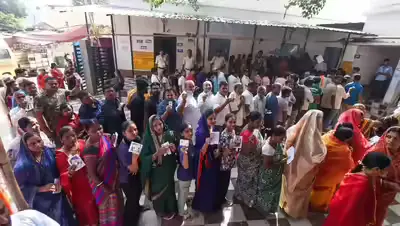
The first phase of the 2025 Bihar Legislative Assembly election concluded today in 121 constituencies across 18 districts, registering a record-high voter turnout of 64.66%. Amid vigorous campaigning by Prime Minister Narendra Modi and Union Home Minister Amit Shah for the ruling National Democratic Alliance (NDA), as well as strong opposition rhetoric from the Indian National Congress and Rashtriya Janata Dal (RJD), the elevated participation underscores the intensity of the political contest and the electorate’s engagement.
The turnout figure of 64.66% marks the highest ever recorded in the state’s history for an assembly election phase. According to the Election Commission of India, more than 3.75 crore voters were eligible in this first phase, setting a new benchmark for participation. Notably, women voters and rural constituencies displayed marked upticks in turnout, reflecting increased political engagement among traditionally underrepresented groups.
For the NDA, the high turnout—anchored by active campaigning from Modi and Shah—is being interpreted as an endorsement of its developmental agenda and governance record. Senior leaders argued that a large voter footprint strengthens the incumbency argument and may energise the coalition’s prospects in subsequent phases. Modi, addressing a rally in Muzaffarpur, stated that the “unprecedented participation of voters” was a sign of confidence in the NDA’s policies of “growth and stability.”
Conversely, the opposition sees the turnout surge differently. Leaders from the Congress and RJD interpret the heightened voter engagement as a call for change rather than continuity. They believe the willingness of voters to turn out in large numbers signals dissatisfaction with the status quo and a desire to alter the political equation. RJD leader Tejashwi Yadav, speaking to the media, remarked that “people are voting for badlav (change), not vikas (development) slogans that have failed to reach the poor.”
Analysts note that a jump in turnout of more than five percentage points from the previous election phase has historically been a hallmark of anti-incumbency waves in Bihar. In 2020 and prior contests, lower turnout figures correlated with more stable outcomes, whereas such spikes often suggest volatility and a shifting mood among voters. The combination of high youth participation, female turnout, and competitive local contests may reshape conventional voting patterns.
The electoral dynamics also included moments of tension. While polling concluded peacefully in most areas, there were isolated incidents of violence, including an attack on the convoy of Deputy Chief Minister Vijay Kumar Sinha. Opposition parties alleged irregularities such as power cuts at booths where the Mahagathbandhan was perceived to have strong support, though election authorities dismissed these claims as unfounded.
The first phase covered several key constituencies with high-profile candidates, including Tejashwi Yadav of the RJD from Raghopur, folk singer-turned-politician Maithili Thakur contesting for the BJP at Alinagar, and Samrat Choudhary representing the NDA from Tarapur. Their constituencies witnessed intense campaigning and significant voter enthusiasm, suggesting that local factors continue to play a decisive role in Bihar’s electoral politics.
The robust turnout in the first phase of Bihar’s assembly election sets the stage for a fiercely contested remainder of the process. For the NDA, the challenge will be converting turnout into seats and maintaining momentum; for the opposition, the high participation offers hope of a mandate for change. Ultimately, the numbers themselves may reflect not simply who showed up, but why they turned up—whether for continuity or transformation. With two more phases to follow, all eyes will be on whether this record turnout will translate into a decisive outcome or a closely fought result.