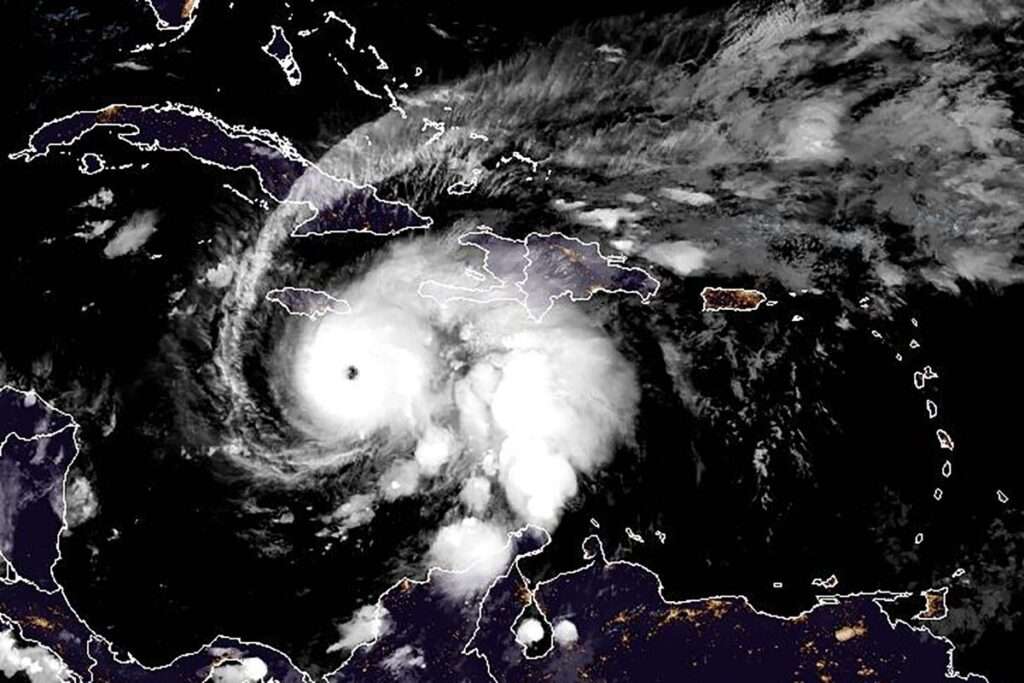
In what meteorologists are calling a catastrophic milestone, Hurricane Melissa made landfall in Jamaica as a Category 5 storm with sustained winds reaching 185 mph, marking it as the fiercest storm to ever strike the island and potentially the strongest globally so far in 2025. With its destructive path now turning toward Cuba, the Caribbean region braces for further devastation, heightened by unusually warm ocean waters fueling the cyclone’s rapid intensification.
The storm crossed Jamaica near the southwestern town of New Hope, tearing through the parish of St. Elizabeth and exiting near St. Ann, leaving in its wake up to 13-foot storm surges, massive flooding and widespread damage to infrastructure and power systems. Prime Minister Andrew Holness described the event as something “no infrastructure in the region can withstand.” At least seven deaths have been confirmed across the Caribbean, including three in Jamaica.
Following landfall, Melissa weakened briefly but is now heading toward eastern Cuba as a powerful Category 4 storm, maintaining life-threatening wind speeds and heavy rainfall potential. Cuban officials report more than 281 000 evacuees in the eastern provinces as preparations intensify for the upcoming strike.
Meteorologists highlight the role of exceptionally warm Caribbean Sea surface temperatures as a key factor in Melissa’s rapid intensification—making this an extreme weather event that underscores the influence of climate change on storm behaviour. The minimal central pressure measured at 892 millibars places Melissa among the lowest-pressure Atlantic landfalling storms on record.
Beyond immediate impacts, the storm is set to severely disrupt Jamaica’s agriculture, infrastructure and power grid. Over 500 000 customers in Jamaica lost electricity following the landfall. Recovery operations are already underway, though officials warn that relief efforts will be hindered by blocked roads, debris and damaged communication links.
As the storm moves on to Cuba, forecasters warn of catastrophic flash flooding and landslides in mountainous terrain receiving up to 20–25 inches of rain. The broader region—including Hispaniola and the Bahamas—remains on alert as Melissa continues its projected north-northeast track.
Hurricane Melissa’s landfall in Jamaica—its overwhelming intensity, rapid intensification and subsequent trajectory toward Cuba—marks a defining moment in the 2025 Atlantic hurricane season. The storm’s unprecedented strength in the region serves as a stark reminder of the growing role climate-driven warming plays in extreme weather events. As Jamaica begins the long process of recovery and Cuba braces for its next strike, the wider Caribbean region must prepare for potentially massive humanitarian and economic consequences. The aftermath will not only test infrastructure and emergency systems but also raise urgent questions about resilience, adaptation and accountability in the face of increasingly volatile storms.