
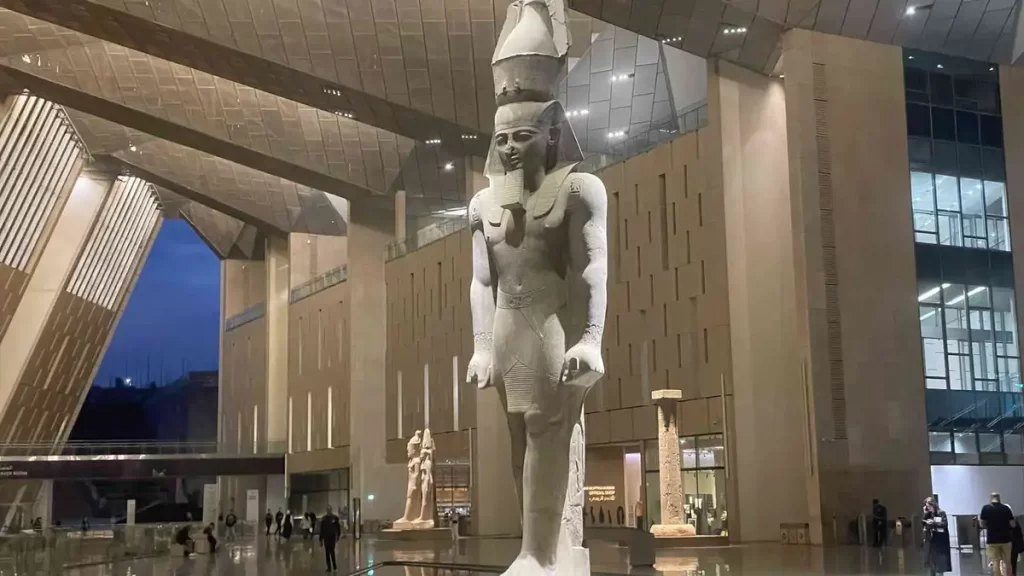
On Saturday, 1 November 2025, the Grand Egyptian Museum (GEM) officially opened its doors in a lavish inauguration ceremony, marking a landmark moment for Egypt’s cultural and tourism strategy. The museum will welcome the general public starting Tuesday, 4 November 2025, fulfilling a long-awaited promise of a world-class institution for ancient Egyptian heritage.
Built adjacent to the iconic Giza Pyramid Complex and after decades of planning and delays, GEM emerges as one of the world’s largest museums dedicated to a single civilisation. Authorities say the museum encompasses more than 50,000 artefacts, including the complete collection of Tutankhamun—some 4,500 objects previously scattered across the country.
The official opening drew an international delegation of heads of state, royalty, and cultural dignitaries, reflecting Egypt’s ambition for this institution to act as both a cultural beacon and a tourism catalyst. The government declared 1 November a paid national public holiday to facilitate the event and enable Egyptians and international guests to take part.
GEM’s architecture aligns with the Giza plateau’s geography—the structure radiates outward toward the pyramids, intentionally not exceeding their height, thereby paying homage to Egypt’s ancient legacy. Inside, visitors ascend a grand six-storey staircase lined with monumental statuary, culminating in panoramic views of the pyramids themselves.
From a tourism and heritage perspective, the museum is expected to draw millions of visitors annually. According to Egypt’s tourism authorities, GEM is central to plans to elevate the country’s visitor numbers and position Cairo as a major cultural destination. Analysts note that the opening signals not just a museum launch but a structurally significant investment in Egypt’s soft-power and economic diversification agenda.
Nonetheless, the project’s journey was far from straightforward. The idea was first proposed in the early 1990s, construction formally commenced in 2005, and the opening was delayed multiple times due to financial crises, political upheaval, and the Covid-19 pandemic. Despite the delays, the wait only heightened global anticipation for GEM.
For tourists and heritage enthusiasts, the museum will serve as a one-stop repository for thousands of years of Egyptian civilization—from Pre-Dynastic through Greco-Roman eras—organised thematically under “Society, Kingship and Beliefs.” Early descriptions emphasise its state-of-the-art conservation labs, interactive technologies, and immersive exhibits that merge ancient artefacts with modern visitor-experience design.
The inauguration of the Grand Egyptian Museum marks a significant milestone in Egypt’s mission to preserve, showcase, and capitalise on its ancient heritage. With its world-class galleries, complete Tutankhamun collection, and strategic location near the Giza pyramids, GEM is poised to redefine the cultural landscape of Cairo and the broader Middle East. As the museum opens to the public on 4 November, the coming years will test its capacity to meet high expectations—both of heritage stewardship and economic impact. Regardless of the outcome, the event underscores Egypt’s enduring ambition to link its timeless past with a modern global audience.

