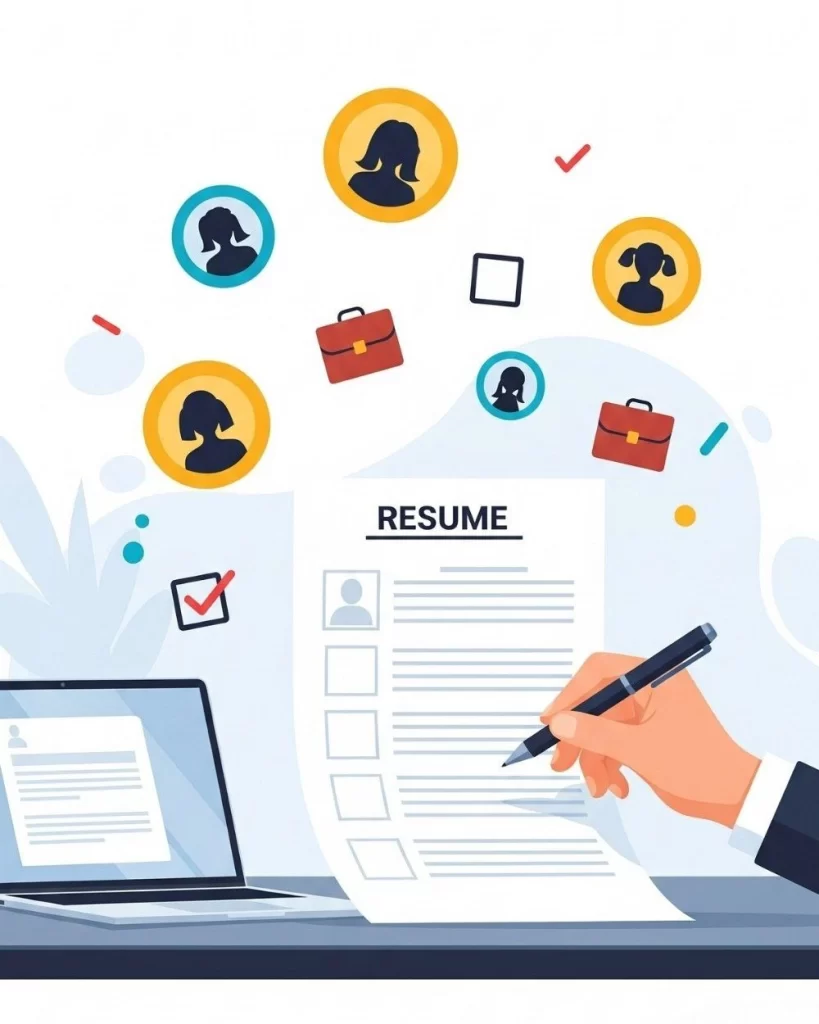
AI is already a part of practically every area of professional life. In 2026, AI-generated resumes are leading the way in revolutionizing how people employ around the world. Job searchers are utilizing high-tech tools to make their applications look ideal, so recruiters are getting a lot of well-organized paperwork. This has caused a big shift toward assessments based on skills and models that combine humans and AI.
The Growth of AI Resume Tools
AI resume builders are quite popular now since they help people make ATS-friendly documents in just a few minutes. BeamJobs, which got a 96% total score in 2026 comparisons, is one of the solutions that employs both automation and customization to match resumes to specific job criteria. Rezi also conducts a wonderful job of finding keywords and studying ATS, which makes sure that resumes pass the first filters without any problems.
Statistics back this up: 68% of those looking for work now use AI to write resumes, and 84% think it helps them locate jobs. A survey from 2025 found that 82% of applicants who used AI technologies obtained interviews, whereas just 58% of those who didn’t get interviews.
These systems let you make dozens of custom versions without any labor. They do this by making sure that the formatting is correct and that the keywords are used correctly. But this easy access comes at a cost. Candidates bring in applications faster than systems can handle, which means that too many applications come in. Recruiters report that their inboxes are full of generic applications that use buzzwords instead of real content.
Issues for Recruiters in the Age of AI
It’s easy to see what the hiring problem will be in 2026: 82% of companies use AI to look at resumes, while 49% of hiring managers automatically turn down resumes that they assume were created by AI. It’s easy to tell when something isn’t real: it has the same phrases over and over, a clear structure, and vague achievements.
Four out of 10 employers now feel that traditional resumes don’t do a good job of predicting someone’s skills, which is making them go away faster. AI tricks ATS systems by filling them with buzzwords, but this masks true qualifications and makes recruiters have to sort through a lot of noise. Ethical difficulties are quite relevant since biased training data in builders can keep prejudices alive, and misrepresented capabilities can cause legal problems.
The labor gets harder too. Even if they say they will be more efficient, the flood needs improved equipment or manual reviews, which causes the time to fill longer. Eight out of ten Americans say that people, not machines, should still make the final decisions.
Hiring Based on Skills
There is a huge change happening at work. Skills-first designs don’t use credential screening, which makes the pool of qualified candidates three to five times larger and the pool of diverse candidates 16% larger. AI doesn’t simply look at how much experience someone has; it also looks at how closely their talents are related and how much potential they have.
The stats are impressive: 67% of organizations use AI to hire individuals, and 78% of businesses do, which is an 189% growth since 2022.
How Employers and Job Seekers See Things
Hiring managers from Toyota and Microsoft explain how the CV has changed: it used to be a story of hard effort, but now it’s often the result of an AI suggestion. Great talent is lost in the same apps, which makes teams look for real capability indications.
Candidates adjust their plans. Resumes that are excessively formal don’t appeal to 62% of employers, but resumes that demonstrate personality and numbers do. There are a number of tips out there, including “Boosted engagement 40%” to illustrate how well you did, editing by hand, and going beyond keywords.
Two-thirds of those who apply don’t want AI to make all the decisions because they value the human touch. Recruiters fight back by using a mix of AI for basic skills and people for soft skills through situational questions.
Popular AI Resume Builders in 2026
New ideas drive the market. BeamJobs is the greatest for automated job matching, Enhancv is the best for writing tales, and Rezi is the best for learning how to use ATS.
Changes in HR that are greater than just resumes. Fifty-six percent use video analysis, and fifty-one percent use automated tests. Predictive intelligence tells you how many people will leave, and chatbots keep prospects fascinated.
More and more people are trying to decrease bias, and 61% of people think AI makes hiring better. But there are still trust difficulties; 40% of professionals are worried about situations that aren’t personal.
How AI-Generated Resumes Are Changing Hiring in 2026