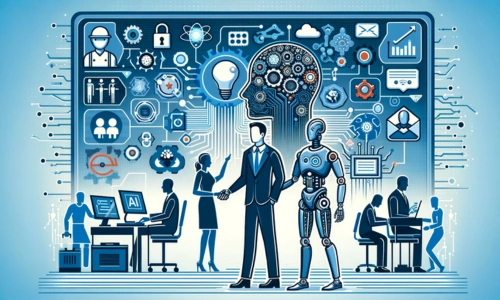
AI is still reshaping economies all around the world, and it has a huge effect on the labour market. AI technologies are getting better very quickly, and they are taking over dull tasks and making people need new skills. This makes people wonder if AI will take jobs or create new ones. What the Headline Does
AI is making huge changes in the job economy. Automation is taking over millions of boring occupations, but it’s also making a lot of new jobs in tech-based fields. According to research, AI will have an impact on up to 40% of jobs throughout the world by 2026. This will make up for lost jobs in manufacturing and administration by creating new jobs in data science and AI ethics. This twofold effect highlights how crucial it is to retrain workers so that AI can reach its full potential.AI’s entry into industries represents a big change in the labour market because it takes over tasks that people used to do. This makes people worry about widespread unemployment. AI makes employment more efficient, but it also puts traditional recruiting practices at risk. For instance, chatbots can help with customer service, and algorithms can make supply chains work better. As President Donald Trump’s administration focusses more on AI leadership in 2026, it’s crucial for workers, lawmakers, and businesses to understand how this will effect the economy as it transforms.
In the past, AI has been changing employment for decades. However, the rapid growth of machine learning since the 2010s accelerated up the changes.Manufacturing companies were some of the first to deploy robots to cut costs on labour. In the previous ten years, the number of assembly line jobs in the U.S.has gone down by 20%. Generative AI technologies like advanced language models can now write, code, and design, just like spreadsheets altered how office work was done in the 1980s.
The COVID-19 pandemic pushed up the usage of AI, and working from home made it more important to automate tasks in industries like retail and logistics. By January 2026, the globe will spend more than $200 billion a year on AI. This will make robots that can look at vast volumes of data faster than people can. This change indicates that AI doesn’t kill jobs; it changes the economy.
The Most Affected Areas
AI has a bigger effect on some businesses than others, especially those that entail predictable, data-heavy tasks.Robotic process automation is taking over more than 70% of repetitive assembly work in manufacturing and logistics. This will slash jobs from 15 million worldwide in 2020 to less than 10 million by 2030. Robots at warehouses process orders 40% faster, so fewer people have to pick them.
AI-powered software that handles scheduling, invoicing, and data entry might take over 25% of office support positions. This would make administrative and clerical work less important.Most of the time, virtual assistants can answer enquiries on their own. In locations like India, chatbots and voice AI manage billions of interactions per year. This means that contact centres need 30% fewer humans. Self-driving cars might put 3 million transportation jobs in the U.S. at risk.By 2026, test programs are already logging millions of self-driving kilometres.
Ways to Make Jobs
AI makes new jobs that are often more than the ones it takes away, even when some employment are lost. By 2025, industries that use AI are estimated to add 97 million new jobs. This trend will continue through 2026, with new jobs like AI trainers, ethicists, and integration specialists seeing demand climb by 35% every year. Millions of individuals in poor nations labour in data interpretation jobs.In creative fields, AI helps by producing sketches for artists to better.
AI is used in healthcare to help in diagnosing ailments. This creates jobs for technicians who look over algorithms that discover diseases 20% more accurately than a regular doctor. AI is used by finance to uncover fraud, which has led to the emergence of compliance analysts who are skilled in machine learning. There could be 5 million fewer employment in manufacturing, but 2 million more opportunities in tech maintenance.There could be 9 million new jobs in the tech and data sectors. Healthcare added 2.5 million jobs, but retail lost 2.5 million.
Issues with the skills gap
AI makes the skills gap worse by making it easier for people who are strong with computers to get jobs. This is because cognitive skills that we use every day lose value 15% faster than manual skills.Governments and corporations react by training people how to do things in new ways: The National Strategy for AI in India proposes that every year, 1 million workers should acquire the basics of machine learning. Google’s AI certifications and other corporate programs have helped 500,000 people around the world get better at their professions, making them 40% more likely to get hired.
AI tutors are part of lifelong learning systems, which makes education more personal for people who generate content and wish to enhance their headlines or SEO. Older workers still have issues, and only half of them can learn new skills on their own without coaching that is tailored to their needs.As the economy transforms in 2026, policymakers are pushing for pilots of universal basic income.
The main focus is India.
AI has an effect on 69 million jobs in India, and 26% of them are at risk.But it also creates 20 million new jobs in software and analytics.It’s getting harder to find workers in Maharashtra’s Pimpri-Chinchwad industrial belt because of factory automation. On the other hand, Pune’s IT clusters are doing well due of AI development. Government programs like NITI Aayog’s AI plan support its usage in farming, which aids rural jobs by employing predictive agriculture practices to enhance yields by 30%.
Ganpati and other festivals encourage the use of AI in logistics to make sure that pilgrims move smoothly. Content makers utilise AI to write articles that don’t copy other people’s work.This is like optimisation approaches like SWOT analysis for news that is important to the market.
Answers to Policy
Governments take explicit steps to stop AI from causing problems. The EU’s AI Act says that companies must be open, which keeps jobs safe in risky fields. President Trump’s plans for the U.S. put AI domination first and allocate $100 billion to research and development to create jobs at home.India’s 2026 budget includes money for AI hubs, with the main goal being to use AI in a responsible way.
The UN and other global groups talk about inequality and ask for progress that includes everyone. Across Europe, labour unions are calling for AI taxes to pay for retraining.
Worries about morals
AI makes divides worse, and workers in developing countries with limited skills are twice as likely to lose their jobs. Biassed algorithms, like hiring tools that favour certain categories of individuals, keep discrimination going.In poor places, jobs could be at risk if AI systems aren’t safe.
We need to keep an eye on the progress of ethical AI, and by 2026, people will have to make significant choices. The negative impacts of losing a job on mental health have led to the development of corporate wellness programs that involve AI coaching.
Looking ahead
By 2030, the job market for AI will include both people and machines, and productivity will rise by 40% in all areas. Upskilling platforms will make it easier for everyone to get what they need, which could add $15 trillion to the world’s GDP.New concepts, like AI agents for teachers, make school better and prepare kids for occupations that involve a lot of technology.