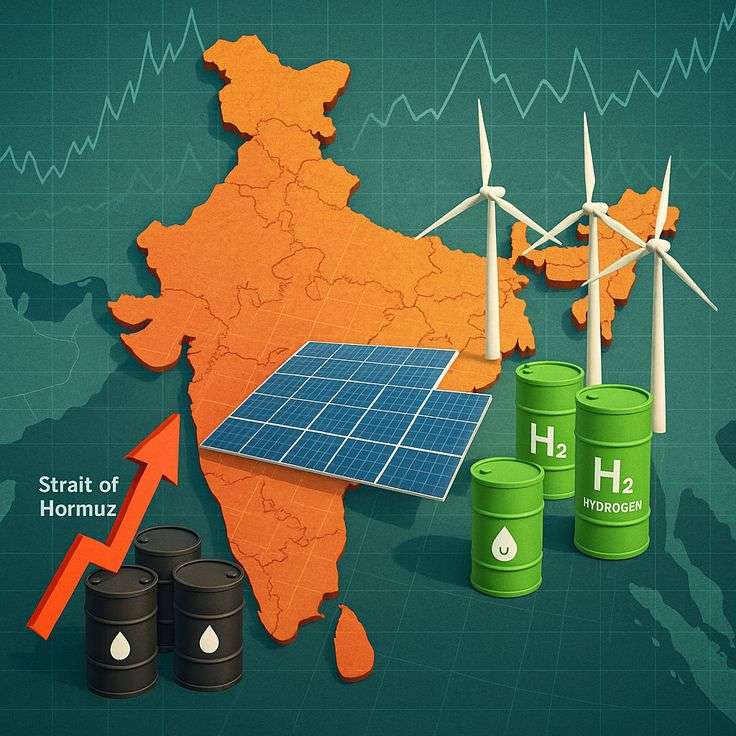
India’s push towards a greener future just got a huge win. The country has achieved the 50% mark for total installed electricity capacity from non-fossil sources like solar, wind and hydro, exceeding its 2030 objective by five full years. This is not simply numbers on a chart; it’s a real trend that is changing energy, jobs and even daily life across the country.
The Big Milestone Explained
Under the Paris Agreement, India committed in 2015 to source half of its power capacity from non-fossil fuels by 2030. Well, that did happen by June 2025. Of the total installed capacity 485 GW, 50.1% was from clean sources. By March 2026, that non-fossil percentage had grown to some 283.46 GW out of a total of nearly 550 GW or more, led by renewables.
Solar power was the star performer, reaching 150.26 GW by early 2026, with a massive addition of 44.6 GW in FY26. Wind came next at 56.09 GW, ahead of large hydro with 51.41 GW, and lower contributions from bioenergy (11.75 GW), small hydro (5.17 GW) and nuclear (8.78 GW). India added a record 55.29 GW of non-fossil capacity in FY26, bringing the renewable pie (excluding large hydro) to 223 GW.
This leapfrog moved India into third place in the world for renewable energy capacity, ahead of Brazil, behind only China and the US. What does this mean for countries such as India where demand for power continues to spike with industry, urbanization and EVs? It’s proof you can stick to bold goals when they’re backed up by action.
Solar and Wind: The Dynamic Duo Behind the Growth
Solar has been the breakout star. Installations boomed, from dry Rajasthan deserts to floating panels on reservoirs. Solar built more capacity in FY26 than many countries had in total. Rooftop solar programs are supposed to blanket millions of houses, adding gigawatts and slashing prices for regular individuals.
Close following is wind power with Tamil Nadu and Gujarat on the coast dotted with giant turbines. Sun and wind intermittents comprise the bulk of new additions, with a threefold increase in a decade. The pace is shown via key stats:
Solar: Over 150 GW, up from less than 3 GW in 2014.
Wind: 56 GW, constant but slow.
Total renewables (ex-large hydro): 223 GW by March 2026.
This was driven by government tenders, auctions and production-linked incentives for panels and turbines. But there are some issues to consider. Farmers who lease their land for panels have a steady income but there are still difficulties. How can we combine cropland with solar farms without straining food production?
The Government’s Push and Smart Policies
Prime Minister Narendra Modi’s COP26 promise of 500 GW non-fossil capacity by 2030 fanned the fire. The impetus was sustained by policies such as viability gap support for new tech, PLI schemes for manufacturing, and rooftop solar subsidies. MNRE coordinated massive projects, from solar parks to green hydrogen pilots.
Power generation in FY26 was 1,846 billion units (BU) whereas non-fossil sources were at 29.2% or 539 BU, a substantial rise. Gujarat and Karnataka led increases, attracting billions of private investment. “Proud moment,” said Minister Pralhad Joshi. “India is leading the way while increasing its economy. This makes India a global renewable energy hub exporting tech and know-how.
Real-Life Impact: Jobs, Economy and Lives
It’s not just an abstract shift. It’s creating jobs – millions of them. A boom in green energy is fueling hiring from solar field technicians to battery plant engineers. 52.5 GW of additional capacity installed in 1st 10 months of FY26, 75% renewable, boosting demand for skilled personnel. Consider Nashik in Maharashtra, where solar panel assembly is keeping local companies busy and employing young people.
Economically, affordable renewables cut the cost of power over the long-term. Power-hungry sectors like steel and textiles benefit, driving up exports. Reliable clean power for homes implies less outages in summer peaks. Environmentally it reduces dependence on coal, the fossil fuel portion is still 248.5 GW but falling. India’s cities are breathing easy, mini-grid electrification lights up the rural areas. One wonders if this technique can assist other emerging countries leapfrog filthy coal?
Obstacles ahead
Fast growth is a headache. Renewable energy stranded by grid congestion – antiquated lines and poor coordination leave thousands of MW idle. Solar peaks at noon, wind at night; without storage, blackouts loom in mismatches.
Battery energy storage is scaling up to 5 GWh by 2026 but India requires 411 GWh by 2032. Pumped hydro and flexible plants help but land bottlenecks, exorbitant costs and finance gaps hinder things. Operational adjustments such as better forecasting and equitable policies are urgently needed. Industry calls for Budget 2026 fixes: increased transmission, storage incentives
With an Eye on the 500 GW Dream
With 283 GW now non-fossil, the 500 GW aim looks achievable, perhaps even beatable if demand increases 6-7% annually. 158 GW renewables, including hydro and nuclear under construction. Green hydrogen, offshore wind and EV charging will accelerate. If storage comes around, non-fossil might be 60-70% by 2030.
India’s story is inspiring – third in solar, wind leaders, feeding 1.4 billion people. There are obstacles to overcome but the roadmap is clear – a self-sufficient, sustainable powerhouse. The biggest winners are ordinary Indians, as clean energy jobs proliferate, and costs tumble. This early milestone? Well, Just the beginning of something greater.
India Achieves 50% Non-Fossil Fuel Target Ahead of Schedule, Tops Clean Energy Race