
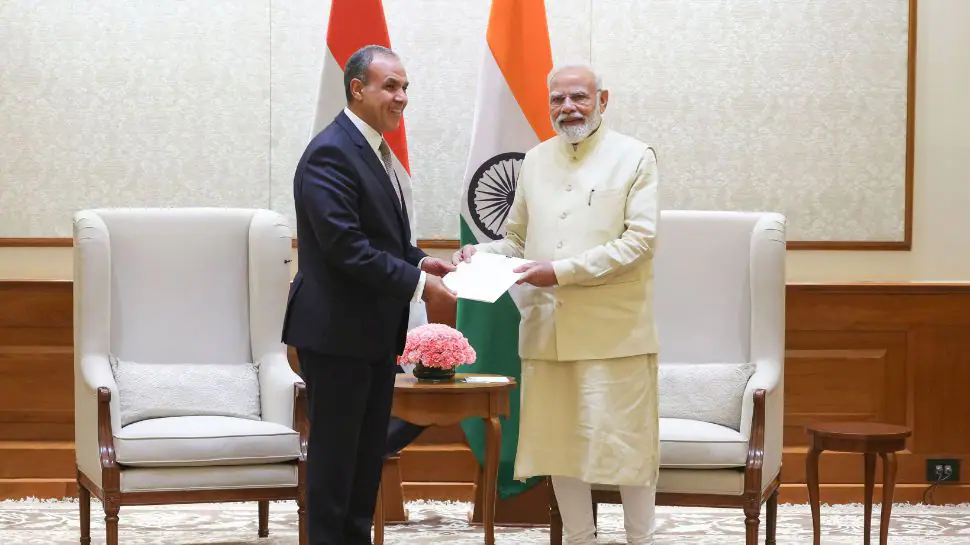
Egyptian Foreign Minister Dr. Badr Abdelatty concluded a high-level visit to New Delhi on Friday, where he met with Prime Minister Narendra Modi and other senior Indian officials to discuss bilateral relations, regional peace, and cooperation in trade and security. The visit underscored the growing strategic partnership between India and Egypt amid rapidly evolving geopolitical developments in the Middle East and South Asia.
Prime Minister Modi commended Egypt’s constructive role in facilitating the recent Gaza Peace Agreement, which brought a temporary halt to months of hostilities in the region. He lauded President Abdel Fattah El-Sisi’s leadership and expressed optimism that Cairo’s diplomatic efforts would help pave the way for a sustainable and inclusive peace process between Israel and Palestine.
According to official sources, the discussions between Dr. Abdelatty and Indian leaders covered a wide spectrum of issues, including regional security, counterterrorism cooperation, trade expansion, and collaboration in renewable energy. Both sides reaffirmed their commitment to strengthening ties through the India–Egypt Strategic Partnership, signed during President Sisi’s visit to India in 2023.
Dr. Abdelatty highlighted Egypt’s desire to enhance economic and cultural linkages with India, emphasizing the need for greater collaboration in sectors such as defense production, green hydrogen, and digital transformation. He also reiterated Egypt’s support for India’s initiatives in the Global South, particularly in promoting equitable development and South–South cooperation.
During the meeting, Prime Minister Modi noted that India and Egypt share a historic bond rooted in mutual respect and shared civilizational values. He emphasized the importance of continued cooperation on issues of global concern, including climate change, energy security, and food supply stability. The two sides also discussed the upcoming India–Africa Forum Summit, with Egypt reaffirming its participation.
Analysts view this visit as a significant step toward deepening India’s engagement with West Asia and Africa. With Egypt serving as a strategic gateway between the two regions, enhanced collaboration could contribute to greater connectivity, economic growth, and geopolitical stability. The visit also reflects India’s balanced diplomatic approach in the Middle East, where it maintains strong relations with both Arab nations and Israel.
Both governments expressed confidence that the renewed dialogue will translate into concrete outcomes in the coming months, particularly in trade, defense, and cultural exchange. The foreign ministers of both countries are expected to meet again early next year to review progress on agreed initiatives.
Dr. Abdelatty’s visit to New Delhi marks an important chapter in India–Egypt relations, reinforcing the two nations’ shared vision for peace, prosperity, and mutual growth. As the global landscape continues to shift, the strengthened partnership between New Delhi and Cairo is expected to play a vital role in promoting regional stability and advancing common interests across Asia and Africa.

