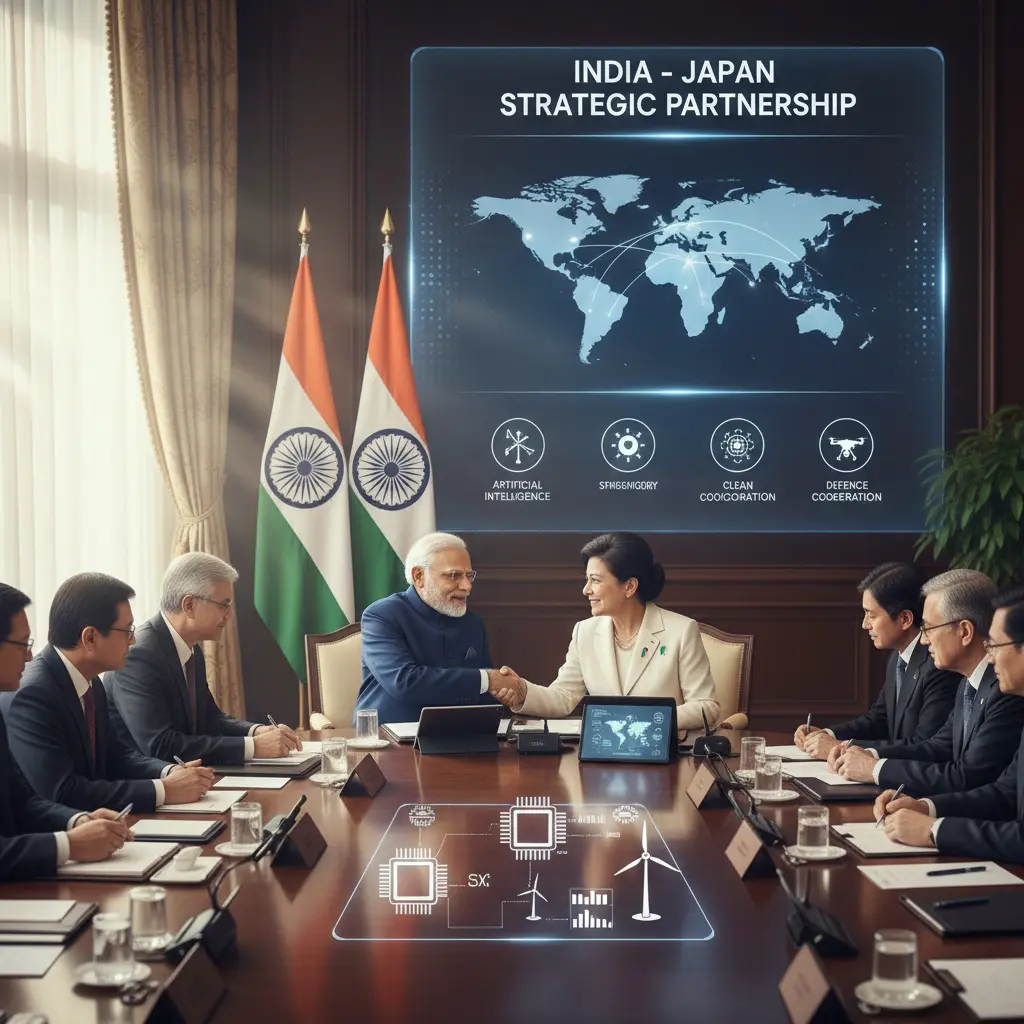
When Japanese Prime Minister Sanae Takaichi landed in New Delhi this week, it wasn’t just another diplomatic photo-op. It marked her first official visit to India since taking office, and it came at a moment when both countries have plenty riding on getting this relationship right. Prime Minister Narendra Modi welcomed her warmly for the 16th India-Japan Annual Summit, and over three days, the two leaders sat down to talk about everything from artificial intelligence to submarines, from semiconductors to solar panels.
This wasn’t a routine catch-up. It was a working meeting between two of Asia’s biggest democracies, trying to figure out how to build a future together that doesn’t depend too heavily on anyone else.
Why This Meeting Mattered Right Now
Timing matters in diplomacy, and the timing here was hard to ignore. The India Japan partnership is unfolding against a genuinely messy global backdrop. Trade tensions with Washington have been rattling both economies, tensions in the Middle East have thrown oil and gas routes into uncertainty, and China-Japan relations have taken a sharp downturn after Takaichi made comments suggesting that Chinese military action against Taiwan could pose a serious threat to Japan. Beijing responded by tightening export controls on dozens of Japanese companies just days before her trip.
None of that is a coincidence. When your neighborhood gets more unpredictable, you look for friends you can actually count on. That’s a big part of why this India Japan cooperation push feels less ceremonial than past summits and more like two nations quietly hedging their bets together.
AI Cooperation Takes Center Stage
One of the most talked-about outcomes of the summit is the push around India AI cooperation. Modi and Takaichi are expected to move forward with the Japan-India Artificial Intelligence Cooperation Initiative, which isn’t just a fancy title. It’s aimed at building joint AI applications in areas like manufacturing, healthcare, and mobility, sectors where both countries have real strengths to combine.
Japan has deep expertise in robotics, precision engineering and industrial technology. India brings a massive pool of software talent and one of the fastest-growing digital economies in the world. Put those together, and there’s a genuine case for meaningful breakthroughs rather than just another government-to-government agreement that sits in a drawer somewhere.
Semiconductors and Supply Chains
The semiconductor partnership angle deserves attention too. Chips have quietly become one of the most strategic goods on the planet, and countries everywhere are scrambling to reduce their dependence on any single supplier. India has been building out its semiconductor ambitions for a few years now, and Japan, with its long history in chip manufacturing equipment and materials, is a natural partner to help fill in the gaps.
Beyond semiconductors, the two sides are also expected to expand cooperation in critical minerals, clean energy, and information technology. These aren’t flashy headlines, but they’re the building blocks of supply chain security, something both nations have learned the hard way not to take for granted after years of global disruptions.
The Economic Weight Behind the Handshakes
It’s easy to treat these summits as symbolic, but the numbers tell a different story. Around 1,400 Japanese companies already operate in India, with close to half of them in manufacturing. Bilateral trade hit roughly $27.5 billion in the last fiscal year, and Japanese investment into India totaled over $3 billion in just nine months between April and December last year.
This visit brought a large Japanese business delegation along with it, with representatives from more than 150 Japanese companies taking part in an economic forum alongside the summit. That’s not just diplomacy for the cameras. It’s real capital, real jobs, and real business relationships being built or expanded.
Defence and the Indo-Pacific Picture
PM Modi Japan talks also touched heavily on defence cooperation, an area where Japan has been shifting its posture in recent years. Tokyo has moved toward allowing more genuine co-production and technology-sharing with trusted partners, a significant change from its historically cautious defence export policies. India is among a select group of countries with a defence technology cooperation agreement with Japan, putting it in a strong position to benefit from this shift.
Both countries are also members of the Quad alongside the United States and Australia, and this summit gave Modi and Takaichi a chance to align their thinking ahead of broader regional discussions. The shared goal, as both sides keep repeating, is a free and open Indo-Pacific, one where no single power gets to dictate the rules for everyone else.
What This Means Going Forward
Summits like this one often get judged too quickly, either dismissed as photo opportunities or hyped as game-changers. The truth is usually somewhere in between. What’s clear from this visit is that India Japan partnership isn’t just a slogan diplomats reach for when they need a headline. It’s backed by real trade numbers, real defence agreements, and real technology initiatives that have been building steadily for over a decade.
The joint declarations expected on economic security and AI cooperation will take time to translate into tangible results. But the direction is unmistakable. Two major Asian democracies, facing similar pressures from an uncertain world, are choosing to lean on each other a little more. For a region watching how the balance of power shifts in the coming years, that’s a development worth paying attention to.
As India diplomacy continues to expand across multiple fronts, this Japan relationship stands out as one of the steadier, more substantive partnerships in India’s foreign policy toolkit, and this week’s summit only reinforced that.
India and Japan Strengthen Strategic Partnership: A New Chapter in Indo-Pacific Cooperation.