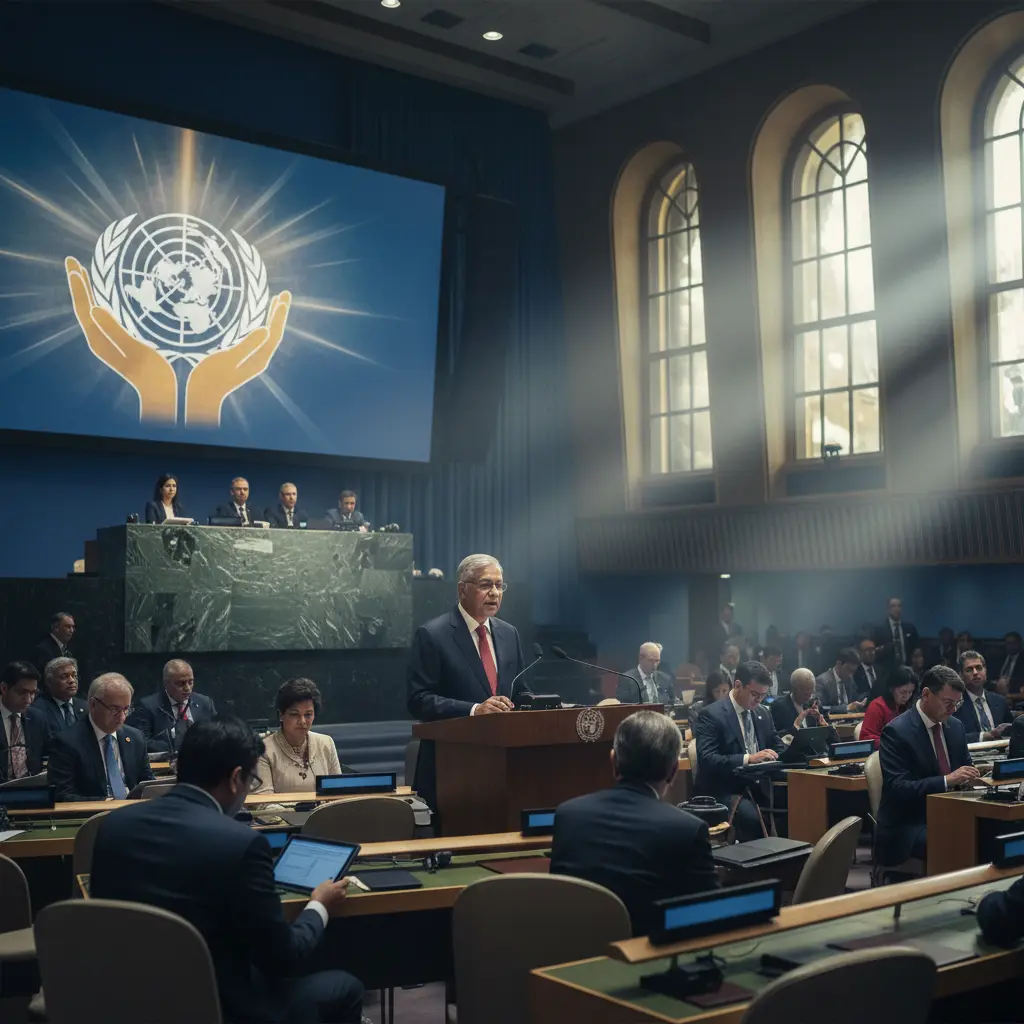
India has officially announced its candidature for the United Nations Security Council’s non-permanent seat for the 2028-29 cycle, and it’s doing so with a clear message: the world needs more trust, more cooperation and fewer walls between nations. The campaign was launched by External Affairs Minister S. Jaishankar at the UN headquarters and he unveiled what is being called the “SHANTI” vision – a name that aptly means “peace” in Hindi and Sanskrit and one that captures exactly what India wants to be known for on the world stage.
What Exactly Is the SHANTI Vision?
SHANTI stands for “Securing Holistic Advancement through Norms, Trust and Integrity.” It’s a six-point manifesto, and rather than being just a catchy acronym, it lays out the priorities India says it will champion if elected: strengthening peacekeeping efforts, pushing sustainable development, deepening multilateral cooperation, and standing up for the interests of developing nations.
Jaishankar didn’t shy away from acknowledging the tricky moment the world finds itself in. He pointed to a strange paradox — global connectivity and cooperation have never been higher, yet conflict, violence, and instability are also rising in ways that touch even countries far removed from the frontlines. That tension, he suggested, is exactly why the UN Security Council needs voices like India’s at the table.
Backing It Up With a Track Record
Diplomacy is one thing, but Jaishankar was quick to remind everyone that India isn’t showing up empty-handed. He highlighted the country’s peacekeeping record, noting that India has contributed nearly 300,000 personnel across roughly 50 UN missions since the organization’s founding — a number few countries can match. That’s not a small talking point; peacekeeping has been central to the UN’s mission since day one, and India has consistently been among the countries willing to send its own troops into difficult, often dangerous, situations to help stabilize regions in crisis.
Beyond peacekeeping, India is positioning itself as a genuine development partner rather than just another nation asking for a favor. The country has been involved in projects across dozens of nations, particularly across Africa, Asia, and the Pacific, and it’s leaning into that experience as proof it understands what developing nations actually need — not just what looks good on paper.
The Voice of the Global South
One phrase that keeps coming up in India’s messaging is “the Voice of the Global South.” It’s become something of a signature line for Indian diplomacy in recent years, and this UNSC campaign leans into it heavily. India as a bridge – a big enough and powerful enough nation to matter on the world stage, but also closely linked to the concerns of smaller and developing nations who often feel unheard in rooms dominated by bigger powers.
This positioning is also important in practice. To win a seat, India will need broad support across the UN General Assembly, and appealing to the dozens of developing nations that make up a huge chunk of that body is a smart strategic move, not just a feel-good talking point.
A Long and Uneven History at the Council
India’s relationship with the Security Council has been a bit of a stop-and-start affair. The country has served eight previous terms — starting all the way back in 1950–51, followed by stints in 1967, 1972, 1977, 1984, 1991, and more recently 2011 and 2021. But the gaps between those terms have sometimes stretched close to two decades, which isn’t exactly ideal if you’re trying to maintain a consistent voice at the world’s most powerful decision-making table.
That’s part of why this campaign matters so much to New Delhi. Officials have been candid that one goal here is to shorten those long gaps and secure more regular representation, rather than waiting years between opportunities to influence global security decisions.
India will be contesting the Asia-Pacific non-permanent seat, and it won’t be walking in unopposed — Tajikistan, backed by the Organisation of Islamic Cooperation, is also in the running. To win, India will need to secure a two-thirds majority in the General Assembly, which means the real work of this campaign will happen quietly, in embassies and foreign ministries around the world, long before any formal vote takes place.
Early Signs of Support
The campaign has already started picking up some diplomatic traction. For example, the Maldives has openly supported India’s bid, citing New Delhi’s consistent leadership in promoting global peace and security. Such endorsements are expected to trickle in over the coming months as India’s foreign ministry increases outreach to member states.
Why This Is Important At its heart, this campaign is about more than a seat at the table. It’s a reflection of how India sees its own role in the world right now — not a rising power waiting in the wings, but an active player that wants a direct hand in shaping how the world responds to conflict, instability, and development challenges. Whether the SHANTI vision translates into real change if India wins remains to be seen, but the messaging is clear: India wants to be seen as a stabilizing, trustworthy voice at a time when the world could really use one.
The General Assembly vote for the 2028–29 term is expected in mid-2027, giving India roughly a year to build the coalition of support it’ll need. Until then, expect Jaishankar and Indian diplomats to keep making this pitch — in New York, in regional capitals, and everywhere else a vote might be won.
India begins UNSC push with ‘SHANTI’ agenda.