
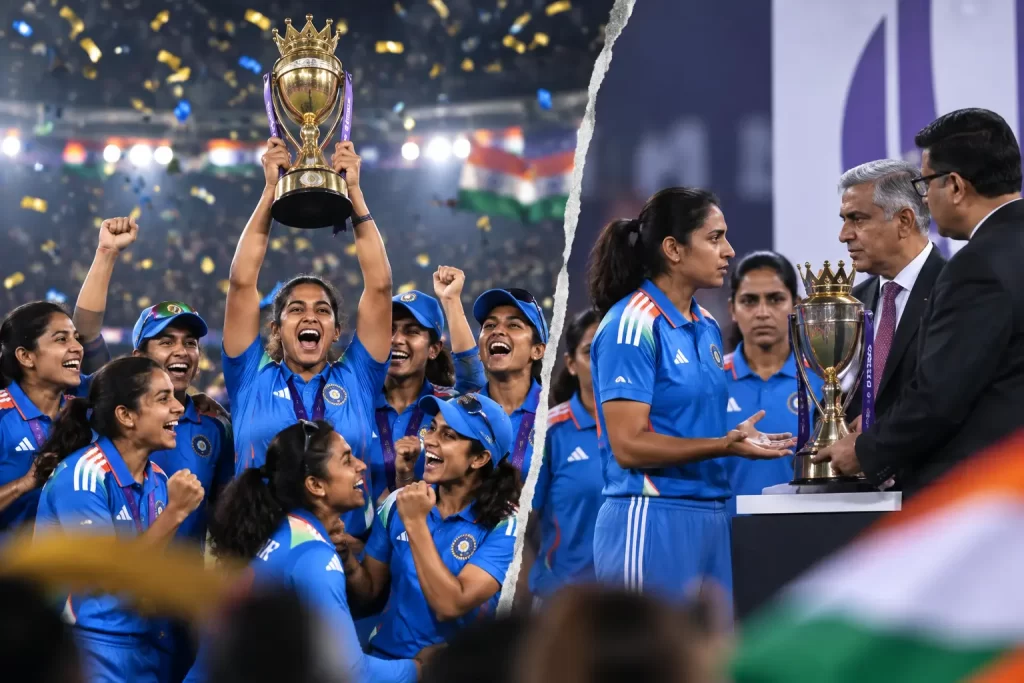
India Clinch Record Eighth Women’s Asia Cup Title, But Trophy Row Resurfaces.

India's women's cricket team have added another chapter to their already glittering trophy cabinet, but as has become almost predictable in recent India-Pakistan cricketing history, the celebrations came with a side of controversy. In the Women's Asia Cup 2026 final in Dubai, India beat Sri Lanka by 72 runs to win the title, extending their dominance in the tournament to an unprecedented eighth crown. Yet once again, the post-match presentation ceremony turned into the real talking point of the day. A Statement Win on the Field Whatever happened off the field, there was no denying the brilliance of India's performance on it. India won the toss and opted to bat first. They scored 183 for 5 in 20 overs thanks to a blistering start at the top. Shafali Verma led the charge, smashing 68 off just 39 balls, getting to her fifty off just 24 balls -- the fastest fifty in Women’s Asia Cup history. She wasn't alone in that effort either; Smriti Mandhana provided the other half of a superb opening partnership, scoring 59 off 39 balls, with the pair adding 129 runs together to lay the platform for a big total. Sri Lanka's bowlers clawed back some control in the closing overs, but the damage was already done. Chasing a stiff target, Sri Lanka were eventually bowled out for 111, with India's bowling attack — led by an impressive Sree Charani — cleaning up the tail and sealing a comfortable 72-run win. It was a complete team performance, the kind that has made the India vs Sri Lanka final feel almost like a formality in recent editions of the tournament, even as Sri Lanka continue to be one of the more competitive sides in the region. For skipper Harmanpreet Kaur, lifting the title — the actual trophy never made it into Indian hands, more on that shortly — marked yet another milestone in a career already stacked with them. She credited her side afterward for consistently matching the high standards the team sets for itself, reflecting the quiet confidence of a squad that has now made winning Asia Cups look almost routine. The Trophy Row, Once Again But no recap of this final would be complete without addressing what happened — or rather, didn't happen — after the last ball was bowled. India's players declined to collect the trophy from Asian Cricket Council chief Mohsin Naqvi, mirroring their male counterparts' actions at last year's Men's Asia Cup. Naqvi wears multiple hats in this saga: he isn't just a senior figure in Pakistani politics, serving as a federal minister, but also president of the Asian Cricket Council — the very body responsible for organizing the tournament, which is exactly why his presence at the presentation has repeatedly become a flashpoint. Rather than take the stage, India skipped the presentation ceremony entirely. Sri Lanka's captain Chamari Athapaththu ended up collecting the runners-up cheque alone, bringing what should have been a celebratory ceremony to an oddly abrupt close. Team India's decision wasn't a spur-of-the-moment call by the players either — it reportedly came after discussions involving the Indian camp and BCCI secretary Devajit Saikia, with the team ultimately deciding not to receive the trophy from Naqvi. India's coaching staff were unambiguous about the reasoning behind the move. Head coach Amol Mazumdar said the stand had been taken by the Board of Control for Cricket in India (BCCI) as an institution, and that the team stood by it. It's a line that echoes almost word for word what was said after the men's team took the same stance roughly a year earlier, underlining that this is very much an institutional position from the BCCI rather than a spontaneous players' protest. Déjà Vu From Last Year If this all feels familiar, that's because it is. A near-identical situation played out when the Indian men's team defeated Pakistan to lift the Asia Cup title in 2025, with India again declining to accept the trophy from Naqvi. That episode dragged on for a while too, with reports suggesting Naqvi eventually left the venue with the trophy, which has remained at the Asian Cricket Council's Dubai headquarters ever since. There had even been attempts to smooth things over in the months since, with the BCCI confirming an informal meeting with Naqvi, facilitated by the ICC, to try to address the earlier controversy. Whatever ground was made in those talks clearly didn't fully translate into a resolution before this final rolled around. The scenes inside the Dubai International Stadium reflected just how charged the atmosphere had become, with fans making their frustration with Naqvi clear as he exited the venue once the truncated ceremony wrapped up. What It Says About the Big Picture Fundamentally, this ongoing tussle is a minor but telling symptom of a much larger disease: the game of cricket between India and Pakistan — or in this case, the administration of cricket that includes both countries — seldom takes place in isolation of the larger canvas of India-Pakistan relations. The BCCI's stance on Mohsin Naqvi isn't really about one individual; it's a reflection of a wider institutional position that has now been applied consistently across both the men's and women's game. For Indian cricket fans, though, the headline story remains the one written on the field. An eighth Women's Asia Cup title, a record-breaking innings from Shafali Verma, a commanding all-round performance, and yet another statement from Harmanpreet Kaur's side that they remain the team to beat in the region. The trophy controversy may dominate headlines for a news cycle, but for the players, the silverware — physical or not — was never really the point. As far as they were concerned, the scoreboard already said everything that needed to be said.


India’s women’s cricket team have added another chapter to their already glittering trophy cabinet, but as has become almost predictable in recent India-Pakistan cricketing history, the celebrations came with a side of controversy. In the Women’s Asia Cup 2026 final in Dubai, India beat Sri Lanka by 72 runs to win the title, extending their dominance in the tournament to an unprecedented eighth crown. Yet once again, the post-match presentation ceremony turned into the real talking point of the day.

A Statement Win on the Field

Whatever happened off the field, there was no denying the brilliance of India’s performance on it. India won the toss and opted to bat first. They scored 183 for 5 in 20 overs thanks to a blistering start at the top. Shafali Verma led the charge, smashing 68 off just 39 balls, getting to her fifty off just 24 balls — the fastest fifty in Women’s Asia Cup history. She wasn’t alone in that effort either; Smriti Mandhana provided the other half of a superb opening partnership, scoring 59 off 39 balls, with the pair adding 129 runs together to lay the platform for a big total.

Sri Lanka’s bowlers clawed back some control in the closing overs, but the damage was already done. Chasing a stiff target, Sri Lanka were eventually bowled out for 111, with India’s bowling attack — led by an impressive Sree Charani — cleaning up the tail and sealing a comfortable 72-run win. It was a complete team performance, the kind that has made the India vs Sri Lanka final feel almost like a formality in recent editions of the tournament, even as Sri Lanka continue to be one of the more competitive sides in the region.

For skipper Harmanpreet Kaur, lifting the title — the actual trophy never made it into Indian hands, more on that shortly — marked yet another milestone in a career already stacked with them. She credited her side afterward for consistently matching the high standards the team sets for itself, reflecting the quiet confidence of a squad that has now made winning Asia Cups look almost routine.

The Trophy Row, Once Again

But no recap of this final would be complete without addressing what happened — or rather, didn’t happen — after the last ball was bowled. India’s players declined to collect the trophy from Asian Cricket Council chief Mohsin Naqvi, mirroring their male counterparts’ actions at last year’s Men’s Asia Cup. Naqvi wears multiple hats in this saga: he isn’t just a senior figure in Pakistani politics, serving as a federal minister, but also president of the Asian Cricket Council — the very body responsible for organizing the tournament, which is exactly why his presence at the presentation has repeatedly become a flashpoint.

Rather than take the stage, India skipped the presentation ceremony entirely. Sri Lanka’s captain Chamari Athapaththu ended up collecting the runners-up cheque alone, bringing what should have been a celebratory ceremony to an oddly abrupt close. Team India’s decision wasn’t a spur-of-the-moment call by the players either — it reportedly came after discussions involving the Indian camp and BCCI secretary Devajit Saikia, with the team ultimately deciding not to receive the trophy from Naqvi.

India’s coaching staff were unambiguous about the reasoning behind the move. Head coach Amol Mazumdar said the stand had been taken by the Board of Control for Cricket in India (BCCI) as an institution, and that the team stood by it. It’s a line that echoes almost word for word what was said after the men’s team took the same stance roughly a year earlier, underlining that this is very much an institutional position from the BCCI rather than a spontaneous players’ protest.

Déjà Vu From Last Year

If this all feels familiar, that’s because it is. A near-identical situation played out when the Indian men’s team defeated Pakistan to lift the Asia Cup title in 2025, with India again declining to accept the trophy from Naqvi. That episode dragged on for a while too, with reports suggesting Naqvi eventually left the venue with the trophy, which has remained at the Asian Cricket Council’s Dubai headquarters ever since. There had even been attempts to smooth things over in the months since, with the BCCI confirming an informal meeting with Naqvi, facilitated by the ICC, to try to address the earlier controversy. Whatever ground was made in those talks clearly didn’t fully translate into a resolution before this final rolled around.

The scenes inside the Dubai International Stadium reflected just how charged the atmosphere had become, with fans making their frustration with Naqvi clear as he exited the venue once the truncated ceremony wrapped up.

What It Says About the Big Picture

Fundamentally, this ongoing tussle is a minor but telling symptom of a much larger disease: the game of cricket between India and Pakistan — or in this case, the administration of cricket that includes both countries — seldom takes place in isolation of the larger canvas of India-Pakistan relations. The BCCI’s stance on Mohsin Naqvi isn’t really about one individual; it’s a reflection of a wider institutional position that has now been applied consistently across both the men’s and women’s game.

For Indian cricket fans, though, the headline story remains the one written on the field. An eighth Women’s Asia Cup title, a record-breaking innings from Shafali Verma, a commanding all-round performance, and yet another statement from Harmanpreet Kaur’s side that they remain the team to beat in the region. The trophy controversy may dominate headlines for a news cycle, but for the players, the silverware — physical or not — was never really the point. As far as they were concerned, the scoreboard already said everything that needed to be said.

Leave a Comment

Your email address will not be published. Required fields are marked *

Scroll to Top
“5 Best Forts Near Pune to Visit on Shivjayanti 2026” 7 facts about Dhanteras