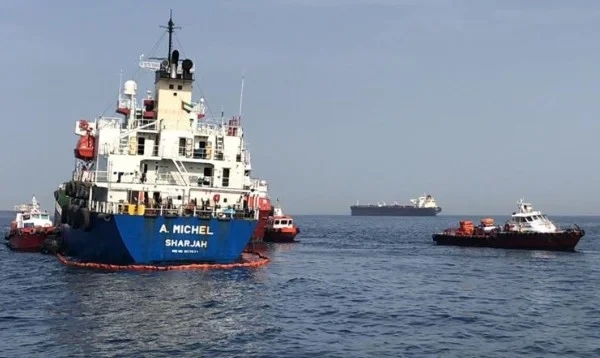
India has strongly denounced a recent attack on the Fujairah Petroleum Industries Zone (FOIZ) in the United Arab Emirates, calling the attack on the zone “unacceptable” and urging an early halt to the hostilities in the Gulf. The incident has revived fears over the vulnerability of energy hubs, civilian infrastructure and foreign workers in an already on-edge region, due to spiralling tensions between the US and Iran and repeated missile and drone strikes.
What went down in Fujairah
Fujairah authorities said a fire broke out at the Fujairah Petroleum Industries Zone following a suspected drone strike, which they said was believed to have emanated from Iran, causing explosions and billowing plumes of smoke over the industrial region. Three Indian citizens working in the zone got moderate injuries and were brought to a nearby hospital where they are said to be undergoing treatment.
The strike was “unacceptable” and that attacking civilians and civilian infrastructure is against international rules, a formal statement from New Delhi, through the Ministry of External Affairs said. Government spokespersons have also called for an immediate end of such hostilities and appealed to all sides to re-engage in conversation and diplomacy to restore peace and stability in the Middle East.
Why Fujairah is important to global trade
Fujairah isn’t your average port city. It is situated on the eastern coast of the UAE, just outside the Strait of Hormuz and is one of the world’s largest bunkering and oil storage hubs. The Fujairah Petroleum Industries Zone has large tank farms, refineries and service terminals that store and distribute fuel to thousands of ships passing through the Arabian Sea, Gulf of Oman and the larger Indian Ocean.
Any strike against FOIZ is not just a threat to local workers and infrastructure, it sends tremors across global energy markets and shipping waterways. The system’s resilience is called into doubt if the same hotspots are targeted repeatedly, as vessel insurance rates, bunker supply costs and even the option of alternate routes can change swiftly when such facilities are struck.
India’s Interests in the Gulf
The onslaught is a home run for India in Fujairah. India has strong economic, energy and demographic linkages with the Gulf, where millions of Indians work in construction, logistics, healthcare and the energy sector. Those workers alone contribute tens of billions of dollars in remittances back home each year, making their safety a concern of national security, not simply diplomacy.
Besides people, India relies substantially on Gulf energy sources. A large portion of India’s crude oil imports originate from countries that lay along or close to these contentious areas thus any disruption to ports, terminals or tanker lanes can swiftly affect fuel prices and industrial activity in Indian cities. In that context, labelling the Fujairah strike as “unacceptable” is not simply symbolic; it is a pointer that New Delhi would not be a silent spectator to repeated attacks on sites where Indian lives and livelihoods are at stake.
More headaches for maritime security
The Fujairah episode fits with a broader pattern of increasing maritime insecurity in the Gulf. Over the past few years, the waters near the Strait of Hormuz, the Gulf of Oman and the Red Sea have been repeatedly hit by drone and missile strikes, seizures of tankers and charges of mining. Shipping agencies and risk experts now call the Gulf and surrounding waterways “critical” or “high risk” and many commercial operators are diverting ships at extra cost or under costly insurance.
Maritime specialists say that attacks on energy hubs, ports and even merchant boats are not isolated incidents anymore but part of a bigger strategy of hybrid warfare that combines cyber, naval and asymmetric tactics. And in that environment, the question many are asking is this: how long can big nations and regional groups keep escalating without precipitating a broader confrontation that might spill well beyond the Middle East?
India’s balancing act in the Gulf India’s response to Fujairah is a lesson in a delicate balancing act. New Delhi, on the other hand, has publicly condemned Iranian-linked strikes on civilian facilities and called for an immediate cessation of hostilities. Indian authorities, meanwhile, have always said they remain dedicated to discussion and diplomacy and want to see a peaceful settlement of regional tensions, not a slide into open war.
Indian policy makers are also aware of the larger geopolitical chessboard. The US and several European capitals are clearly engaged in damage control following strikes in the Gulf, while countries such as the UAE and Saudi Arabia are attempting to hedge between security cooperation with Western powers and the need to avoid a complete rupture with Iran. India in the meantime is seeking to hold to its traditional policy of non-alignment while covertly improving marine relations, intelligence sharing and contingency preparation with its Gulf neighbors.
Fears for Indian Workers and Far Ocean Trade
The Fujairah bombing is a grim reminder to the Indian community in the Gulf that even “safe-hub” industrial zones are not immune from being targeted at times of heightened tension. Families back home in Kerala, Tamil Nadu, Uttar Pradesh and other states increasingly follow the news from Gulf capitals with a mixture of fear and resignation, wondering how long their loved ones can stay working in places that are often highlighted in missile-and-drone threat alerts.
India’s strategists are also keeping a close watch on the frequency and locations of assaults from a trade and shipping standpoint. The country’s merchant fleet and coastal ports are increasingly considering the feasibility of roundabout routes, pre-planned diversions and improved security for ships navigating the Gulf and nearby seas. Indian-linked cargoes are already avoiding some regions altogether or making the journey with tighter escort arrangements, adding cost and operational complexity to what used to be a rather routine voyage.
How this fits into the broader conflict picture
Fujairah, analysts point out, is not just another dot on the map, but in the present period of US-Iran tensions has become symbolic of how energy infrastructure may be used as a negotiating chip or a target for retaliation. When Iran or its proxies fire missiles and drones in the direction of the Gulf, they are typically probing the reaction of air defenses, the willingness of countries to retaliate, and the resilience of global markets.
The timing of the Fujairah strike also poses the question of what actors are seeking to achieve. In a tight standoff between Washington and Tehran, and with several other Gulf states watching carefully, striking a major bunkering hub with foreign labor can be a way of squeezing both regional economies and global sentiment. But one has to wonder: as these strikes keep on, will the world finally experience a tipping point when one incidence causes a chain-reaction response by several actors, that no one can easily control?
What India may do next
So far, India has adopted a tough but cautious approach: denounce the attack, call for the safety of civilians and civilian infrastructure, and provide a space for diplomacy. But behind the scenes there are probably numerous tracks being followed. These might include deeper security cooperation with the UAE and other Gulf partners, expanded consular outreach to Indian workers, and more comprehensive contingency preparation for energy and supply-chain disruptions.
There may also be subtle pressure on international platforms to push for resolutions which specifically call out attacks on civilian energy infrastructure and specify consequences for repeat offenders. New Delhi is also likely to reject being dragged into any formal military coalition or alliance that limits its freedom of movement in the region, preferring to build bilateral security partnerships without publicly taking sides.
India condemns Fujairah attack — government calls assault on Indian nationals “unacceptable,” raising maritime security concerns in the Gulf.