
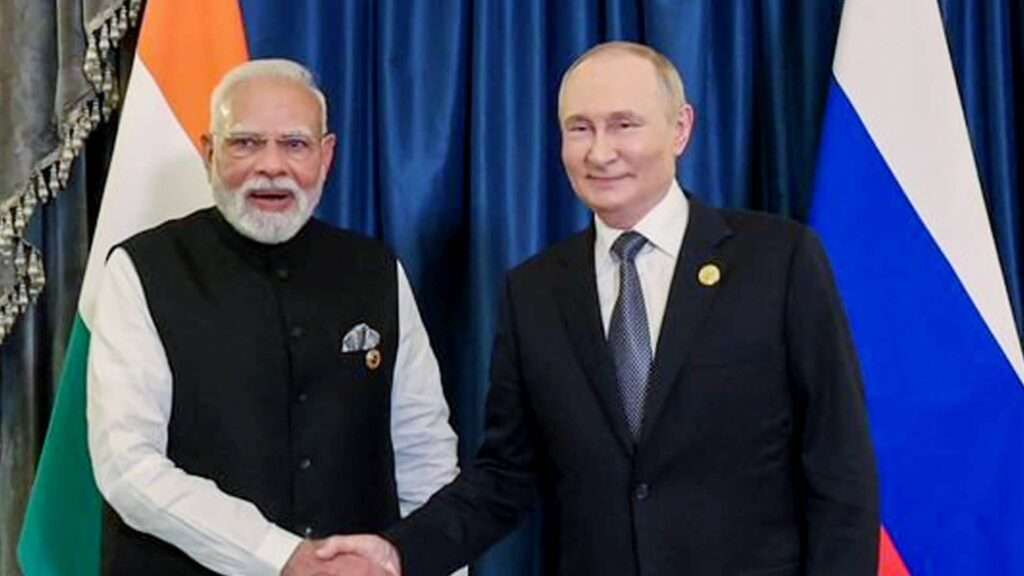
India on Thursday categorically denied NATO Secretary-General Mark Rutte’s recent statement that Prime Minister Narendra Modi had called Russian President Vladimir Putin to discuss strategy related to the Ukraine conflict. The Ministry of External Affairs (MEA) described Rutte’s claim as “factually incorrect and entirely baseless,” calling for accuracy and caution from international leaders in making public assertions.
NATO Chief’s Statement Sparks Diplomatic Rebuttal
Mark Rutte, speaking at the sidelines of the United Nations General Assembly in New York, reportedly asserted that Prime Minister Modi had engaged directly with President Putin over Ukraine. This remark immediately drew attention, given India’s delicate diplomatic balancing act amid the ongoing Russia–Ukraine war. NATO officials have not released any corroborating details of such a conversation.
The MEA promptly issued a statement emphasizing that “no such phone call took place between Prime Minister Modi and President Putin.” It reaffirmed India’s stance on maintaining an independent foreign policy, rooted in dialogue, peace, and respect for sovereignty, especially concerning the war in Ukraine.
India’s Position on the Russia–Ukraine Conflict
India has consistently maintained a neutral stance in the Russia–Ukraine conflict, advocating dialogue and diplomacy. While India has called for an immediate ceasefire and resolution through peaceful means, it has also resisted joining Western sanctions against Russia, citing its own strategic interests, energy security concerns, and geopolitical balance.
The alleged phone call claim, if true, would have had significant implications for India’s global diplomatic image, potentially affecting relations with Western powers and NATO members. By refuting the claim, India reasserted its position that its foreign policy decisions remain sovereign and independent of outside influence.
Reactions and Implications
Experts suggest that the denial underscores India’s sensitivity to any narrative linking it directly to the war strategy of Russia. “India is conscious of maintaining its credibility as a neutral player,” said Dr. Rajesh Malhotra, a geopolitical analyst. “A confirmation of such a call could compromise that perception.”
Diplomatic observers also note that NATO’s statement, whether intentional or erroneous, could reflect the increasing complexities in global alliances and the sensitive nature of information surrounding the Ukraine crisis.
As the Russia–Ukraine war continues to influence global geopolitics, India’s diplomatic posture remains under close scrutiny, balancing its relations with Russia, Western powers, and its own strategic priorities.

