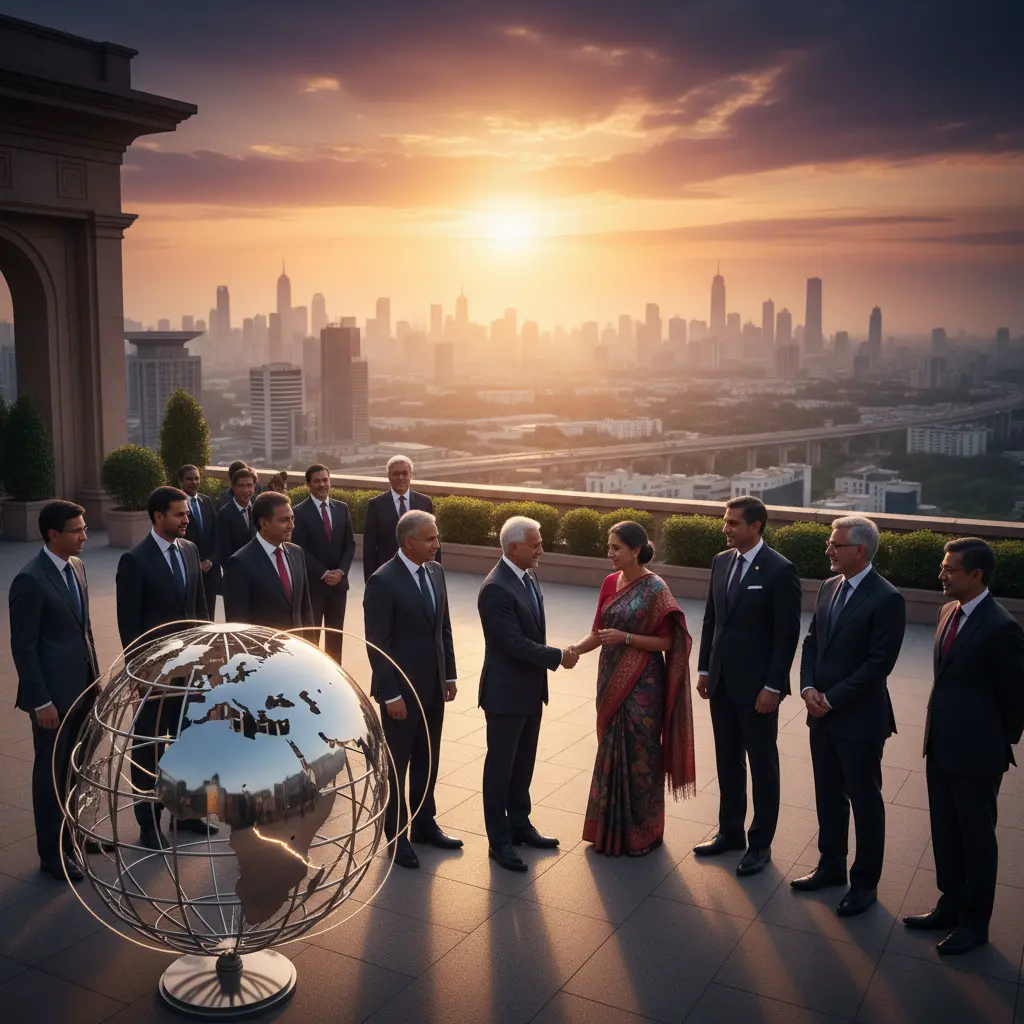
India’s foreign policy machinery has been unusually busy of late, and it isn’t hard to see why. Between high-level diplomatic visits, trade talks, and a steady stream of defence and technology partnerships, the Indian government is signalling something fairly clear: it wants a bigger seat at the table, and it’s not waiting for an invitation.
This isn’t a sudden shift. It’s the continuation of a foreign policy approach that has been building for years, one where India positions itself less as a country choosing sides in global rivalries and more as an independent power that partners where it makes sense — economically, strategically, and technologically. Officials have repeatedly emphasized that this outreach isn’t about aligning with one bloc over another. It’s about expanding options.
Trade and Investment Take Center Stage
A lot of the recent diplomatic energy has gone into trade and investment talks. This makes sense given where India is right now — a large, young workforce, a fast-growing consumer base, and a manufacturing sector that’s trying to position itself as an alternative to over-reliance on any single global supply chain. Foreign governments and investors have taken notice, and Indian officials have been quick to capitalize on that interest.
Trade talks with various regions have picked up pace, covering everything from tariff reductions to easier access for Indian goods in foreign markets. This is a big shift in thinking for a country that has traditionally been wary of opening its markets too fast. The logic seems to be that deeper trade integration brings not only economic benefits but political goodwill that can be used in other areas — defence, technology and regional security among them.
The promotion of investment has followed a similar pattern. Indian officials have been aggressively wooing foreign capital for infrastructure, renewable energy, semiconductors and manufacturing, marketing India as a stable, democratic alternative for companies looking to diversify their operations. Whether or not every deal materializes at the scale promised, the intent behind the push is unmistakable.
Defence Collaboration Gets Real
Defence cooperation has quietly become one of the more consequential threads in India’s foreign engagement. Joint military exercises, technology-sharing agreements, and co-production arrangements with foreign partners have all expanded in recent years. This matters because defence partnerships are usually more intense and durable than trade agreements – they require trust, interoperability and long-term investment from both sides.
Changing global supply dynamics have hammered home the lesson that this is also about reducing reliance on any one supplier for military hardware for India. What emerges repeatedly in these agreements is the focus on developing manufacturing capacity at home via foreign collaboration, not simply imports, tying in with India’s larger push towards self-reliance in strategic sectors.
Technology Partnerships: A New Frontier If trade and defence are the traditional pillars of foreign policy, technology now is the newer, faster-moving one. Semiconductors, artificial intelligence, critical minerals and clean energy technology have all featured heavily in recent diplomatic conversations. These aren’t abstract talking points – it’s an acknowledgement that the next phase of geopolitical competition will be shaped as much by technological capability as traditional military or economic strength.
India’s goals here are twofold: to attract the technology and investment necessary to build domestic capacity, as well as to position itself as a trusted partner for countries that want to diversify their own tech supply chains. It is a pragmatic approach and one that leverages India’s strengths—a large pool of technical talent and a growing digital economy.
The Indo-Pacific Framing Much of this activity is taking place against the backdrop of the Indo-Pacific, the region that has emerged as the central arena of global strategic competition. India’s involvement here is no accident. The country’s outreach has been repeatedly cast by officials as part of a larger commitment to regional peace, stability and a rules-based order — language that has resonated with many of India’s partners in Southeast Asia, the Pacific and elsewhere.
This positioning enables India to join the growth of its influence without being pigeonholed as a countervailing force against any particular power. Instead it is presented as a stabilising force with its own independent interests – a framing that has generally been well received among countries reluctant to be forced to choose sides.
Implications for the Future None of this happens in a vacuum. Trade deals, defence pacts and technology partnerships all form part of a bigger strategy to cement India’s role as a major player on the global stage, not just regionally but internationally. This ambition can be seen in the government’s diplomatic calendar, with officials working across multiple continents to find partnerships that serve both economic and strategic interests.
Whether this translates into lasting influence will depend on execution — on turning agreements into actual trade flows, functioning defence programs, and real technology transfer. That’s always the harder part. But the direction of travel is clear enough. India isn’t just participating in the current wave of global diplomatic realignment; it’s actively trying to shape it.
For a country long associated with strategic caution, this more assertive, multi-front approach to foreign policy marks a meaningful shift — one that’s likely to keep India’s diplomatic calendar full for the foreseeable future.
India Expands Strategic Foreign Engagement.