When a nation is chosen by the world stage, a particular kind of pride often develops. Not the short-lived pride that comes from winning a medal or breaking a record, but something deeper: the realization that a country has arrived, not just as a participant in global sport, but as a host, an organizer, and a destination worthy of the world’s best athletes. India is about to feel that pride fully.
World Athletics has confirmed that India will host the 2028 World Indoor Athletics Championships. This is a massive development, and it’s got everyone in the country’s sports world, and many others, buzzing with anticipation. It’s more than just a simple matter of scheduling, this.
It is the result of years of careful planning, ambition, and a quiet but powerful change in how India sees itself in the global sports world.
What Makes This Moment Different
India has held big sports events in the past. Cricket is almost a religion here, and the country has hosted ICC tournaments on a scale that would make most other countries blink. It has hosted the Commonwealth Games, the World Wrestling Championships, and more and more international football and kabaddi competitions. The World Indoor Athletics Championships, on the other hand, is in a whole other place.
Track and field, in its most basic form, is the heart of the Olympic movement. The most basic way to tell who is a champion in this sport is by who runs the fastest, jumps the highest, and throws the farthest. By hosting the World Indoor Athletics Championships, India is saying that it is ready to be at the center of the conversation, not on the edge of it.
It also comes at an important time for both Indian sports officials and athletes. The time after Neeraj Chopra, when the javelin star is still very much competing, has made people want to be the best in the world and at the Olympics in all sports. A group of young Indian runners, jumpers, and field athletes are now training with a level of seriousness that wasn’t there twenty years ago. Hosting these championships in 2028 will give that generation something very important: a home crowd.
The Infrastructure Story Behind the Bid
You can’t just be excited to win a bid this big. World Athletics uses a tough checklist to rate host countries. It looks at the quality of the venue, how well it connects to transportation, how many people can stay there, the broadcast infrastructure, and the national federation’s history of organizing events. India checked off everything on that list, and in some areas, it did even better than expected.
Over the past ten years, the country’s investment in sports infrastructure has grown a lot. Several cities have built or improved world-class indoor arenas. The Jawaharlal Nehru Stadium hallways and the newer multi-sport complexes in Ahmedabad, Pune, and Bhubaneswar are examples of a new generation of Indian sports facilities that were built from the ground up for international competition, not adapted for it.
Bhubaneswar has become India’s quiet capital of world-class sports events. It has hosted the Hockey World Cup twice and the Athletics Asia Championships.
India has built the institutional strength to host global events smoothly, in addition to the physical spaces. The Athletics Federation of India has been building relationships with international federations for years, with help from the Sports Authority of India and the central government. That groundwork, unglamorous as it is, was every bit as important as any stadium construction.
How the Championships Will Actually Look
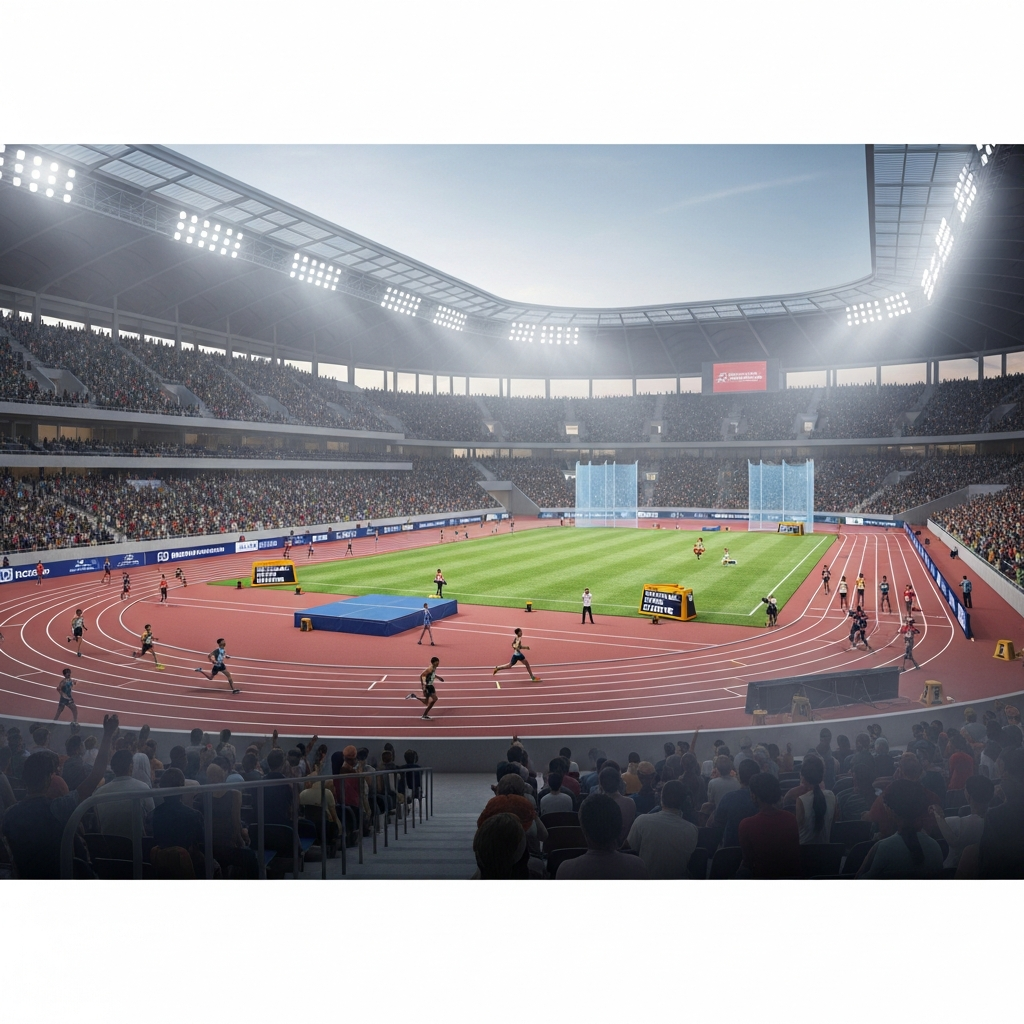
The World Indoor Athletics Championships is a two-year event where the fastest and most explosive track and field athletes from around the world compete on a 200-meter banked indoor track. The format is small and exciting, with shorter races, smaller fields, and louder crowds. There are events that range from the 60-meter sprint to the 1500-meter race, as well as the long jump, triple jump, high jump, pole vault, shot put, and the very hard heptathlon and pentathlon combined events.
There is a certain closeness to indoor athletics that outdoor
championships can’t quite match. There is less space between athletes and fans. The sound quality in an enclosed arena makes every footstep and every roar from the crowd louder. For Indian sports fans, being able to see these championships live will be a whole new experience. In the past, they have only been able to watch them on TV, usually at a strange hour because of the time zone.
A Spark for the Next Generation
India’s sports planners are more interested in the long-term effects of hosting major global events than in the show itself. India has hosted a world-class competition in every sport, and each time it has led to more people playing that sport at the grassroots level. Before the Bhubaneswar World Cup, young people in Odisha had never played hockey before. After India’s Saina Nehwal and P.V. Sindhu were at the top of the badminton world, a lot of people signed up for badminton academies. This happened at the same time as big international events in India.
The 2028 championships are a chance for athletics to do the same thing. A kid who sees a 60-meter dash won in front of a cheering Indian crowd and feels the electricity in the air is much more likely to put on spikes the next week. That isn’t a sentimental theory; it’s a pattern that experts in sport development have seen happen over and over again in different countries and sports.
India’s Time on the Track
There is still a lot to do before 2028. There are still a lot of things to do before the world championship can happen, like getting the venue ready, figuring out how to sell tickets, finding places for athletes to stay, and making deals with broadcasters. India has proven more than once that it can perform at this level. But each new event is a test in its own right, and World Athletics expects the country to meet the high standards it sets for its host cities.
What can’t be made, though, is the feeling of the thing. No logistics plan can do that. The sound of a crowd cheering when a local athlete crosses the finish line. Before the jump, everyone held their breath. The moment a country knows, deep down, that it should be at the center of the world’s sports story.
India has earned that time. It will finally get to live it in 2028, on its own turf.