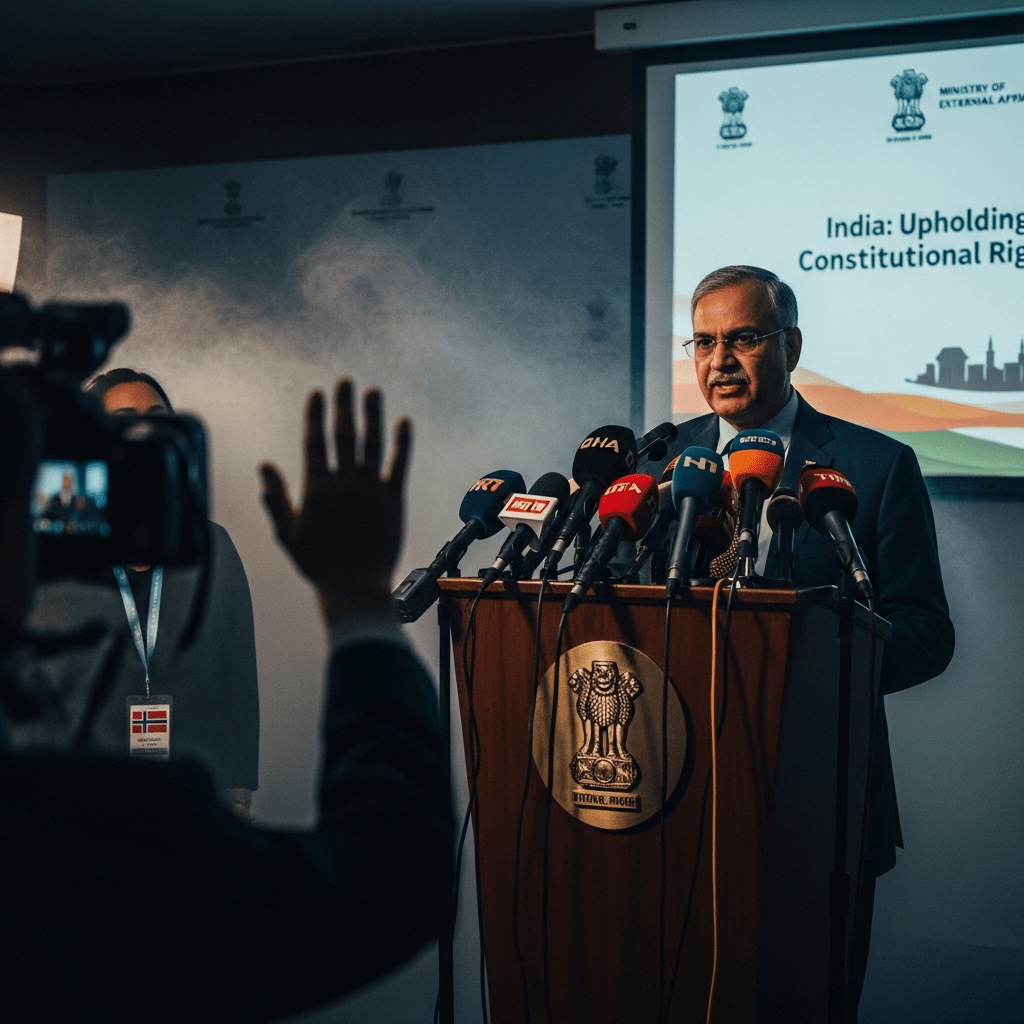
New Delhi’s Ministry of External Affairs has fired back at international scrutiny over its rights record — and the exchange is shaping up to be more than a press conference moment. Analysts say it could reshape diplomatic conversations with Europe for months to come.
Setting the scene
Diplomatic spats rarely begin with a declaration. They begin with a question — one that the other side was not expecting to be asked so directly, in so public a forum. That appears to be what happened when India’s Ministry of External Affairs faced pointed international press questions on the country’s human rights record. The response from New Delhi was swift, firm, and carefully calibrated: a rebuttal that went well beyond standard diplomatic language and signalled that India intends to contest the framing, not merely the facts.
The MEA statement pushed back hard against what officials described as a narrative driven by “misleading NGO reports” — a phrase that carries significant weight in the context of India’s foreign policy over the past several years. India has grown increasingly vocal in challenging the authority of international civil society organisations to speak on its domestic affairs, and the latest exchange reflects a posture that has been building for some time.
“India intends to contest the framing, not merely the facts — a distinction that matters enormously in diplomatic discourse.”
What New Delhi is defending
The government’s position, as articulated by its representatives, rests on a set of arguments that are familiar from earlier episodes in the human rights debate around India. First, that India is a functioning democracy with independent legal processes and constitutional protections that place it in a different category from authoritarian states. Second, that foreign-funded NGOs with particular ideological or political orientations are not neutral reporters of Indian domestic reality. And third, that international criticism framed around human rights is frequently inconsistent — applied selectively to India while more serious violations elsewhere go largely unmentioned.
These are not arguments without substance. India’s democratic architecture — its courts, its press freedoms (contested as they may be in some quarters), its electoral processes, and its constitutionally guaranteed rights — does distinguish it meaningfully from many other nations that face international scrutiny on similar grounds. The MEA’s confidence in making these arguments publicly, rather than absorbing criticism quietly through back-channel diplomacy, reflects a shift in how India positions itself globally. Political news India observers have noted that the current government is notably less deferential to international opinion than its predecessors, and more willing to assert the principle of non-interference as a core diplomatic value.
The international dimension
What makes this exchange more consequential than a routine press-conference rebuttal is the audience. India’s diplomatic interactions with European nations are at a delicate stage. The India-EU Free Trade Agreement negotiations — long stalled, recently revived — involve precisely the kind of sustained high-level engagement where atmospherics matter. When human rights concerns get raised publicly and met with sharp official pushback, the ripple effects move quickly into trade delegations, parliamentary committees, and the working-level discussions that actually drive diplomatic progress.
European interlocutors, particularly those from Scandinavian nations with strong civil society traditions and a history of raising rights concerns in multilateral forums, are watching how India manages this moment. The India foreign policy establishment is, in turn, watching how much weight European governments actually give to NGO-driven narratives versus their own strategic and economic interests — in a world where both sides have significant incentives to deepen the relationship despite these tensions.
It would be a mistake to read this as a crisis. India and Europe are not adversaries. But the human rights debate, when it surfaces in this way — through public rebukes at press interactions rather than quiet bilateral conversations — has a way of creating political facts on the ground that constrain what diplomats can do next. A European parliament resolution, a parliamentary question, or an NGO report that gains traction in the international media can set a context that negotiators then have to work around.
“It would be a mistake to read this as a crisis. But the debate creates political facts on the ground that diplomats then have to work around.”
Domestic political resonance
At home, the MEA’s firm response has been received positively across much of India’s political mainstream. There is broad cross-party sentiment — extending beyond the ruling establishment — that India should not accept a characterisation of its domestic governance through the lens of international advocacy organisations, particularly those perceived as having political agendas or foreign funding that creates conflicts of interest. The government’s assertion that India’s constitutional protections and independent legal processes are functioning as designed aligns with a widely held view in domestic political discourse.
Critics, however, point out that dismissing all scrutiny as NGO-driven misinformation risks closing off legitimate channels of accountability. Political analysts note that how a government responds to human rights questions matters as much as the substance of the response — and that sharp, dismissive rebuttals, while politically popular domestically, can sometimes harden positions internationally in ways that are ultimately counterproductive to diplomatic goals.
The months ahead
India diplomacy in the coming months will be tested on multiple fronts where the human rights dimension is unavoidable. EU-India trade negotiations, India’s engagement with multilateral human rights mechanisms, and bilateral diplomatic conversations with Norway, France, and Germany — all of these involve interlocutors for whom civil society concerns have domestic political salience. India’s approach will need to be simultaneously firm in its core principles and deft enough to prevent these exchanges from becoming obstacles to a relationship that serves both sides’ strategic interests.
The press interaction that sparked the latest round of commentary is, in isolation, a minor diplomatic moment. But it sits within a larger pattern — of India asserting its own terms of global engagement, pushing back on narratives it finds unfair, and demanding to be treated as a peer rather than a subject of international concern. Whether that posture serves Indian interests in the long run is the question that political analysts on both sides of the debate are quietly working through.
India’s position
Robust democratic institutions
Constitutional rights guaranteed
NGO reports seen as biased
Sovereignty principle paramount
Independent judiciary functioning
International concerns
Civil society space shrinking
Press freedom indices declining
Minority rights monitoring
NGO regulatory environment
EU diplomatic ripple effects