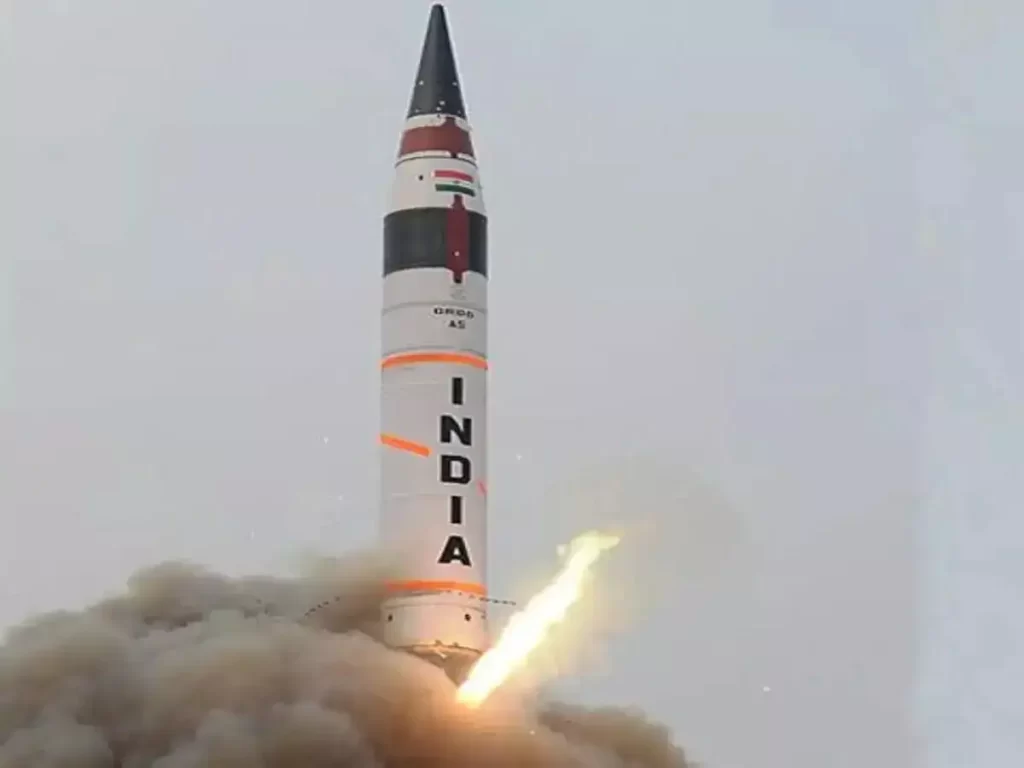
August 20, 2025: In a major boost to its strategic defence capabilities, India on Wednesday successfully test-fired its Agni-5 intermediate-range ballistic missile (IRBM) from the Integrated Test Range (ITR) at Chandipur, off the Odisha coast. The launch was conducted under the supervision of the Strategic Forces Command and validated all operational and technical parameters of the missile.
The Agni-5, developed indigenously by the Defence Research and Development Organisation (DRDO), is a three-stage, solid-fueled missile capable of carrying nuclear warheads over a range exceeding 5,000 kilometres. Equipped with multiple independently targetable re-entry vehicles (MIRVs), the missile significantly enhances India’s second-strike nuclear capability, ensuring a credible deterrent against potential adversaries.
Advanced guidance systems, including a ring laser gyroscope-based inertial navigation system and satellite navigation support from India’s NavIC as well as U.S. GPS, provide the missile with high precision and reliability. Experts say this technological advancement strengthens the effectiveness of India’s strategic deterrence.
The successful test has far-reaching implications for regional security. With its extended range, the Agni-5 can target strategic locations across the Asia-Pacific region, including parts of China and Pakistan. Analysts believe the development may influence the defence strategies and calculations of neighbouring countries.
Speaking on the successful test, a senior official from DRDO stated, “The Agni-5 represents a significant milestone in India’s indigenous missile programme and is a testament to the country’s commitment to strengthening its strategic capabilities.”
The missile launch underscores India’s continued focus on self-reliance in defence technology and its determination to maintain a credible nuclear deterrent. The Agni-5, with its advanced systems and extended range, is expected to play a pivotal role in India’s strategic security architecture in the years to come.